High Court Prepones Hearing on Data Centres Near Wildlife Reserve
Source:deccan-chronicle ↗
ఇది ఎందుకు ముఖ్యం
This article underscores the ongoing friction between large-scale infrastructure development (like data centres) and ecological conservation. It highlights critical regional geography for APPSC aspirants (Kambalakonda, Mudasarlova, Simhachalam) and touches on environmental impact assessments and the role of the judiciary through PILs in safeguarding local ecosystems.
సారాంశం
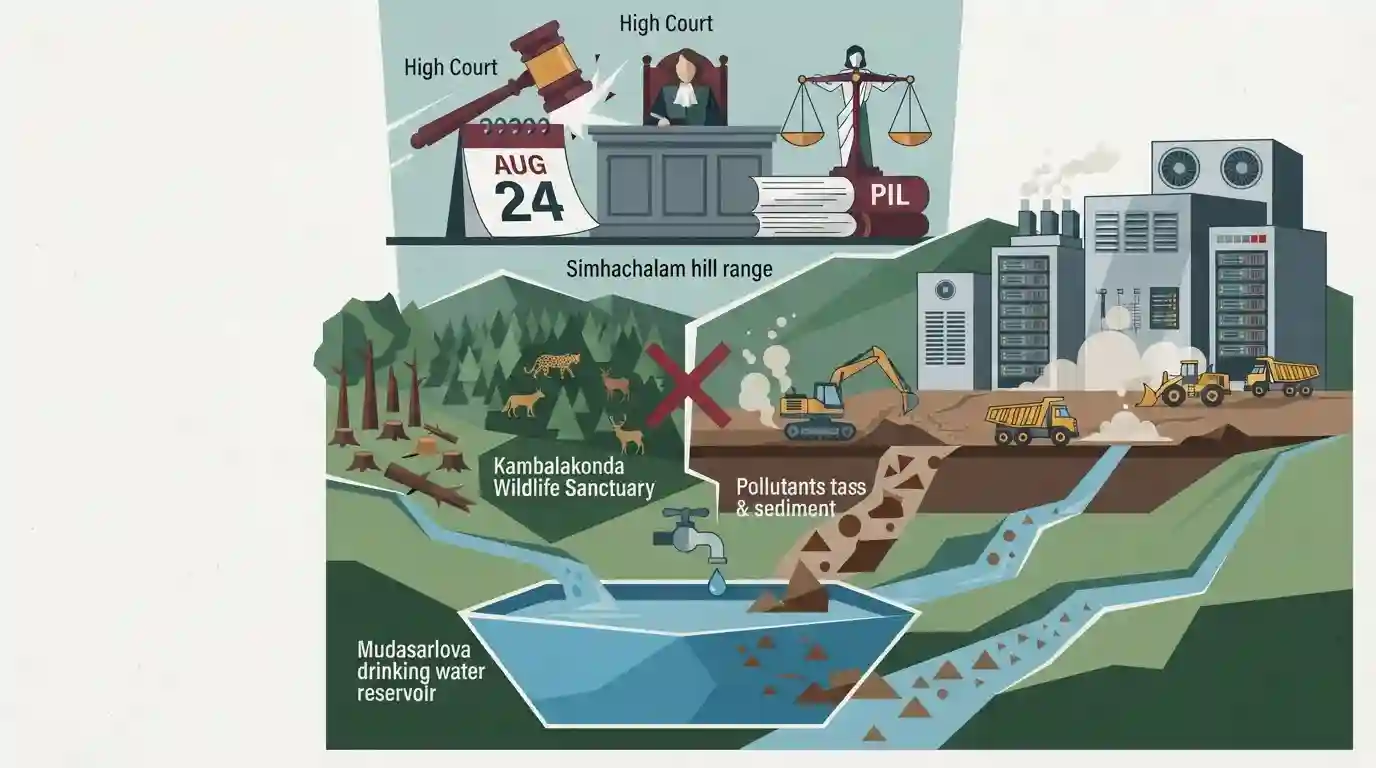
The Andhra Pradesh High Court has advanced the hearing of a Public Interest Litigation (PIL) concerning the construction of large-scale data centres near the Kambalakonda Wildlife Sanctuary in Visakhapatnam. The PIL, filed by Bolisetti Satyanarayana of Jal Biradari, highlights severe ecological threats, including ongoing tree felling and land levelling on the Simhachalam hill range without proper statutory environmental and wildlife clearances. The petition stresses that these infrastructure activities endanger the Mudasarlova drinking water reservoir and local natural water streams. Acknowledging the potential for irreparable environmental damage, Chief Justice Lisa Gill scheduled the hearing for August 24, 2026, directing the government and project proponents to file their counter-affidavits.
ముఖ్య అంశాలు
- The Andhra Pradesh High Court advanced the hearing of a Public Interest Litigation (PIL) aimed at protecting the Kambalakonda Wildlife Sanctuary and Mudasarlova drinking water reservoir in Visakhapatnam.
- The PIL highlights the environmental risks posed by the construction of large-scale data centres, particularly ongoing land levelling and tree felling on the Simhachalam hill range.
- Petitioner Bolisetti Satyanarayana argues that the data centre projects lack the requisite statutory environmental and wildlife clearances, risking severe damage to local ecosystems and water streams.
- Chief Justice Lisa Gill preponed the hearing to August 24, 2026, to address concerns over irreparable damage to public drinking water sources.
ముఖ్యమైన పదాలు
Kambalakonda Wildlife Sanctuary

A 71-square-kilometer tropical dry evergreen forest and wildlife sanctuary located near Visakhapatnam, Andhra Pradesh, administered since 1970 and known for its hilly Eastern Ghats terrain and indicator species like the Indian leopard.
UPSC context
GS Paper 3 (Environment and Biodiversity). Tests knowledge of protected areas, Western/Eastern Ghats ecosystems, and regional indicator species in India.
Public Interest Litigation (PIL)
A legal mechanism in India where a public-spirited individual or group can file a petition to protect public welfare and constitutional rights of marginalized groups, enabled by relaxing the traditional rule of locus standi.
UPSC context
GS Paper 2 (Polity and Governance). Tests understanding of judicial activism, access to justice, constitutional remedies, and judicial overreach.
Environmental Clearance
A mandatory regulatory approval required under the Environment (Protection) Act, 1986 and EIA Notification, 2006, assessing potential ecological, social, and economic impacts before launching any major industrial or infrastructure project.
UPSC context
GS Paper 3 (Environmental Impact Assessment). Tests the balance between sustainable development, judicial rulings on retrospective approvals, and environmental governance frameworks.
Jal Biradari
A national network and movement in India dedicated to water conservation, community-driven water management, and river rejuvenation, led by the "Waterman of India" Dr. Rajendra Singh.
UPSC context
GS Paper 3 (Conservation and Water Resources). Tests civil society movements, decentralized resource management, and traditional water-harvesting practices.
Simhachalam Hill Range
A prominent mountain range in the Eastern Ghats near Visakhapatnam, Andhra Pradesh, ecologically significant for urban biodiversity and historically famous for housing the medieval Varaha Lakshmi Narasimha Temple.
UPSC context
GS Paper 1 (Geography & Indian Culture). Tests knowledge of Eastern Ghats physiography, local water security landscapes, and temple architecture.
ప్రిలిమ్స్ ఉచ్చు
Eco-Sensitive Zones around Kambalakonda Wildlife Sanctuary are declared under the Wildlife (Protection) Act, 1972.
Eco-Sensitive Zones (ESZs) are notified under the Environment (Protection) Act, 1986, not the Wildlife (Protection) Act, 1972.
అనుసంధానమైన స్థిర భావనలు
What are the characteristics of Tropical Dry Evergreen Forests found in Kambalakonda?
- Geographic spread: Restricted primarily to the Coromandel Coast (Andhra Pradesh and Tamil Nadu).
- Climate dependency: Unlike most of India, these areas receive their primary rainfall from the retreating North-East monsoon.
- Vegetation profile: Characterized by short, stunted evergreen trees, leathery leaves, and a mixture of thorny shrubs without a distinct canopy.
Why do hyperscale data centres require strict environmental appraisals?
- High water footprint: They consume millions of gallons of freshwater daily for evaporative cooling systems, stressing local reservoirs.
- Thermal pollution: Continuous server operation generates massive waste heat, creating localized thermal pollution that can alter micro-climates.
- Energy intensity: They require massive, continuous electricity supply, indirectly driving up fossil fuel consumption if grid power is not green.
అంతర-అంశ నమూనాలు
Digital Infrastructure vs. Water Security
The massive water footprint of data centre cooling systems directly conflicts with urban drinking water needs (like Mudasarlova), linking 'Digital India' infrastructure pushes with urban water crises.
Public Trust Doctrine in PILs
Courts consistently invoke the Public Trust Doctrine to protect local water bodies and hill ranges from commercial encroachment, frequently overriding state-granted infrastructure permissions.

The ecological footprint of data centers (water and thermal) is a prime candidate for a GS3 Mains question bridging Tech and Environment.
అనుసంధాన PYQలు · 2
అనుసంధాన PYQలు · 2
- 2004APPSC_PRELIMSGS1
The Kambalakonda Reserve Forest in A. P. has been declared by the Union Government a Wildlife Sanctuary. Where is it located?
- 2024APPSC_PRELIMSGS1
Match the following : | List-I (Wildlife Sanctuary in Andhra Pradesh) | List-II (Region) | |---|---| | A. Coringa | I. Kurnool | | B. Gundla Brahmeswaram | II. Kadapa | | C. Rollapadu | III. East Godavari | | D. Sri Lankamalleswara | IV. Kurnool and Prakasam | Choose the correct answer using the codes given below : Code: A B C D
