Chitrakoot on high alert as Mandakini River overflows banks
Source:india-com ↗
Why It Matters
The drainage systems of Uttar Pradesh and the confluence of major tributaries of the Ganga and Yamuna are frequently tested in UPPSC PCS Prelims. Additionally, understanding the statutory mechanisms of disaster response under the Disaster Management Act, 2005 (such as NDRF/SDRF roles) is vital for state services exams.
Summary
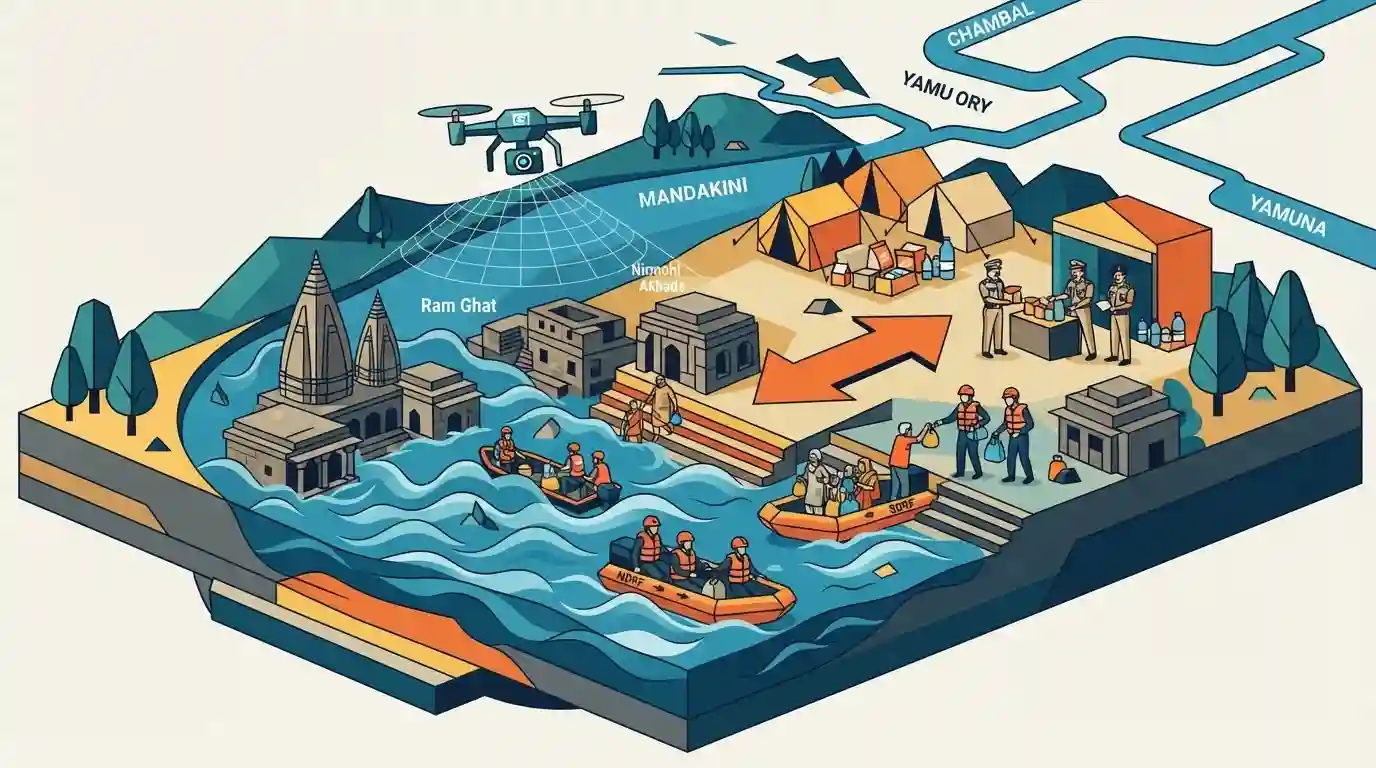
A high alert was declared in Chitrakoot, Uttar Pradesh, as the Mandakini River overflowed and flooded critical areas like Ram Ghat and Nirmohi Akhada. The UP state administration deployed drone surveillance, along with NDRF and SDRF teams, to safely evacuate pilgrims and residents while providing relief materials.
Key Points
- A high alert was sounded in Chitrakoot, Uttar Pradesh, after a significant rise in the water level of the Mandakini River (also known as the Paisuni River) led to flooding in low-lying areas.
- Key pilgrimage sites along the river, including Ram Ghat and Nirmohi Akhada, experienced flood-like situations, prompting the deployment of rescue services.
- The Uttar Pradesh government utilized drone surveillance to monitor water flow, review inundated areas in real time, and coordinate rescue efforts.
- The National Disaster Response Force (NDRF) and State Disaster Response Force (SDRF) were deployed on-ground to evacuate stranded pilgrims and locals to safer locations.
- The Mandakini River in Chitrakoot is a right-bank tributary of the Yamuna River flowing through the Bundelkhand region, distinct from the Mandakini River of Uttarakhand (which joins the Alaknanda).
- District administrative heads, including the District Magistrate and Superintendent of Police Arun Kumar Singh, supervised the distribution of essential medicines and food supplies.
Important Terms
Disaster Management Act, 2005

A landmark parliamentary act providing the legal and institutional framework for disaster management, establishing national, state, and district-level authorities to shift focus from reactive relief to proactive mitigation.
UPSC context
GS Paper 3 (Disaster Management). Tests understanding of India's statutory emergency response and mitigation framework.
National Disaster Response Force (NDRF)
A specialized federal force constituted under the Disaster Management Act, 2005, trained and equipped for professional, rapid rescue operations during major natural or man-made disasters across India.
UPSC context
GS Paper 3 (Disaster Management). Tests knowledge of India's specialized central disaster rescue and response mechanism.
State Disaster Response Force (SDRF)
A state-level specialized wing of the Uttar Pradesh Police formed in 2016 to execute rapid search, rescue, and relief operations during regional disasters and emergencies.
UPSC context
GS Paper 3 (Disaster Management) & GS Paper 5 (UP Security Forces). Tests specialized state-level disaster response structures.
Uttar Pradesh Government
The executive governing authority of Uttar Pradesh, responsible for formulating state policies, administering public safety, and coordinating regional disaster management plans through the SDMA.
UPSC context
GS Paper 5 (UP Polity and Administration). Tests institutional knowledge of state governance and executive functioning.
Chitrakoot Police
The district law enforcement agency of Chitrakoot, Uttar Pradesh, responsible for maintaining law and order and deploying drone surveillance for real-time flood monitoring and evacuation.
UPSC context
GS Paper 5 (UP Law & Order). Tests on-ground local administration and surveillance-driven crisis response.
Prelims Trap
The Mandakini River flowing through Chitrakoot originates from the Chorabari glacier near Kedarnath.
The Chitrakoot Mandakini (Paisuni) originates in the Vindhyan range (MP) and joins the Yamuna, whereas the Himalayan Mandakini joins the Alaknanda at Rudraprayag.
Static Concepts Connected
What is the drainage pattern of the Yamuna River in Uttar Pradesh?
- Right-bank tributaries: Includes Chambal, Sindh, Betwa, Ken, and Paisuni (Mandakini) originating from the Vindhyan/Bundelkhand region.
- Key confluences: Betwa joins the Yamuna near Hamirpur, Ken joins near Banda, and Paisuni joins near Karwi in Chitrakoot.
What are the key confluences of the Panch Prayag system?
- Rudraprayag confluence: The Himalayan Mandakini (originating from Chorabari glacier) meets the Alaknanda River here.
- Devprayag confluence: The Alaknanda finally meets the Bhagirathi River here to officially form the Ganga River.
Cross-Topic Patterns
Heritage Tourism vs. Riverine Disasters
Flooding of the Mandakini directly impacts the Ramayana Spiritual Circuit, highlighting the need for climate-resilient infrastructure around heritage ghats.
Drone Technology in Disaster Response
Utilizing UAVs for real-time flood monitoring aligns with the National Disaster Management Plan's focus on tech-driven search and rescue.

Match-the-following question pairing Bundelkhand rivers (Paisuni, Betwa, Ken) with their specific UP confluence points is highly likely.
Linked PYQs · 3
Linked PYQs · 3
- 2020UPPSC_PRELIMSGS1
Consider the following tributaries of River Yamuna and arrange them from West to East : 1. Betwa 2. Ken 3. Sindh 4. Chambal Select the correct answer from the codes given below.
- 2023UPPSC_PRELIMSGS1
Which of the following statement is correct? (1) Ram Ganga river joins the Ganga at Kannauj. (2) River Betwa joins the Yamuna near Prayagraj. Select the correct answer using the code given below –
- 2021UPPSC_PRELIMSGS1
The National Disaster Management Division in India is the nodal division in the Ministry of Home Affairs for disaster management. Who is the Ex-officio Chairman of the National Disaster Management Authority?
