Data Centres Water Footprint and Environmental Impact in India
Source:The Hindu ↗
কেন এটি গুরুত্বপূর্ণ
Provides a crucial and contemporary linkage between technological advancement (AI and Data Centres) and ecological degradation (Groundwater depletion and Marine pollution). Serves as an excellent case study for GS-3 answers on sustainable development, infrastructure planning, and environmental impact assessment.
সারসংক্ষেপ
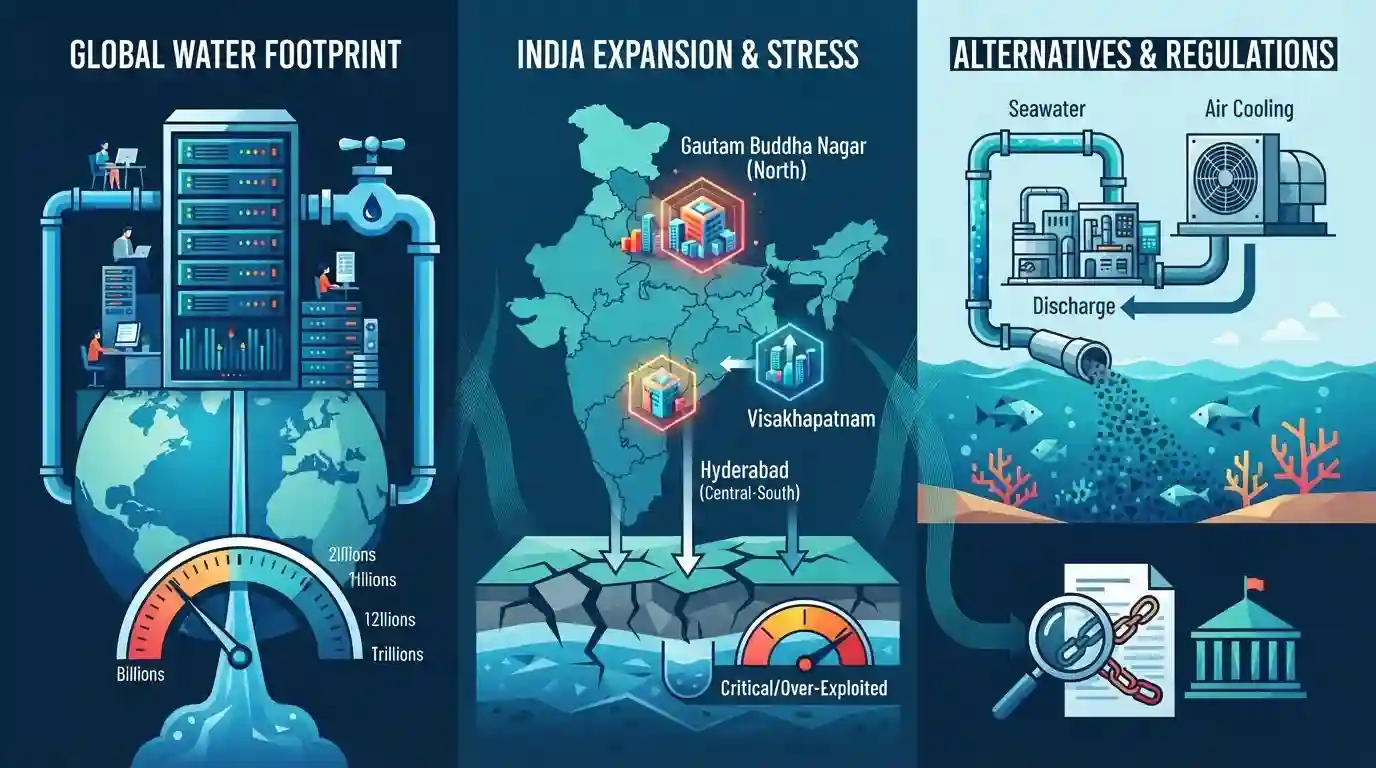
The explosive growth of artificial intelligence and digital infrastructure carries a massive, largely hidden environmental cost in terms of water consumption. According to a UN report, data centres are projected to have a water footprint of 9.3 trillion litres globally by 2030, driven by the cooling needs of high-density AI servers. In India, data centre capacity is rapidly expanding, with states like UP, Gujarat, and Andhra Pradesh rolling out attractive policy incentives. However, massive hubs are being built in regions like Gautam Buddha Nagar, Hyderabad, and Visakhapatnam, which the Central Ground Water Board (CGWB) already flags as water-stressed or over-exploited. While alternatives like seawater cooling are being considered, they pose new threats to marine ecosystems via brine discharge, highlighting the need for mandatory disclosure norms and stricter environmental regulations.
মূল বিষয়
- A UN report projects global data centres\' water footprint to reach 9.3 trillion litres by 2030, highlighting the massive environmental cost of cooling high-density servers required for Artificial Intelligence.
- India\'s data centre capacity is rapidly expanding from 375MW in 2020 to a projected 13.56 GW by 2031-32, with major tech giants establishing hubs in India.
- States like UP, Gujarat, and Andhra Pradesh are offering policy incentives for data centres despite several proposed locations (e.g., Gautam Buddha Nagar, Visakhapatnam, Hyderabad) already being flagged as water-stressed or over-exploited by the CGWB.
- Companies are exploring alternatives like seawater cooling (already used in Finland), but experts warn that improper disposal of resulting brine discharge threatens marine ecosystems.
গুরুত্বপূর্ণ শব্দ
UP Data Centre Policy, 2026

An industrial framework approved by the Uttar Pradesh government aiming to create 2 GW of AI-ready, green data centre capacity. It provides capital subsidies and specifically encourages development in regions like Bundelkhand to decentralize digital infrastructure.
UPSC context
Relevant for GS-3 (Infrastructure/IT). Illustrates sub-national policy efforts to build out capital-intensive physical architecture for the AI economy.
Viksit Gujarat Data Centre Policy 2026-29
Gujarat's framework targeting 7.5 GW of hyperscale green AI data centre capacity with projected investments of ₹6 lakh crore. It notably mandates that eligible projects source at least 51% of their electricity from renewable sources.
UPSC context
Relevant for GS-3 (Infrastructure & Environment). Demonstrates the integration of strict renewable energy mandates within digital infrastructure expansion.
Andhra Pradesh Data Centre Policy 4.0
An Andhra Pradesh policy designed to attract AI investments by offering incentives such as capital subsidies and a "deemed distribution licence," enabling data centres over 300 MW to establish independent distribution networks and procure renewable power directly.
UPSC context
Relevant for GS-3 (Energy/Infrastructure). Highlights innovative regulatory incentives in India's energy sector to support power-hungry tech hubs.
University of California, Riverside
The research institution responsible for pioneering studies quantifying the unseen environmental cost of AI. Their research revealed that executing 20 to 50 ChatGPT queries consumes approximately half a litre of fresh water for server cooling.
UPSC context
Relevant for GS-3 (Environment/Technology). Tests awareness of the hidden resource consumption and ecological degradation driven by digital technologies.
প্রিলিমস ফাঁদ
The Central Ground Water Authority (CGWA) was constituted under the Water (Prevention and Control of Pollution) Act, 1974.
Aspirants intuitively link groundwater bodies to the Water Act. However, CGWA was explicitly established under Section 3(3) of the Environment (Protection) Act, 1986.
সংযুক্ত স্থির ধারণা
How is groundwater extraction categorized and regulated in India?
- Regulatory Body: The Central Ground Water Authority (CGWA), formed under the Environment (Protection) Act, 1986, is the apex body regulating extraction.
- Categorization: CGWB assesses areas into Safe, Semi-critical, Critical, and Over-exploited zones based on the extraction rate versus natural recharge rate.
- NOC Exemptions: Agriculture, individual domestic consumers, and certain MSMEs drawing below a specific threshold are generally exempt from seeking a No Objection Certificate (NOC).
What is Brine Discharge and its impact on marine ecosystems?
- Density Sinking: Brine from desalination or cooling is hypersaline. Being denser than standard seawater, it sinks and pools on the ocean floor (benthic zone).
- Hypoxia Creation: Accumulated brine drastically reduces dissolved oxygen levels at the seafloor, leading to hypoxia and creating ecological dead zones.
- Osmotic Shock: The abrupt, extreme increase in localized salinity causes osmotic shock, severely disrupting cellular processes of bottom-dwelling marine flora and fauna.
আন্তঃবিষয় প্যাটার্ন
Water-Energy Nexus in Emerging Tech
AI policy directly clashes with regional resource geography, as tech giants seek cheap land and power in states like Gujarat and AP, regions already flagged for severe groundwater stress.
Coastal IT Hubs vs. CRZ Rules
Shifting data centres to coastal areas for seawater cooling merges IT infrastructure policy with Marine Coastal Regulation Zone (CRZ) rules and blue economy sustainability.

Expect a 2026 Prelims question linking the massive AI data centre water footprint with the statutory powers of the CGWA under EPA 1986.
সংযুক্ত PYQ · 5
সংযুক্ত PYQ · 5
- 2025MainsGS3
Examine the factors responsible for depleting groundwater in India. What are the steps taken by the government to mitigate such depletion of groundwater?
- 2020PrelimsGS1
Consider the following statements: 1. 36% of India's districts are classified as "overexploited" or "critical" by the Central Ground Water Authority (CGWA). 2. CGWA was formed under the Environment (Protection) Act. 3. India has the largest area under groundwater irrigation in the world. Which of the statements given above is/are correct?
- 2023MainsGS3
Introduce the concept of Artificial Intelligence (AI). How does Al help clinical diagnosis? Do you perceive any threat to privacy of the individual in the use of Al in healthcare?
- 2015MainsGS1
India is well endowed with fresh water resources. Critically examine why it still suffers from water scarcity.
- 2022PrelimsGS1
Which one of the following has been constituted under the Environment (Protection) Act, 1986?
