US Tariffs Impact on India Knowledge Economy and Talent Mobility
Source:Indian Express ↗
Why It Matters
This issue is critical for GS2 (International Relations) and GS3 (Economy), as it highlights the vulnerabilities of India's service-led growth model to shifting geopolitical realities and Western protectionism. Aspirants should understand how deglobalization impacts modern tech economies and the policy responses required to sustain export growth.
Summary
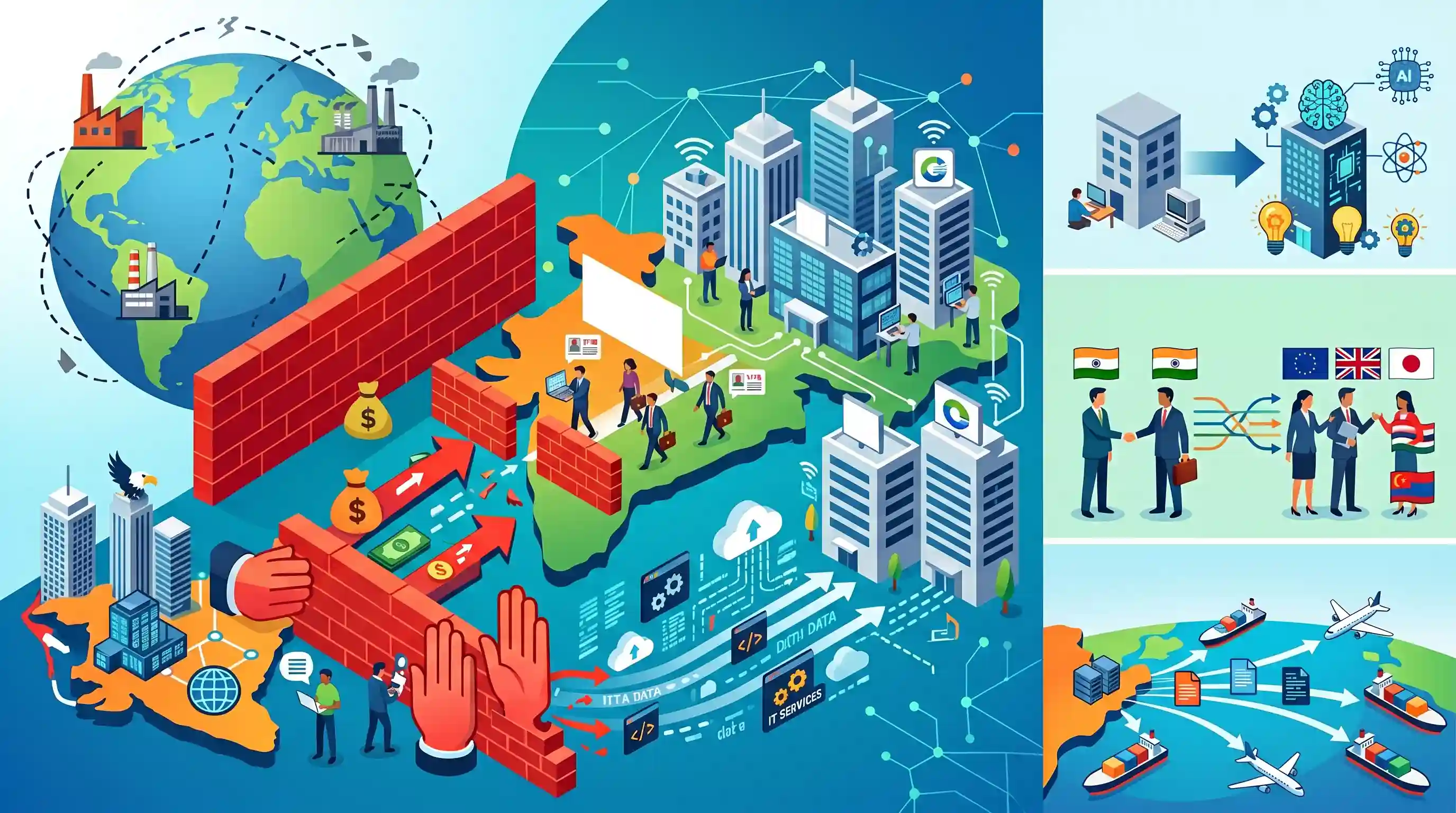
The article examines the secondary but significant impacts of potential US protectionist tariffs on India's thriving knowledge economy. While typical trade wars focus on manufacturing and physical goods, restrictive US policies under a Trump administration could severely disrupt the cross-border flow of tech talent (via H-1B visas) and digital services that fuel India's IT sector and Global Capability Centres (GCCs). The author highlights that as global trade fragments and moves away from free trade principles, India must proactively safeguard its digital exports. Strategic recommendations include transitioning from basic service provision to deep-tech innovation, establishing robust bilateral technology partnerships, and diversifying digital export destinations to reduce over-reliance on the US market.
Key Points
- Protectionist policies and tariffs under a Trump administration not only affect physical trade but also pose latent threats to talent mobility and digital services, key pillars of India's knowledge economy.
- India's IT services and Global Capability Centres (GCCs) rely on seamless cross-border data flows and H-1B visas, both of which are vulnerable to restrictive US trade actions and 'America First' inward-looking policies.
- A shift from multilateralism to bilateralism and protectionism forces Indian tech firms to endure higher compliance costs and may trigger a rethinking of US tech offshoring models.
- To mitigate these risks, India must move up the value chain toward high-end innovation, seek dedicated bilateral digital trade agreements, and diversify its technology export markets away from heavy US reliance.
Important Terms
H-1B Visa Program

A non-immigrant visa allowing US companies to employ foreign workers in "specialty occupations" requiring technical expertise, such as IT, engineering, and medicine. India is the largest beneficiary, accounting for over 70% of petitioners.
UPSC context
GS-2 International Relations; tests impact of US immigration policy on the Indian diaspora and bilateral economic interdependence.
Global Capability Centres (GCCs)
Strategic offshore hubs established by multinational corporations to handle high-value internal functions like R&D, AI, and cybersecurity. India hosts nearly 50% of the world’s GCCs, employing millions of professionals.
UPSC context
GS-3 Economy; tests understanding of India’s transition from a "back-office" hub to a global innovation engine.
General Agreement on Trade in Services (GATS)
The first and only multilateral agreement governing international trade in services. It establishes rules for liberalizing service sectors like telecommunications, finance, and professional services across WTO member nations.
UPSC context
GS-3 Economy/GS-2 IR; crucial for topics on rules-based global trade and India’s service export interests.
Knowledge Economy
An economic system where growth is primarily driven by intellectual capital, high-tech innovation, and digital services rather than traditional physical manufacturing or natural resources.
UPSC context
GS-3 Economy; tests understanding of India’s structural shift towards technology-driven growth and high-end service exports.
World Trade Organization (WTO)
The only global international organization dealing with the rules of trade between nations. It facilitates negotiations, resolves disputes, and currently oversees debates on digital trade and e-commerce duties.
UPSC context
GS-3 Economy/GS-2 IR; essential for understanding multilateralism, trade disputes, and global economic governance.
Protectionism
The economic policy of restricting imports through tariffs, quotas, or regulations to protect domestic industries from foreign competition. It is often linked to the current global trend of deglobalization.
UPSC context
GS-3 Economy; relevant for analyzing global trade fragmentation and its impact on India’s export-oriented sectors.
Trade-Related Investment Measures (TRIMS)
A WTO agreement prohibiting domestic investment regulations that distort trade in goods, such as local content requirements or trade balancing mandates that prefer domestic products over imports.
UPSC context
GS-3 Economy; tests knowledge of international investment rules and their impact on domestic manufacturing and foreign investment.
Prelims Trap
"The US levies high import tariffs on IT services imported from India."
Tariffs typically apply to physical goods. Protectionism in services usually takes the form of Non-Tariff Barriers (NTBs) like visa restrictions or data localization, not traditional customs duties.
Static Concepts Connected
What are the four Modes of Supply under the WTO's GATS?
- Mode 1 (Cross-border): Services supplied from one country to another via telecommunications or internet (e.g., offshore IT support).
- Mode 2 (Consumption abroad): Consumers traveling to another country to consume a service (e.g., medical tourism, studying abroad).
- Mode 3 (Commercial presence): Establishing a foreign branch or subsidiary to provide services (e.g., a US bank opening in Mumbai).
- Mode 4 (Natural persons): Individuals traveling temporarily to supply a service (e.g., Indian tech professionals working in the US on H-1B visas).
How do Global Capability Centres (GCCs) differ from traditional BPOs?
- Ownership structure: GCCs are captive, in-house offshore centers owned directly by the parent multinational corporation, unlike third-party BPO service providers.
- Value chain positioning: While traditional BPOs focused on cost-arbitrage and routine tasks, GCCs function as core innovation hubs driving R&D, AI, and deep-tech for the parent company.
Cross-Topic Patterns
Digital Trade vs. Sovereign Data Laws
Western data localization mandates and visa restrictions threaten India's GCCs, linking international trade directly to domestic policies like India's DPDP Act and its own cross-border data transfer rules.
From Multilateralism to Friendshoring (iCET)
The shift from multilateral WTO mechanisms to bilateral technology pacts reflects broader 'friendshoring' trends, where strategic tech alliances (e.g., iCET) replace purely market-driven IT offshoring.

Expect a GS3 Mains question on India's transition from BPO cost-arbitrage to GCC-led deep-tech amid rising Western protectionism.
Linked PYQs · 5
Linked PYQs · 5
- 2012MainsGS2
Discuss the likely negative impact of the protectionist measures proposed by the US on India's software industry.
- 2023MainsGS3
What is the status of digitalization in the Indian economy? Examine the problems faced in this regard and suggest improvements.
- 2025MainsGS3
What are the challenges before the Indian economy when the world is moving away from free trade and multilateralism to protectionism and bilateralism? How can these challenges be met?
- 2020PrelimsGS1
With reference to Trade-Related Investment Measures (TRIMS), which of the following statements is/are correct? 1. Quantitative restrictions on imports by foreign investors are prohibited. 2. They apply to investment measures related to trade in both goods and services. 3. They are not concerned with the regulation of foreign investment. Select the correct answer using the code given below:
- 2023PrelimsGS1
Consider the following statements: Statement-I: Recently, the United States of America (USA) and the European Union (EU) have launched the 'Trade and Technology Council'. Statement-II: The USA and the EU claim that through this they are trying to bring technological progress and physical productivity under their control. Which one of the following is correct in respect of the above statements?
