Geopolitical Challenges in Disarming Hezbollah in Lebanon
Source:Indian Express ↗
આ શા માટે મહત્વનું છે
The Middle East is highly significant for India's energy security, trade, and diaspora. The complexities surrounding non-state actors like Hezbollah, proxy warfare, and the limitations of UN resolutions provide critical insights into global geopolitics, counter-terrorism, and security challenges.
સારાંશ
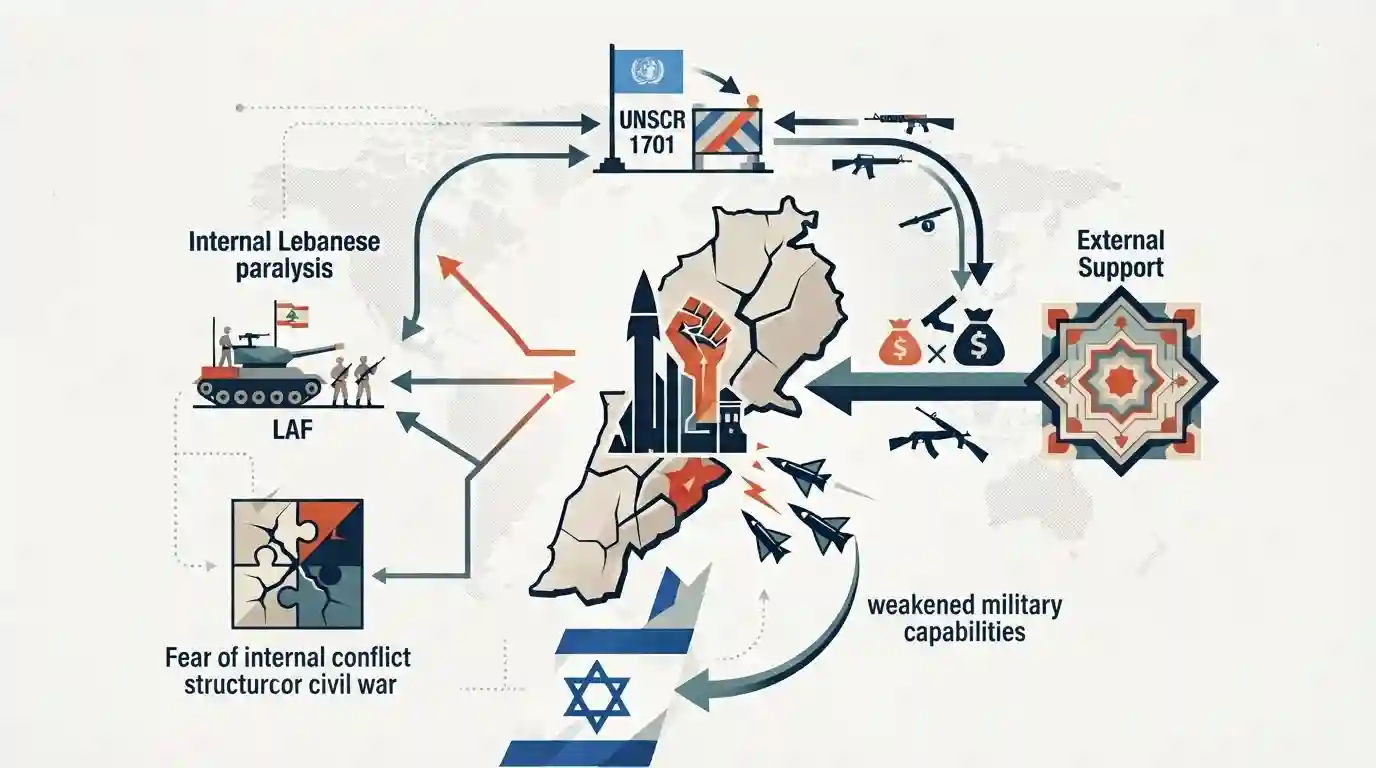
The article examines the profound challenges in disarming Hezbollah amidst the Israel-Lebanon conflict. Although Hezbollah has been significantly weakened by targeted Israeli military operations, enforcing a complete disarmament is complicated by its entrenched socio-political role in Lebanon. The Lebanese state and its Armed Forces (LAF) lack the power and political will to dismantle Hezbollah's military wing, fearing a descent into civil war. Furthermore, as a crucial proxy for Iran's 'Axis of Resistance', Hezbollah continues to receive external support, rendering international mandates like UN Security Council Resolution 1701 largely ineffective without a broader regional settlement.
મુખ્ય મુદ્દા
- Despite military and leadership setbacks due to recent Israeli strikes, disarming Hezbollah remains highly improbable.
- Hezbollah's deep integration into Lebanon's socio-political framework, functioning essentially as a 'state within a state', insulates it from domestic disarmament efforts.
- The Lebanese Armed Forces (LAF) and state institutions lack both the military capacity and the political consensus required to forcibly disarm the group without risking a civil war.
- Enforcing UN Security Council Resolution 1701, which mandates Hezbollah's withdrawal north of the Litani River and its disarmament, faces severe implementation challenges.
- Iran's strategic backing of Hezbollah as the vanguard of its 'Axis of Resistance' ensures the group retains the resources to resist disarmament and eventually rebuild its capabilities.
મહત્વપૂર્ણ શબ્દો
UN Security Council Resolution 1701

A 2006 resolution aimed at ending the Israel-Hezbollah war. It mandates Hezbollah's disarmament and withdrawal north of the Litani River, leaving only the Lebanese Armed Forces and UN peacekeepers in southern Lebanon.
UPSC context
GS Paper 2 (International Relations). Tests knowledge of Middle East geopolitics, UN mandates, and the challenges of enforcing international peacekeeping agreements.
Hezbollah
An Iran-backed Lebanese Shia Islamist political party and powerful paramilitary group. Formed in 1982 to resist Israeli occupation, it operates as a 'state within a state' and is a primary non-state actor in West Asia.
UPSC context
GS Paper 2 & 3 (International Relations; Role of Non-State Actors). Important for understanding proxy warfare and security dynamics in the Middle East.
Axis of Resistance
An informal, Iran-led military and political coalition operating across West Asia. It includes Hezbollah, Hamas, the Houthis, and various Iraqi militias, united by their opposition to Israeli and US influence in the region.
UPSC context
GS Paper 2 (International Relations). Crucial for analyzing Iran's regional strategy, proxy coalitions, and their broader impact on global stability.
Lebanese Armed Forces (LAF)
The national military of Lebanon. A multi-confessional force striving to maintain internal stability, it remains severely under-equipped and lacks the political consensus necessary to forcibly disarm powerful non-state actors like Hezbollah.
UPSC context
GS Paper 2 (International Relations). Illustrates the limitations of state capacity and civil-military challenges in deeply divided, fragile democracies.
United Nations Security Council (UNSC)
The principal UN organ responsible for maintaining international peace and security. It has the authority to establish peacekeeping operations, enact international sanctions, and authorize military action through binding resolutions.
UPSC context
GS Paper 2 (Important International Institutions). Tests understanding of global governance structures, their mandates, and their effectiveness in resolving international conflicts.
પ્રિલિમ્સ ટ્રેપ
"The Litani River forms the international boundary between Israel and Lebanon."
The Litani River is entirely within Lebanon. The actual UN-demarcated boundary separating Lebanon from Israel is the Blue Line, established in 2000.
સંલગ્ન સ્થિર ખ્યાલો
What are the key geopolitical markers in the Israel-Lebanon theater?
- Blue Line: The UN-drawn border demarcation published in 2000 to determine whether Israel had fully withdrawn from southern Lebanon.
- Litani River: A major watercourse flowing entirely within Lebanon, serving as the northern edge of the UNSC 1701 demilitarized buffer zone.
- Golan Heights: A strategic plateau captured by Israel from Syria in 1967, which borders southern Lebanon and forms part of the regional conflict dynamic.
How do non-state armed groups consolidate de facto state power?
- Parallel Governance: Groups like Hezbollah provide essential services (health, education) where state capacity is weak, building immense grassroots legitimacy.
- Sectarian Pacts: Exploiting domestic power-sharing pacts (like Lebanon's 1989 Taif Agreement) to legally or practically retain independent militias under the guise of 'resistance'.
- External Sponsorship: Continuous financial, military, and diplomatic backing from sovereign states (e.g., Iran's Axis of Resistance) to project proxy power.
આંતર-વિષય પેટર્ન
Geography of West Asian conflicts
UPSC frequently tests regional geography through conflict zones. The Litani River aligns with past Prelims trends testing the exact location of the Golan Heights, Aleppo, and the Red Sea.
Non-State Actors & UN Limitations
The failure of UNSC Res 1701 mirrors difficulties in enforcing mandates against non-state groups like the Houthis, highlighting structural weaknesses in international law enforcement.

Expect a 'Places in News' Prelims question in 2026 pairing the Litani River, Blue Line, or Beqaa Valley with the Lebanon-Israel theater.
સંલગ્ન PYQ · 3
સંલગ્ન PYQ · 3
- 2025MainsGS2
"Energy security constitutes the dominant kingpin of India's foreign policy, and is linked with India's overarching influence in Middle Eastern countries.” How would you integrate energy security with India's foreign policy trajectories in the coming years?
- 2024MainsGS2
‘Terrorism has become a significant threat to global peace and security.’ Evaluate the effectiveness of the United Nations Security Council's Counter Terrorism Committee (CTC) and its associated bodies in addressing and mitigating this threat at the international level.
- 2021MainsGS3
Analyse the multidimensional challenges posed by external state and non-state actors, to the internal security of India. Also discuss measures required to be taken to combat these threats.
