Hemkunt Sahib Yatra Records High Devotee Turnout Before Closure
Source:republicworld ↗
Why It Matters
Hemkunt Sahib is a major pilgrimage site in Uttarakhand, relevant to the state's geography, tourism economy, and cultural heritage. Its location near the Valley of Flowers and the mention of Brahma Kamal directly tie into recurring UKPSC themes of state geography, UNESCO heritage sites, and alpine ecology.
Summary
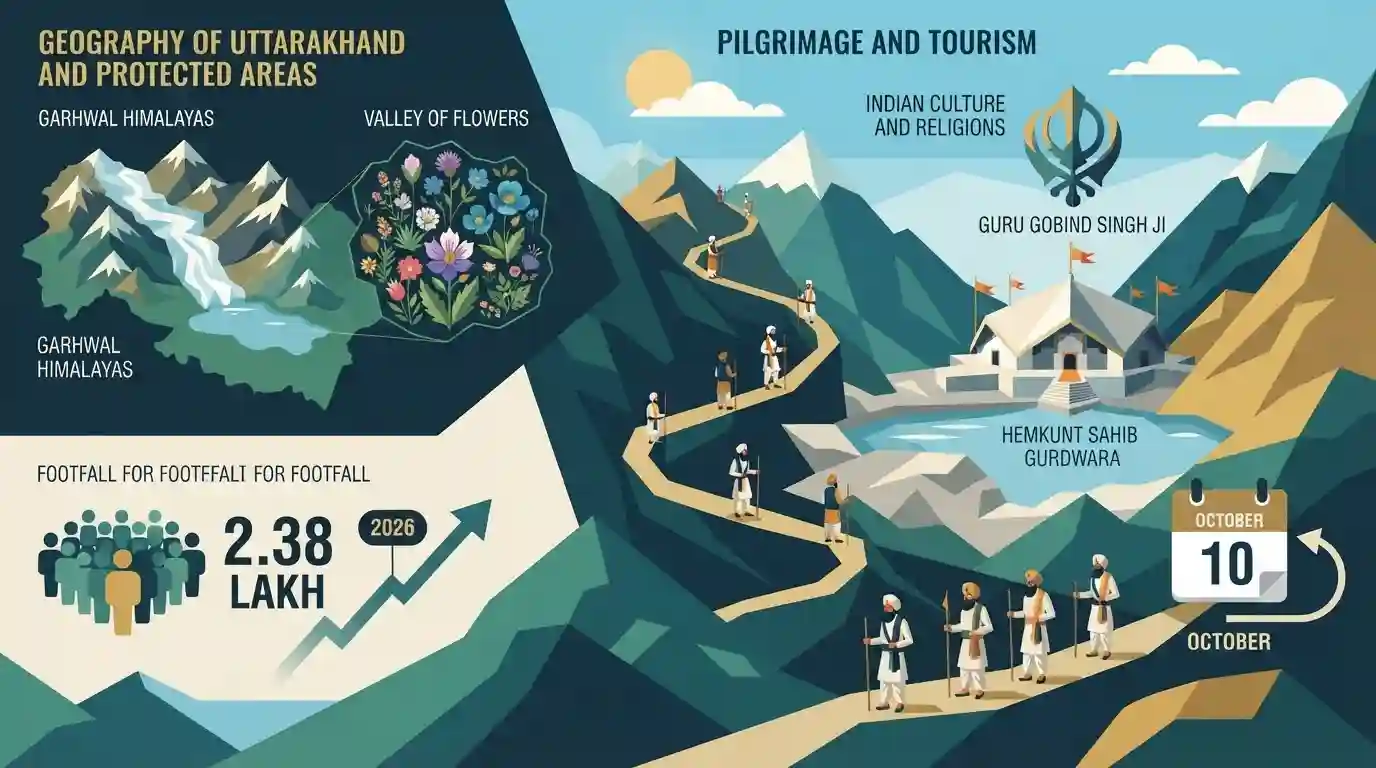
The Hemkunt Sahib Yatra in Uttarakhand is set to conclude on October 10, 2026, recording a footfall of over 2.38 lakh devotees for the year. Positioned at an altitude of more than 15,000 feet alongside a glacial lake, the shrine holds immense significance in Sikh tradition, being associated with Guru Gobind Singh Ji's past-life meditation as detailed in the Dasam Granth. Its proximity to the Valley of Flowers also highlights the region's geographical and ecological importance.
Key Points
- The Hemkunt Sahib Yatra, an important Sikh pilgrimage in Uttarakhand, concludes on October 10, with over 2.38 lakh devotees having visited in 2026.
- Located at an altitude of over 15,000 feet, the shrine is surrounded by seven snow-clad peaks and features a high-altitude glacial lake.
- According to the 'Bachittar Natak' in the Dasam Granth, Hemkunt Sahib is the Tapasthan (place of meditation and penance) of Guru Gobind Singh Ji in his previous life.
- The site is situated near the ecologically significant Valley of Flowers, which is renowned for the Brahma Kamal.
Important Terms
Hemkunt Sahib

A highly revered Sikh pilgrimage site located at over 15,000 feet in Uttarakhand's Chamoli district. It sits alongside a high-altitude glacial lake surrounded by seven snow-clad Himalayan peaks.
UPSC context
Relevant to GS-1 and GS-3, highlighting religious geography, Himalayan topography, and the ecological impact of pilgrimage tourism.
Dasam Granth
A sacred religious text in Sikhism encompassing the writings and compositions attributed to the tenth Sikh Guru, Guru Gobind Singh Ji, which details his past-life meditation.
UPSC context
Crucial for GS-1 (Art and Culture), testing knowledge of Sikh religious literature, spiritual philosophy, and texts associated with the Gurus.
Valley of Flowers National Park
A UNESCO World Heritage site and high-altitude national park in Uttarakhand, renowned for its diverse endemic alpine flora, situated adjacent to the Hemkunt Sahib shrine.
UPSC context
Important for GS-3 (Environment and Ecology), focusing on UNESCO World Heritage sites, Himalayan biodiversity, and high-altitude protected areas.
Gurudwara Shri Hemkunt Sahib Management Trust
The principal administrative body responsible for the management, upkeep, and organization of the annual Hemkunt Sahib Yatra, ensuring infrastructure and facilities for thousands of visiting pilgrims.
UPSC context
Relevant for GS-2 (Governance), illustrating the role of civil society and religious trusts in managing large-scale pilgrimage logistics and infrastructure.
Prelims Trap
Hemkunt Sahib's significance is detailed in the Guru Granth Sahib as the meditation site of Guru Nanak Dev Ji.
It is mentioned in the 'Bachittar Natak' of the Dasam Granth, and relates to the past-life meditation of the tenth Sikh Guru, Guru Gobind Singh Ji.
Static Concepts Connected
What are the key distinctions between the Guru Granth Sahib and the Dasam Granth?
- Guru Granth Sahib: The central religious scripture and eternal living Guru of Sikhism, compiled initially by the fifth Guru, Guru Arjan Dev.
- Dasam Granth: Contains texts attributed to Guru Gobind Singh (10th Guru), including mythological and autobiographical works like Bachittar Natak.
- Spiritual Status: Dasam Granth is highly revered but considered secondary; it does not hold the status of the eternal Guru.
What is the ecological significance of the Nanda Devi Biosphere Reserve?
- Core Zones: Comprises Nanda Devi National Park and Valley of Flowers National Park (both designated as UNESCO World Heritage Sites).
- Transition Zone: Forms a unique ecological transition zone between the Zanskar mountain range and the Greater Himalayas.
- Flora and Fauna: Famous for endemic alpine flowers (like Brahma Kamal) and endangered fauna such as the snow leopard and Himalayan musk deer.
Cross-Topic Patterns
Pilgrimage vs. Alpine Carrying Capacity
The heavy footfall near the Valley of Flowers links Cultural tourism to Geography, specifically the carrying capacity of fragile glacial environments and UNESCO World Heritage zones.
Zanskar and Greater Himalayas mapping
UPSC frequently targets ecological transition zones. The Valley of Flowers sitting perfectly between the Zanskar range and Greater Himalayas makes map-based tracking of this region essential.

Expect a pair-matching question linking specific Sikh texts (Dasam Granth) to Gurus, or Biosphere core zones to precise Himalayan ranges.
Linked PYQs · 3
Linked PYQs · 3
- 2025UKPSC_PRELIMSGS1
Which of the following UNESCO World Heritage Sites is/are located in Uttarakhand? Choose the correct option: A. Valley of Flowers B. Kaziranga National Park C. Mountain Railways of India D. Nanda Devi National Park
- 2024UKPSC_PRELIMSGS1
Which of the following pairs is not correctly matched ?
- 2021UKPSC_PRELIMSGS1
Which of the following is a State tree of Uttarakhand?
