Supreme Court Directives on Illegal Sand Mining in Chambal Sanctuary
Source:Indian Express ↗
Why It Matters
This article highlights a critical overlap between environmental conservation, natural resource economics (sand mining), and governance challenges. It is highly relevant for GS3 (Environment) and GS2 (Judiciary/Governance), showcasing how illegal resource extraction directly threatens biodiversity and how the judiciary steps in when executive enforcement fails. Understanding the ecological significance of the Chambal river is also important for Prelims Geography and Environment mapping.
Summary
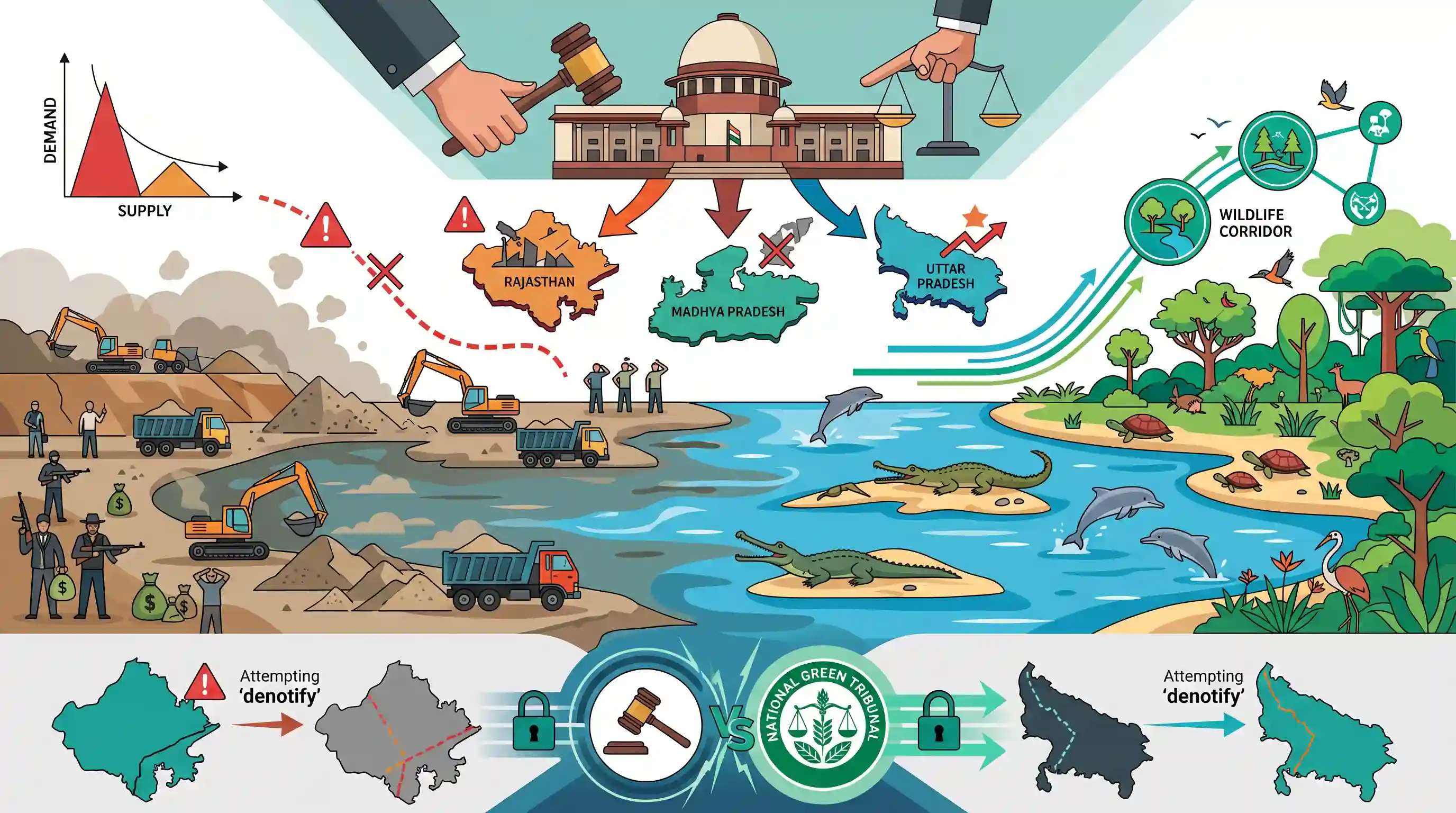
The Supreme Court of India has reprimanded the governments of Rajasthan, Madhya Pradesh, and Uttar Pradesh for failing to curb illegal sand mining in the National Chambal Gharial Sanctuary. The Court rejected the states' defense of helplessness against armed sand mafias, emphasizing that administrative apathy has led to a severe environmental and governance crisis. The illegal extraction of sand, driven by an immense national supply gap, severely degrades the Chambal's pristine riverine ecosystem. The river is a vital habitat for critically endangered species like the gharial and red-crowned roofed turtle, as well as the endangered Gangetic dolphin. It also functions as an essential wildlife corridor connecting several national parks. Attempts by states to denotify parts of the sanctuary for mining and urban projects have been actively blocked by the Supreme Court and the National Green Tribunal (NGT), underscoring the critical need for sustained judicial and administrative enforcement to protect the region's biodiversity.
Key Points
- The Supreme Court strictly admonished Rajasthan, Madhya Pradesh, and Uttar Pradesh for their failure to stop illegal sand mining in the National Chambal Gharial Sanctuary, rejecting their claims of "helplessness" against armed mining mafias.
- Despite a ban on sand mining in the sanctuary since 2006, organized syndicates continue indiscriminate extraction, which damages aquatic habitats, alters environmental flows, and threatens the survival of species.
- The Chambal river ecosystem is immensely biodiverse, hosting significant breeding populations of the critically endangered gharial, the red-crowned roofed turtle, and the endangered Gangetic dolphin, alongside numerous bird species like the Indian skimmer.
- State attempts to denotify portions of the sanctuary to allow regulated mining and urbanization have faced legal hurdles, with the Supreme Court and NGT intervening to halt such denotifications.
- The river also acts as a critical wildlife corridor connecting fragmented forest landscapes across over a dozen protected areas, including Ranthambore, Kuno-Palpur, and Mukundra.
Important Terms
National Chambal Gharial Sanctuary

A tri-state protected area (Rajasthan, MP, UP) along the Chambal River, home to 90% of the world's wild gharials and endangered Gangetic dolphins.
UPSC context
GS3/Environment: Critical for biodiversity conservation and riverine ecosystems; frequently tested in Prelims (location/species) and Mains (threats).
Sand Mining Framework 2018
A 2018 policy by the Ministry of Mines providing national guidance for sustainable sand extraction, focusing on availability, monitoring, and curbing illegal mining networks.
UPSC context
GS3/Natural Resources: Part of the regulatory framework for minor minerals; relevant for answers on sustainable resource management.
National Green Tribunal (NGT)
A specialized judicial body established under the NGT Act, 2010, for the fast-track disposal of cases related to environmental protection and forest conservation.
UPSC context
GS2/Statutory Bodies: Tests knowledge of environmental governance, judicial powers, and the principle of 'sustainable development'.
Minor Mineral
Minerals such as sand, gravel, and building stones whose regulation and leasing rights are vested in State Governments under the MMDR Act, 1957.
UPSC context
GS3/Economic Geography: Distinguishes between Central and State jurisdiction in mining; crucial for federalism and resource-governance questions.
Mines and Minerals (Development and Regulation) Act, 1957 (MMDR Act)
The primary legislation governing the mining sector in India, empowering the government to grant mineral concessions and prevent illegal mining activities.
UPSC context
GS3/Infrastructure & Resources: The statutory basis for all mining regulations, including the 2015 amendments regarding stringent penalties.
Article 21 (Right to Life)
Constitutional provision interpreted by the Supreme Court to include the 'right to a clean and healthy environment' as a fundamental right.
UPSC context
GS2/Polity: Core of environmental jurisprudence; explains the Supreme Court’s authority to intervene in cases of ecological degradation.
Sustainable Sand Mining Management Guidelines
Guideline issued by MoEFCC mandating scientific 'replenishment studies' and IT-enabled monitoring to ensure sand extraction does not exceed natural replenishment rates.
UPSC context
GS3/Environmental Degradation: Key technical standards for curbing the 'sand mafia' and ensuring ecological balance in riverbeds.
Prelims Trap
"The National Chambal Gharial Sanctuary is exclusively administered by the state of Madhya Pradesh."
It is actually India's only tri-state protected area, co-administered by Rajasthan, Madhya Pradesh, and Uttar Pradesh. Aspirants frequently assume single-state jurisdiction for sanctuaries.
Static Concepts Connected
What is the statutory and judicial process for denotifying a Wildlife Sanctuary?
- NBWL Recommendation: State governments cannot unilaterally denotify; they must first obtain a recommendation from the National Board for Wildlife (NBWL) under the Wildlife Protection Act.
- Supreme Court Mandate: Following strict judicial precedents to prevent ecological degradation, altering boundaries or denotifying protected areas generally requires explicit approval from the Supreme Court.
Why is river sand ecologically critical for riverine biodiversity?
- Obligate Nesting Habitats: Intact sandbars are non-negotiable for the survival of critically endangered reptiles like the Gharial and Red-crowned roofed turtle, which rely on them for basking and nesting.
- Hydrological Balance: Sand acts as a natural sponge and filter. Its removal alters channel morphology, destroys deep pools required by Gangetic dolphins, and severely impairs groundwater recharge.
Cross-Topic Patterns
Judicial intervention vs. Executive apathy
The SC and NGT repeatedly stepping in to ban sand mining highlights the ongoing theme of executive apathy forcing judicial intervention in environmental governance, echoing the historic Godavarman case.
Rivers as terrestrial wildlife corridors
The Chambal river basin is not just an aquatic habitat; its ravines function as a crucial terrestrial corridor connecting tiger (Ranthambore) and cheetah (Kuno) landscapes for genetic dispersal.

Minor mineral rules, NBWL denotification powers, and Chambal's critically endangered species form a prime 2026 Prelims combination.
Linked PYQs · 5
Linked PYQs · 5
- 2017PrelimsGS1
If you want to see gharials in their natural habitat, which one of the following is the best place to visit?
- 2019PrelimsGS1
Consider the following pairs: Wildlife Naturally found in 1. Blue-finned Mahseer : Cauvery River 2. Irrawaddy Dolphin : Chambal River 3. Rusty-spotted Cat : Eastern Ghats Which of the pairs given above are correctly matched?
- 2014PrelimsGS1
Other than poaching, what are the possible reasons for the decline in the population of Ganges River Dolphins? 1. Construction of dams and barrages on rivers 2. Increase in the population of crocodiles in rivers 3. Getting trapped in fishing nets accidentally 4. Use of synthetic fertilizers and other agricultural chemicals in crop-fields in the vicinity of rivers Select the correct answer using the code given below.
- 2019MainsGS3
Coastal sand mining, whether legal or illegal, poses one of the biggest threats to our environment. Analyze the impact of sand mining along the Indian coasts, citing specific examples.
- 2025MainsGS3
Mineral resources are fundamental to the country's economy and these are exploited by mining. Why is mining considered an environmental hazard? Explain the remedial measures required to reduce the environmental hazard due to mining.
