Climate Change Vulnerabilities Among Rural Elderly Population
Source:The Hindu ↗
Why It Matters
The intersection of climate change and demographic ageing is an emerging policy challenge. The article provides concrete data on how climate hazards act as a threat multiplier for vulnerable groups, which is directly relevant to GS2 (welfare schemes/geriatric care) and GS3 (disaster vulnerability).
Summary
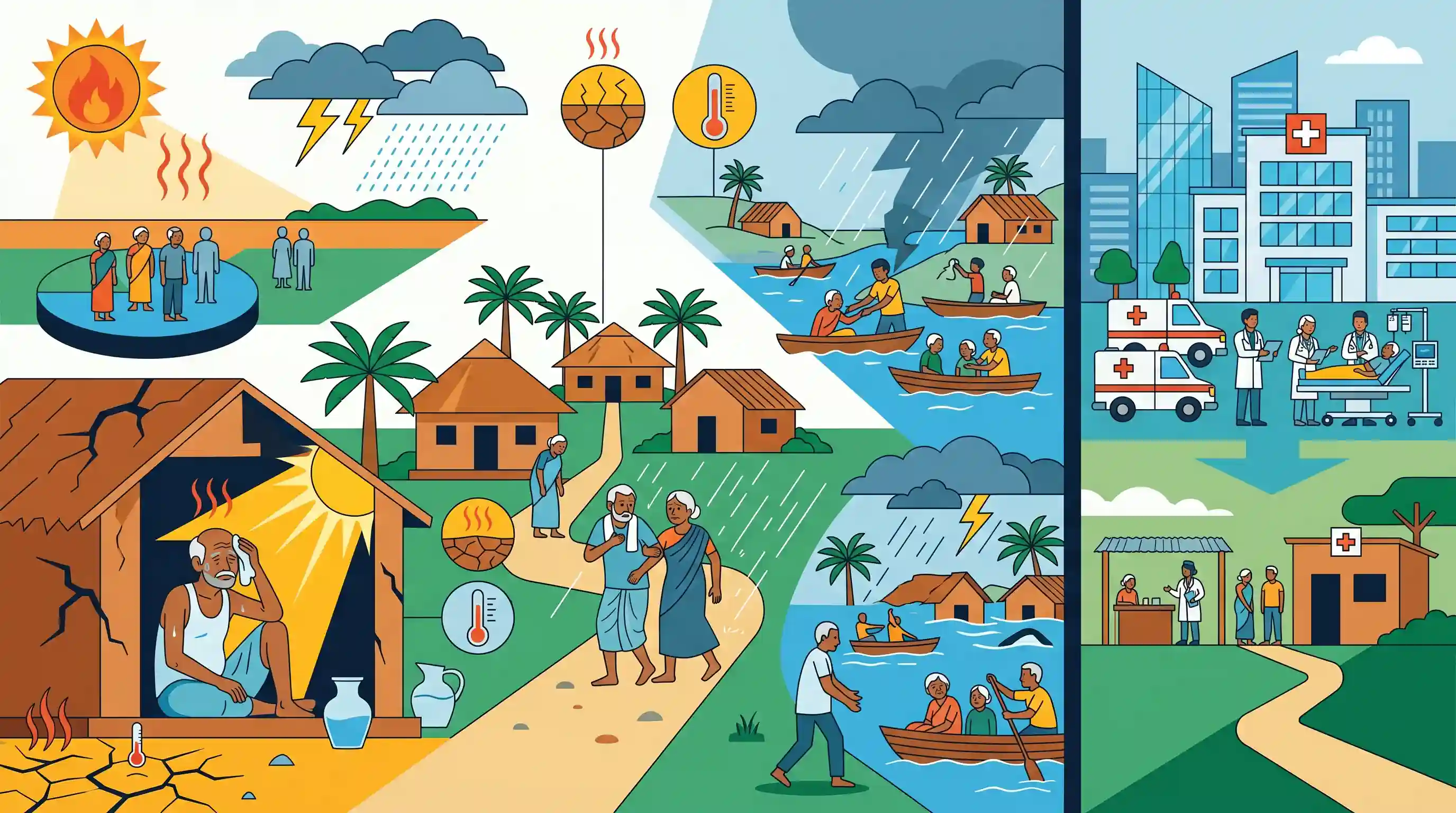
A study released by HelpAge India on World Elder Abuse Awareness Day, titled "Climate Resilient Ageing," details how the elderly, particularly in rural India, are highly vulnerable to climate change impacts. Surveying over 2,200 senior citizens across 10 states, the report found that 78% faced climate-related hazards recently. It highlights that poor housing conditions, combined with extreme weather events and phenomena like El Niño, severely increase heat stress and dehydration among the elderly. Furthermore, the report underscores the stark lack of adequate emergency response and geriatric healthcare infrastructure in rural areas compared to cities, compounding disaster vulnerabilities.
Key Points
- HelpAge India released a study titled 'Climate Resilient Ageing' highlighting the disproportionate impact of climate-related hazards on the elderly.
- A staggering 78% of the 2,224 elderly respondents reported experiencing climate-related hazards in the last three years.
- The rural ageing population faces severe health risks, notably dehydration and heat stress, exacerbated by poorly ventilated homes and lack of accessible healthcare.
- The report identifies significant disparities in emergency medical response and geriatric care facilities between urban and rural areas.
- Climate phenomena such as El Niño and Urban Heat Islands act as critical threat multipliers for the already vulnerable senior citizen demographic.
Important Terms
HelpAge India

A secular, not-for-profit NGO (est. 1978) working for the care, rights, and dignity of disadvantaged older persons in India.
UPSC context
GS Paper 2: Role of NGOs/Civil Society and welfare of vulnerable sections. Notable for winning the UN Population Award 2020.
Geriatric Care
Specialized medical care for senior citizens, addressing the complex interplay of chronic non-communicable diseases, physical disabilities, and psychological health.
UPSC context
GS Paper 2: Social sector/Health. Crucial as India’s elderly population is projected to reach 20% by 2050.
World Elder Abuse Awareness Day
An annual UN observance on June 15 aimed at raising awareness about the physical, emotional, and financial abuse of older persons.
UPSC context
GS Paper 2: Social Justice. 2024 theme: "Spotlight on Older Persons in Emergencies," relevant for disaster vulnerability.
El Niño
The warm phase of the ENSO cycle involving Pacific Ocean surface warming, which typically disrupts the Indian monsoon, causing heatwaves and droughts.
UPSC context
GS Paper 1 (Geophysical phenomena) and Paper 3 (Disaster Management/Agriculture). Triggers heat stress mentioned in the report.
Climate Resilience
The capacity of a community or system to prepare for, withstand, and recover from climate-induced hazards like floods and extreme heat.
UPSC context
GS Paper 3: Environment and Disaster Management. The report advocates for "Climate Resilient Ageing" in rural policy.
Vulnerable Sections
Segments of the population (e.g., elderly, disabled, BPL families) at higher risk of harm from socio-economic shocks and disasters.
UPSC context
GS Paper 2: Mechanisms and laws for the protection and betterment of vulnerable sections.
Prelims Trap
"HelpAge India is a statutory body under the Ministry of Social Justice mandated to draft climate policies for the elderly."
HelpAge India is a prominent NGO, not a statutory body. Furthermore, India’s Heat Action Plans currently lack statutory mandates specifically for elderly-centric climate adaptation.
Static Concepts Connected
What are the key features of the National Programme for the Health Care of Elderly?
- Core Objective: Provides accessible, affordable, and comprehensive geriatric care services primarily delivered through the existing primary and secondary healthcare delivery system.
- Infrastructure setup: Establishes dedicated geriatric wards at district hospitals and Regional Geriatric Centres (RGCs) at selected medical colleges.
- Scheme Type: It is a Centrally Sponsored Scheme with a typical 60:40 fund-sharing ratio between the Centre and States.
How does the Urban Heat Island (UHI) effect compound heatwave mortality risks?
- Albedo reduction: Urban concrete and asphalt absorb rather than reflect solar radiation, significantly raising localized daytime temperatures compared to surrounding rural areas.
- Nighttime heat retention: UHI prevents night-time cooling, denying the human body (especially the elderly) the critical physiological recovery period needed to survive prolonged heat stress.
Cross-Topic Patterns
Demographic transition meets climate justice
As India's elderly population grows, their physiological vulnerability to climate extremes highlights the need to integrate GS1 demographic shifts with GS3 disaster management frameworks.
Heat Action Plans & Social Vulnerability
The absence of localized early warning systems and elderly-specific adaptation strategies in local Heat Action Plans is a critical gap linking GS2 governance with GS3 environment.

Expect a GS2/GS3 Mains question merging demographic transition (an aging population) with climate justice and inadequate heat action plans.
Linked PYQs · 4
Linked PYQs · 4
- 2020MainsGS2
In order to enhance the prospects of social development, sound and adequate health care policies are needed particularly in the fields of geriatric and maternal health care. Discuss.
- 2019MainsGS3
Vulnerability is an essential element for defining disaster impacts and its threat to people. How and in what ways can vulnerability to disasters be characterized? Discuss different types of vulnerability with reference to disasters.
- 2013MainsGS1
Bring out the causes for the formation of heat islands in the urban habitat of the world.
- 2014MainsGS1
Most of the unusual climatic happenings are explained as an outcome of the El-Nino effect. Do you agree?
