Haridwar Ardh Kumbh 2027 to Feature AI Crowd Control and New Helipad
Source:timesofindia ↗
Why It Matters
Kumbh and Ardh Kumbh are of immense cultural, spiritual, and historical significance to Uttarakhand. The integration of advanced technology (AI and IoT) alongside massive physical infrastructure (ghats, bridges, and helipads) for crowd and disaster management is a major focus area for state civil services exams. Additionally, the historic participation of all 13 Akharas represents a landmark cultural event.
Summary
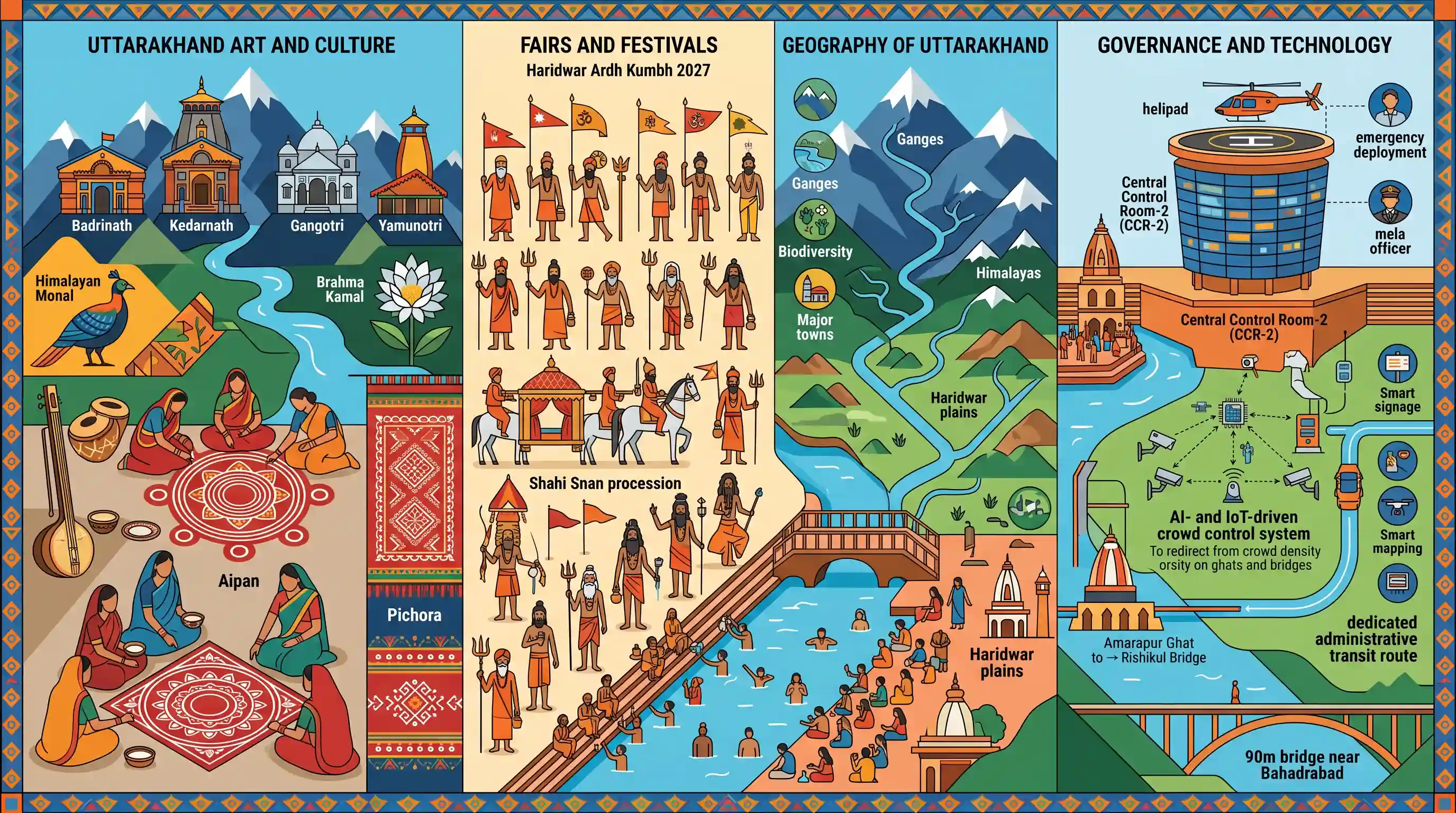
The Uttarakhand government is planning extensive infrastructure and high-tech upgrades for the Haridwar Ardh Kumbh 2027, scaling the event to match a full Kumbh. Key projects include a Rs 50+ crore helipad atop the Central Control Room-2 (CCR-2) near Har-ki-Pauri for emergency deployment, AI- and IoT-driven crowd control systems, a dedicated administrative transit route, a new ghat from Amarapur Ghat to Rishikul Bridge, and a 90m bridge near Bahadrabad. In a historic first for an Ardh Kumbh, all 13 Akharas have agreed to participate in the Shahi Snan. Dayanand Saraswati has been appointed as the additional mela officer to oversee the projects.
Key Points
- The Uttarakhand government is launching major infrastructure and technological initiatives to host the Haridwar Ardh Kumbh 2027 on the scale of a full Kumbh Mela.
- A high-tech helipad will be constructed atop the proposed Central Control Room-2 (CCR-2) near Har-ki-Pauri at an estimated cost of over Rs 50 crore, serving as an integrated command center for rapid deployment.
- Advanced Artificial Intelligence (AI) and Internet of Things (IoT) technologies will be deployed for real-time crowd management, traffic monitoring, and pilgrim safety.
- In a historical milestone for any Ardh Kumbh in Haridwar, all 13 traditional Hindu Akharas (monastic orders) have committed to participating in the Shahi Snan (Royal Bath).
- Infrastructural upgrades include a dedicated administrative transit route for emergency vehicles, a new ghat from Amarapur Ghat to Rishikul Bridge, and a 90-meter bridge on the SIDCUL-Dhanauri road near Bahadrabad.
- Dayanand Saraswati has been designated as the additional mela officer to supervise and streamline the preparatory works.
Important Terms
Akharas

Monastic orders of Hindu ascetics established by Adi Shankaracharya in the 8th century to safeguard and propagate Sanatan Dharma, historically categorized into Shaiva, Vaishnava, and Udasin sects.
UPSC context
GS Paper I (Art & Culture); tests knowledge of ancient monastic systems, religious sects, and traditional institutions of Indian philosophy.
Ganga Sabha
A prominent socio-religious institution founded in 1916 by Pt. Madan Mohan Malaviya in Haridwar to manage the daily Ganga Aarti at Har Ki Pauri and maintain the sanctity of the ghats.
UPSC context
GS Paper I (Modern History); tests understanding of Pt. Madan Mohan Malaviya's socio-religious reforms and the management of India's riverine heritage.
Ardh Kumbh Mela
A major Hindu pilgrimage festival celebrated every six years at Haridwar and Prayagraj, occurring at the halfway mark of the twelve-year Purna Kumbh Mela cycle.
UPSC context
GS Paper I (Art & Culture); tests comprehension of major national festivals, sacred geography, and UNESCO's Intangible Cultural Heritage of Humanity list.
Shahi Snan
The ceremonial "Royal Bath" representing the most auspicious ritual during the Kumbh Mela, where ascetics from various Akharas lead grand processions to take a sacred dip.
UPSC context
GS Paper I (Art & Culture); tests familiarity with sacred rituals, pilgrimage customs, and the historical conventions of monastic assemblies in India.
Prelims Trap
Ardh Kumbh is celebrated every six years by rotation across all four traditional Kumbh Mela sites.
Ardh (Half) Kumbh is celebrated only at two locations (Haridwar and Prayagraj), whereas the Purna (Full) Kumbh rotates across all four locations (including Nashik and Ujjain) every 12 years.
Static Concepts Connected
How are the 13 traditional Hindu Akharas classified under the Akhil Bharatiya Akhara Parishad?
- Shaiva Sect: Comprises seven monastic orders (e.g., Juna, Mahanirvani) dedicated primarily to the worship of Lord Shiva.
- Vaishnava Sect: Consists of three monastic orders (e.g., Digambar, Nirmani) dedicated to Lord Vishnu and his incarnations.
- Udasin Sect: Includes three akharas tracing lineage back to Sri Chand (son of Guru Nanak Dev), bridging Sikh and Hindu ascetic traditions.
- Governing Body: Formed in 1954 as the apex organization to coordinate royal baths (Shahi Snan) and resolve inter-sect disputes.
What are the core NDMA guidelines for managing crowds at mass religious gatherings?
- Unified Command: Establishes a Joint Control Room (JCR) featuring unified command structures under a designated Mela Officer for real-time response.
- Capacity Control: Mandates designated holding areas and one-way exit routes to regulate flow and avoid reverse-flow-induced stampedes.
- Tech Integration: Recommends GIS mapping, drone surveillance, and computerized ticketing/monitoring to prevent critical crowd densities.
Cross-Topic Patterns
Intangible Heritage + Digital Governance
Linking India's UNESCO Intangible Cultural Heritage (Kumbh Mela) with AI/IoT diagnostics showcases a policy shift toward tech-enabled cultural preservation under modern digital governance frameworks.
Disaster Management + Smart Logistics
Integrating NDMA crowd-management guidelines with real-time drone and IoT telemetry demonstrates how smart administrative logistics are replacing reactive policing during complex mass religious gatherings.

UPSC may couple UNESCO Intangible Cultural Heritage criteria with NDMA crowd-management protocols in a multi-statement question.
Linked PYQs · 2
Linked PYQs · 2
- 2025UKPSC_PRELIMSGS1
Which one of the following is incorrectly matched about festivals/exhibitions/expos held in Uttarakhand in 2025?
- 2024UKPSC_PRELIMSGS1
Which of the following is the 5ᵗʰ generation AI programming language ?
