UCADA Secures Free Helicopter Services For Emergency Rescue Operations
Source:etvbharat ↗
Why It Matters
It showcases an innovative governance and procurement model where state authorities utilize tender conditions to secure private helicopter resources for public emergency rescue operations, significantly strengthening disaster resilience in the ecologically fragile and disaster-prone Himalayan terrain.
Summary
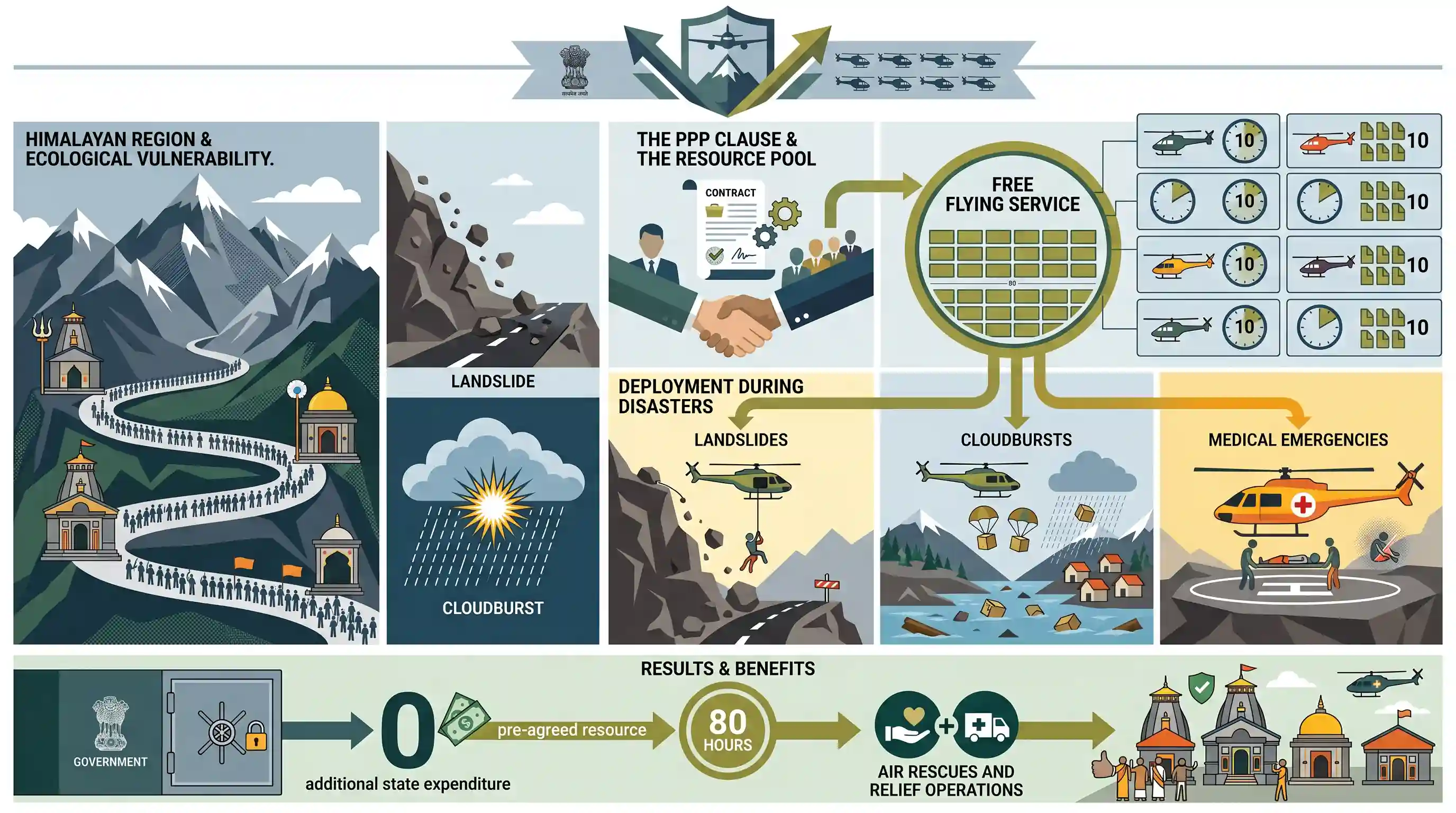
The Uttarakhand Civil Aviation Development Authority (UCADA) has leveraged a public-private partnership clause in its aviation tenders to strengthen disaster management during the Char Dham Yatra. Eight private helicopter operators are required to provide 10 hours each of free flying services (totaling 80 hours) to UCADA. This free flight capacity is deployed during landslides, cloudbursts, and medical emergencies in the highly vulnerable Himalayan regions of Uttarakhand to conduct prompt air rescues and relief operations without incurring additional state expenditure.
Key Points
- The Uttarakhand Civil Aviation Development Authority (UCADA) has mandated that private helicopter operators serving the Char Dham Yatra provide free flight hours to assist in disaster management and emergency relief operations.
- Under the tender selection terms, each of the eight helicopter companies operating in the state must provide 10 hours of free flight service, totaling 80 hours, to UCADA during the pilgrimage season.
- These free air services are deployed specifically for medical emergencies, rescue operations, and relief work in inaccessible, mountainous regions when road networks are disrupted by landslides, cloudbursts, or heavy rainfall.
- This model enables the state administration to provide prompt, life-saving air support in the high Himalayan regions without placing any additional financial burden on the government treasury.
- According to UCADA officials, more than 100 people have been airlifted during medical emergencies this season alone (mostly in the Kedarnath region), following the rescue of over 200 individuals in the previous year.
Important Terms
Uttarakhand Civil Aviation Development Authority (UCADA)

A state government agency established in 2013 to develop sustainable civil aviation infrastructure, improve regional connectivity, and manage emergency heli-services, particularly during the high-altitude Char Dham Yatra.
UPSC context
GS Paper 3: Infrastructure and Disaster Management. Tests air rescue strategies and state-led aviation capacity in disaster-prone terrains.
Char Dham Yatra
A revered Himalayan pilgrimage circuit in Uttarakhand consisting of four shrines—Yamunotri, Gangotri, Kedarnath, and Badrinath—which faces extreme weather, geographical vulnerabilities, and massive tourism management challenges.
UPSC context
GS Paper 1: Indian Culture and GS Paper 3: Disaster Management. Tests sustainable religious tourism and disaster-resilient mountain planning.
Public-Private Partnership (PPP)
A long-term collaborative agreement between a government agency and private sector entities to leverage private capital, technology, and operations for public infrastructure, services, or disaster relief resource sharing.
UPSC context
GS Paper 3: Economic Development and Infrastructure. Tests collaborative models, risk-sharing mechanisms, and private sector involvement in emergency logistics.
Carrying Capacity
The maximum level of human activity, tourism, and infrastructure that an ecosystem can sustainably support without triggering severe environmental degradation, resource depletion, or worsening natural hazards.
UPSC context
GS Paper 3: Environmental Conservation. Tests the balance between infrastructure development, regional security, and preserving fragile Himalayan ecosystems.
Prelims Trap
The State Disaster Management Authority (SDMA) or Revenue Department is the primary body responsible for preparing the Uttarakhand Action Plan on Climate Change.
While disaster response is executed by the SDMA/Revenue Department, the overarching UAPCC is prepared and monitored by the specialized State Council for Climate Change (SCCC), established in 2011.
Static Concepts Connected
What is the 'Central Seismic Gap' in the Indian Himalayan Region?
- Definition: It is a ~400 km segment of the Himalayas between the 1905 Kangra and 1934 Bihar-Nepal earthquake epicenters.
- Seismic Silence: This region has not experienced a major, strain-releasing earthquake for over 200 years, making it highly primed for a major tectonic rupture.
- Tectonic Strain: Driven by the Indian Plate colliding with and sliding under the Eurasian Plate at a rate of approximately 4 to 5 cm per year.
How do Landslide Lake Outburst Floods (LLOFs) differ from GLOFs?
- Trigger Mechanism: LLOFs occur when landslide debris temporarily dams a river channel, creating a reservoir that eventually breaches catastrophically under water pressure.
- Moraine vs Debris: GLOFs are triggered by the failure of moraine dams holding back glacial meltwater, whereas LLOFs are purely landslide-induced.
- Vulnerability Hotspots: The Alaknanda River basin is historically and geomorphologically the most vulnerable to landslide-induced river blockages in Uttarakhand.
Cross-Topic Patterns
Pilgrimage Tourism vs Himalayan Carrying Capacity
Links GS-1 fragile geomorphology with GS-3 disaster resilience, analyzing how mass religious tourism (Char Dham) exceeds carrying capacity and increases vulnerability to extreme weather events.
PPP Procurement as a Disaster Mitigation Tool
Connects GS-3 infrastructure procurement with disaster response, showing how state tenders can embed non-fiscal public service obligations (like free helicopter hours) for emergency management.

Mains 2026 may ask to evaluate the role of PPP models and corporate resources in reinforcing Himalayan disaster response capabilities.
Linked PYQs · 3
Linked PYQs · 3
- 2025UKPSC_PRELIMSGS1
As per Uttarakhand Budget 2025-26, the amount allocated for Char Dham Road network improvement is
- 2016UKPSC_PRELIMSGS1
Which one of the following shrines of Uttarakhand was visited by maximum number of tourists in the year 2015?
- 2025UKPSC_PRELIMSGS1
Consider the following statements and select the correct answer from the options given below : Statement 1 : Uttarakhand is highly vulnerable to climate change. Statement 2 : Climate change is causing water stress and depleting biodiversity in Uttarakhand.
