US Defense Assessment of Strikes on Iran Nuclear Sites
Source:The Hindu ↗
Why It Matters
Escalations between the U.S. and Iran have significant geopolitical ramifications, notably concerning global nuclear non-proliferation and Middle Eastern stability, which directly affect global energy security and India's strategic interests.
Summary
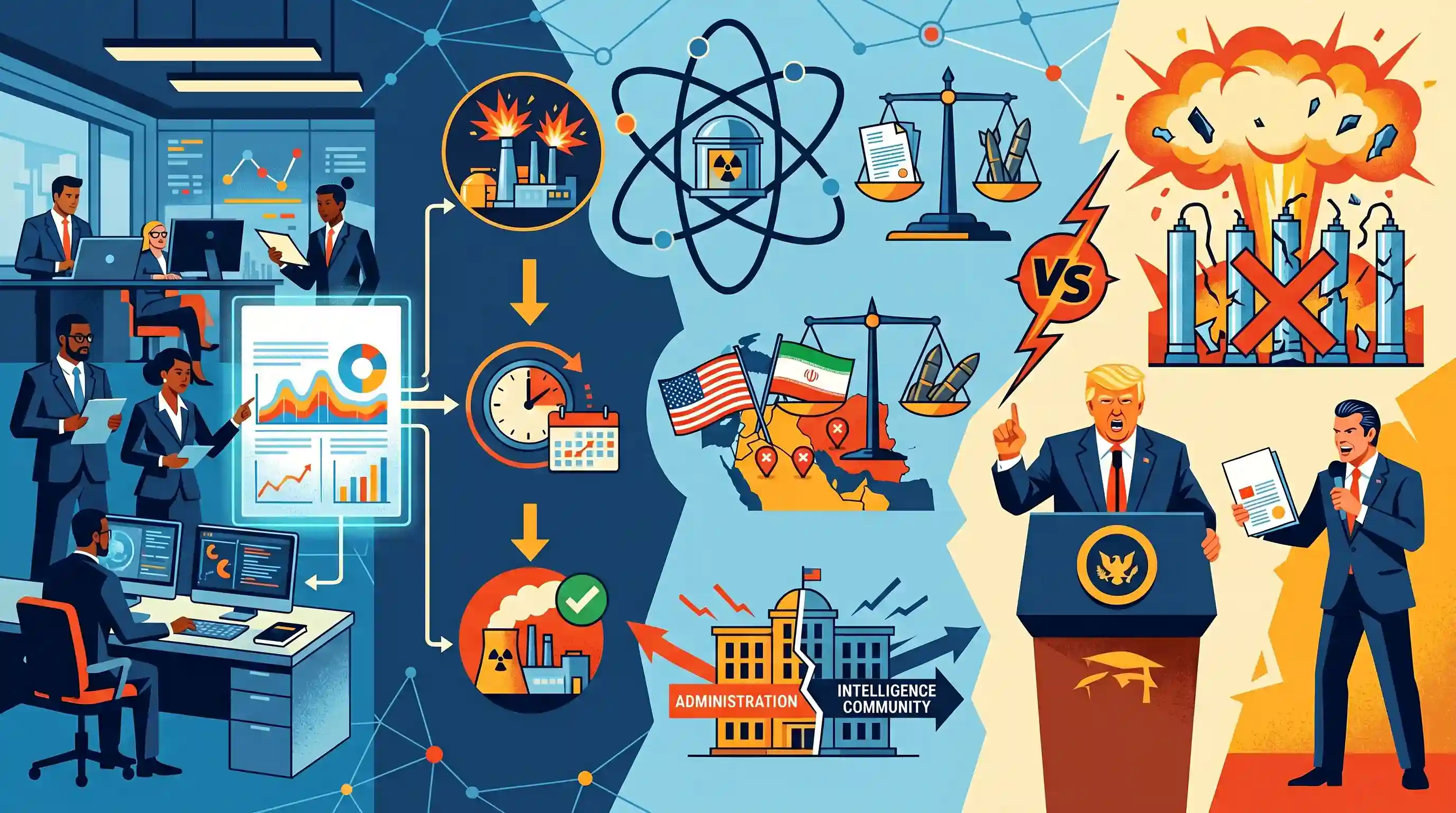
U.S. Defense Secretary Pete Hegseth addressed a leaked intelligence report suggesting that recent U.S. strikes on Iran's nuclear facilities only delayed the program by a few months. This assessment directly contradicted President Donald Trump's assertion that the Iranian nuclear program was completely obliterated. The incident underscores ongoing tensions between the Trump administration and the U.S. intelligence community over the framing and consequences of American foreign policy in the Middle East.
Key Points
- A leaked U.S. intelligence report assessed that recent American strikes on Iranian nuclear sites only delayed the program by a few months.
- President Donald Trump rejected the intelligence assessment, insisting the strikes completely obliterated Iran's nuclear capabilities.
- U.S. Defense Secretary Pete Hegseth defended the administration's position and downplayed the leaked report as preliminary.
- The disagreement highlights renewed friction between the Trump administration and the U.S. intelligence community regarding foreign policy communication.
Important Terms
Joint Comprehensive Plan of Action (JCPOA)

A 2015 landmark agreement between Iran and the P5+1 powers to limit Iran's nuclear activities in exchange for the lifting of economic sanctions.
UPSC context
GS-2 (International Relations). Essential for understanding West Asian stability, global energy security, and India's strategic interests in Iran (e.g., Chabahar Port).
Nuclear Non-Proliferation
Global efforts to prevent the spread of nuclear weapons and technology, primarily governed by the 1970 Non-Proliferation Treaty (NPT) and its three pillars.
UPSC context
GS-2/3 (Security/International Relations). Tests knowledge of global regimes, India’s 'No First Use' policy, and its refusal to sign the 'discriminatory' NPT.
International Atomic Energy Agency (IAEA)
The 'UN nuclear watchdog' tasked with promoting peaceful nuclear energy use while verifying that nuclear materials are not diverted for military purposes.
UPSC context
GS-2 (International Institutions). Important for global governance, safeguards, and India's 123 Agreement/Civil Nuclear Deal.
U.S. Intelligence Community
A group of 18 U.S. government agencies (e.g., CIA, NSA) that collect and analyze intelligence to support national security and foreign policy.
UPSC context
GS-2 (International Relations). Relevant for analyzing the friction between objective intelligence assessments and political executive decision-making in foreign policy.
Pentagon
The headquarters of the U.S. Department of Defense; metonymically used to refer to U.S. military leadership and defense administration.
UPSC context
GS-2 (International Relations). Significant for India-US defense ties (e.g., iCET) and security cooperation in the Indo-Pacific and Middle East.
White House
The official residence and principal workplace of the U.S. President, serving as the center of executive power and foreign policy.
UPSC context
GS-2 (International Relations). Represents the political executive whose decisions shape global diplomacy and bilateral relations with India.
Prelims Trap
"The Non-Proliferation Treaty (NPT) completely prohibits non-nuclear weapon states from enriching uranium."
False. The NPT guarantees the inalienable right to develop nuclear energy for peaceful purposes. It allows uranium enrichment provided the country remains under strict IAEA safeguards.
Static Concepts Connected
What is the core framework of the Joint Comprehensive Plan of Action (JCPOA)?
- Core Premise: The P5+1 agreed to lift international economic sanctions on Iran in exchange for strict, verifiable limitations on its nuclear program.
- Enrichment Caps: Restricted Iran's uranium enrichment to 3.67%, which is suitable for civilian energy and far below the ~90% threshold required for weaponization.
- Breakout Time: Extended Iran's "breakout time" (time needed to produce fissile material for one weapon) to at least a year, monitored via intrusive IAEA inspections.
How do US-Iran tensions directly threaten India's geostrategic interests?
- Energy Chokepoints: The Strait of Hormuz is a vital transit route. Disruptions here threaten the roughly 40% of India's crude imports that pass through this narrow chokepoint.
- Strategic Connectivity: Escalation and sanctions jeopardize India's Chabahar Port investments and the International North-South Transport Corridor (INSTC), crucial for accessing Central Asia while bypassing Pakistan.
Cross-Topic Patterns
Energy Security & Macroeconomic Stability
US-Iran military escalation threatens the Strait of Hormuz, risking oil supply shocks. For India, this directly inflates crude prices, exacerbating domestic inflation and widening the Current Account Deficit.
Strategic Autonomy vs Western Sanctions
Intensifying US-Iran conflicts place India on a diplomatic tightrope, forcing it to balance ties with Washington while shielding its Iranian connectivity projects (Chabahar, INSTC) from secondary sanctions.

Expect a 2026 Prelims mapping question pairing Iran’s nuclear sites (Natanz, Fordow) with regional chokepoints like the Strait of Hormuz.
Linked PYQs · 2
Linked PYQs · 2
- 2018MainsGS2
In what ways would the ongoing US-Iran Nuclear Pact Controversy affect the national interest of India? How should India respond to this situation?
- 2025MainsGS2
"Energy security constitutes the dominant kingpin of India's foreign policy, and is linked with India's overarching influence in Middle Eastern countries.” How would you integrate energy security with India's foreign policy trajectories in the coming years?
