Karnataka Government Withdraws Land Acquisition for Aerospace Park
Source:The Hindu ↗
Why It Matters
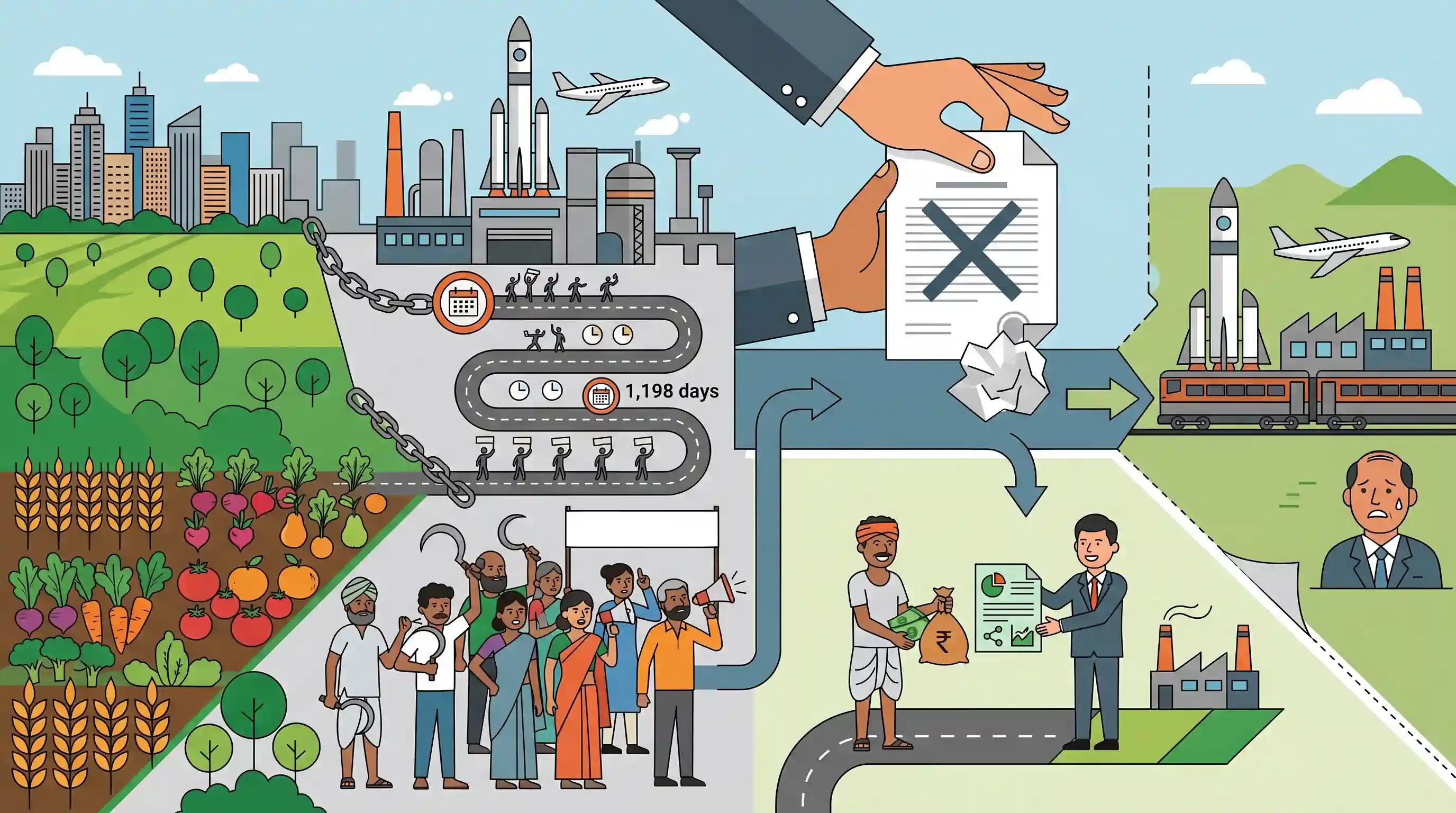
Highlights the critical policy conflict between expanding industrial infrastructure (like aerospace parks) and safeguarding agricultural livelihoods. It underscores the effectiveness of grassroots farmer movements in shaping government land acquisition policies and transitioning towards consent-based models.
Summary
Following a protracted 1,198-day protest by farmers, the Karnataka government has decided to drop the mandatory acquisition of 1,777 acres of prime agricultural land in Devanahalli taluk intended for an aerospace park. Farmers and civil society organizations successfully argued against trading fertile, multi-crop land near Bengaluru markets for industrial development. The state government has instead shifted to a consent-based acquisition model, offering enhanced financial compensation or developed land shares to those willing to voluntarily part with their land, despite acknowledging the risk of industries moving to neighboring states.
Key Points
- The Karnataka government has officially withdrawn the proposed acquisition of 1,777 acres of fertile agricultural land in Devanahalli taluk for the Haralur aerospace park.
- The decision follows a historic 1,198-day protest by local farmers who argued that acquiring multi-crop irrigated land would destroy their livelihoods and food security.
- The government announced it will now only acquire land based on voluntary consent, offering fair compensation or a share of the developed industrial land for willing landowners.
- The farmer struggle was supported by various civil society and progressive organizations, underscoring the growing role of non-state actors in influencing public policy.
Important Terms
Karnataka Industrial Areas Development Board (KIADB)

A statutory body established under the KIAD Act, 1966, to promote rapid industrial development in Karnataka by acquiring land and providing basic infrastructure.
UPSC context
GS II (Statutory Bodies) and GS III (Infrastructure); tests understanding of state-level agencies in industrial growth and land acquisition.
LARR Act, 2013
Federal legislation governing land acquisition in India, mandating Social Impact Assessment (SIA), fair compensation (2-4x market value), and specific consent thresholds for non-government projects.
UPSC context
GS II (Government Policies) and GS III (Land Reforms); crucial for questions on development vs. displacement and property rights.
Consent-based Land Acquisition
A land acquisition model where the state obtains property only through voluntary agreement and negotiation with owners, replacing mandatory state-enforced eminent domain.
UPSC context
GS III (Land Reforms); tests ability to analyze alternative models of development that minimize social conflict and legal disputes.
Permanent Special Agriculture Zone (PSAZ)
A land-use designation that legally protects fertile agricultural land from industrial or commercial conversion to preserve food security and local ecosystems.
UPSC context
GS III (Major Crops/Land Use); relevant for debates on balancing food security with industrialization and the creation of industrial corridors.
Samyukta Horata Karnataka
A broad coalition of farmer, Dalit, and labor organizations in Karnataka that acts as a pressure group against policies like forced land acquisition and agrarian distress.
UPSC context
GS II (Pressure Groups); exemplifies the role of civil society and collective bargaining in shaping state policy.
Aerospace Park
A specialized industrial cluster focused on manufacturing, research, and maintenance (MRO) for the aviation and defense sectors to foster a niche industrial ecosystem.
UPSC context
GS III (Industrial Policy and Infrastructure); relates to indigenization of technology and the "Make in India" initiative.
Prelims Trap
Under the LARR Act 2013, 80% consent of affected families is mandatory for all land acquisition.
Consent is mandated for Private companies (80%) and Public-Private Partnerships (70%). Purely government projects for public purpose are exempt from these specific consent clauses.
Static Concepts Connected
What are the LARR 2013 safeguards for multi-crop irrigated land?
- Exceptional use: Acquisition of multi-crop irrigated land is strictly restricted and permitted only as a demonstrable last resort under exceptional circumstances.
- Quantitative limits: State governments must set a strict upper limit on the total area of agricultural/multi-crop land that can be acquired within a district or state.
- Compensatory agriculture: If multi-crop land is acquired, an equivalent area of culturable wasteland must be developed for agricultural purposes to offset the loss.
How does 'Land Pooling' differ from traditional Land Acquisition?
- Voluntary participation: Instead of compulsory state acquisition, landowners voluntarily hand over their land parcels to a government agency or development authority.
- Developed land share: Farmers receive a proportionate share of the newly developed infrastructure land as compensation, rather than just a one-time monetary settlement.
- Economic stake: It converts displaced farmers into equity stakeholders, allowing them to benefit from the post-development appreciation in land value.
Cross-Topic Patterns
SEZ conflicts vs. Peri-urban Food Security
The shift from aerospace parks to agricultural preservation echoes historical SEZ conflicts (like Singur/Nandigram), highlighting the persistent GS-3 dilemma between preventing state capital flight and protecting peri-urban food security.
Land Pooling as an Urbanization Model
To bypass LARR 2013 acquisition hurdles, states increasingly adopt land pooling (e.g., the Amaravati model), linking this topic directly to urban development and infrastructure financing models.

Expect a GS-3 Mains question on 'Land Pooling as an alternative to LARR 2013' or a Prelims trap on PPP/Private consent thresholds.
Linked PYQs · 4
Linked PYQs · 4
- 2019MainsGS2
What are the methods used by the farmers' organisations to influence the policy-makers in India and how effective are these methods?
- 2021MainsGS3
“Investment in infrastructure is essential for more rapid and inclusive economic growth.” Discuss in the light of India's experience.
- 2016MainsGS3
Discuss the role of land reforms in agricultural development. Identify the factors that were responsible for the success of land reforms in India.
- 2024MainsGS3
What were the factors responsible for the successful implementation of land reforms in some parts of the country? Elaborate.
