HECI Bill and Higher Education Regulatory Reforms
Source:Indian Express ↗
Why It Matters
The HECI Bill is one of the most significant proposed reforms in India's higher education sector, directly stemming from NEP 2020. It is highly relevant for UPSC aspirants as it intersects multiple GS2 themes: the restructuring of statutory bodies, the balance of power in Centre-State relations (federalism), and the socio-economic impacts of moving from state-funded to loan-funded public education.
Summary
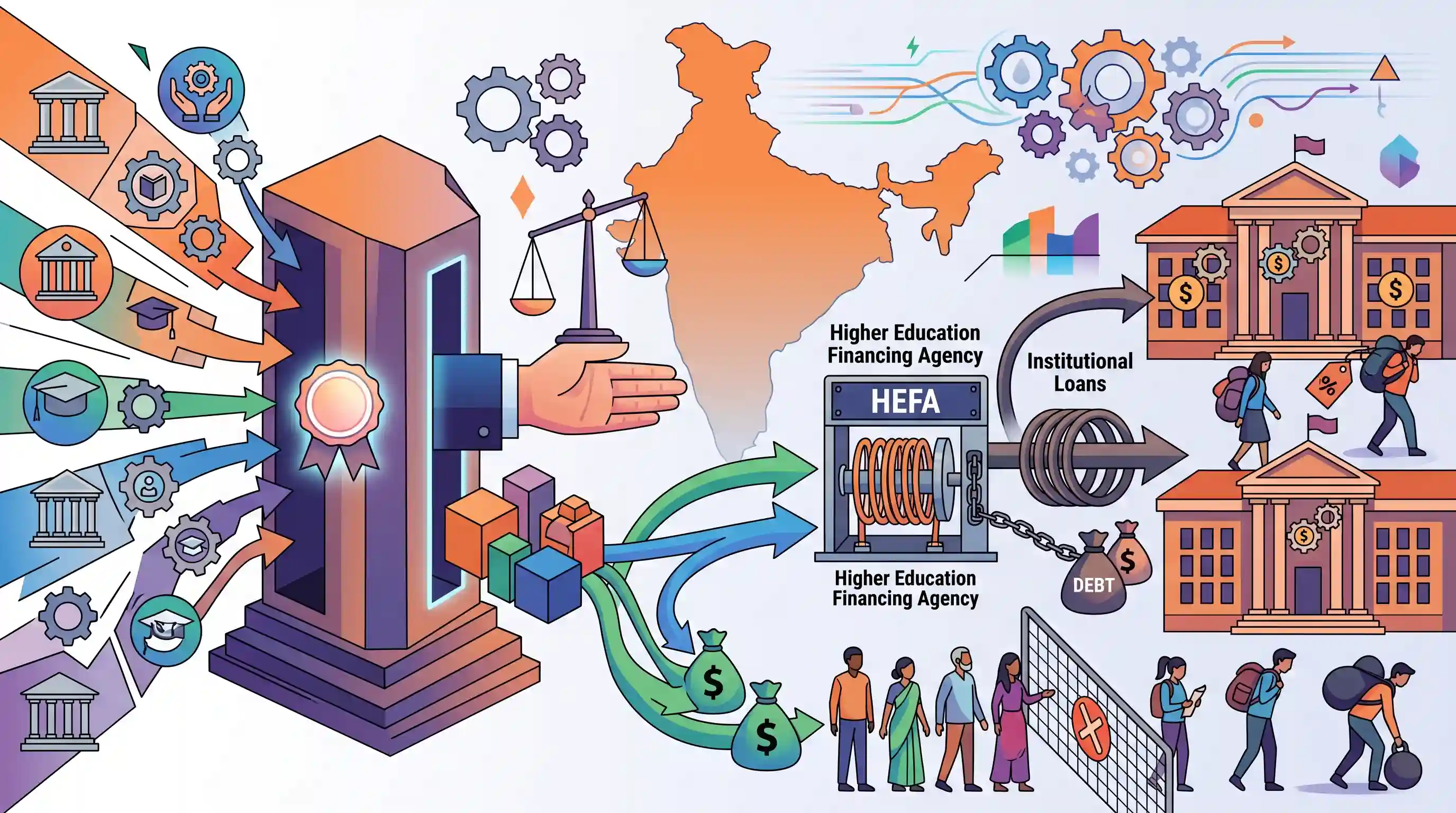
The article critically examines the proposed Higher Education Commission of India (HECI) Bill, which aims to consolidate higher education regulation by replacing bodies like the UGC and AICTE with a single umbrella authority. While aligned with the National Education Policy (NEP) 2020, the bill raises significant concerns regarding the over-centralization of educational governance and its impact on federalism. Furthermore, the article highlights a concerning shift toward a loan-driven funding model through the Higher Education Financing Agency (HEFA). This transition from public grants to institutional loans threatens to accelerate the commercialization of higher education, as universities may be forced to hike student fees to meet debt obligations, thereby restricting access for marginalized communities.
Key Points
- Regulatory Overhaul: The HECI Bill seeks to dismantle existing statutory bodies like the UGC and AICTE, replacing them with a single overarching commission to govern higher education.
- Centralization of Power: Critics argue that the proposed structure concentrates excessive regulatory and financial control at the Centre, eroding the autonomy of state-level universities and straining federal relations.
- Loan-Driven Financing Model: The proposed framework indicates a shift away from traditional public grants (formerly disbursed by the UGC) toward infrastructure loans managed by the Higher Education Financing Agency (HEFA).
- Risk of Commercialization: The reliance on loans forces public institutions to generate revenue for debt repayment, which could lead to exorbitant fee hikes, effectively commercializing higher education and making it inaccessible for marginalized sections.
Important Terms
Higher Education Commission of India (HECI)

A proposed overarching regulator for Indian higher education (excluding medical/legal), designed to replace fragmented bodies like the UGC and AICTE to streamline academic standards, accreditation, and regulation.
UPSC context
GS Paper 2 (Issues relating to Education; Regulatory Bodies). Tests understanding of institutional restructuring and governance efficiency in the social sector.
National Education Policy (NEP) 2020
India’s 2020 framework for overhauling the education system, emphasizing holistic development, multidisciplinary learning, and a 'light but tight' regulatory structure featuring a single higher education regulator.
UPSC context
GS Paper 2 (Government Policies). Tests analysis of transformative reforms, their foundational pillars (Access, Equity, Quality), and implementation challenges.
Higher Education Financing Agency (HEFA)
A joint venture between the Ministry of Education and Canara Bank providing low-interest loans for infrastructure and R&D in premier institutions, shifting funding from traditional public grants to debt-based models.
UPSC context
GS Paper 2 (Education) and GS Paper 3 (Investment Models). Tests critical evaluation of funding shifts and their impact on educational commercialization.
University Grants Commission (UGC)
A statutory body established in 1956 charged with coordinating, determining, and maintaining standards of higher education and disbursing grants to recognized universities and colleges in India.
UPSC context
GS Paper 2 (Statutory, Regulatory Bodies). Tests knowledge of current educational governance and the rationale behind its proposed replacement by HECI.
All India Council for Technical Education (AICTE)
A statutory body responsible for the planning, formulation, and maintenance of norms and standards for technical and management education institutions across India.
UPSC context
GS Paper 2 (Education). Tests understanding of technical education regulation and the drive toward a unified regulatory umbrella for better academic outcomes.
Prelims Trap
"HECI will serve as the sole overarching regulatory body for all higher education disciplines, including medical and legal education."
HECI deliberately excludes medical and agricultural/legal education, which remain under bodies like NMC and BCI. Absolute statements claiming it covers 'all' disciplines are incorrect.
Static Concepts Connected
How is legislative power over education distributed in the Indian Constitution?
- Concurrent List: Education was moved from the State List to the Concurrent List (List III) by the 42nd Constitutional Amendment Act of 1976.
- Union List Entry 66: Grants the Centre exclusive power over the "coordination and determination of standards" in institutions for higher education or research.
- Article 254: Under the Doctrine of Repugnancy, central laws like HECI prevail over conflicting state university legislation unless the state law has Presidential assent.
What is the structure and mandate of the Higher Education Financing Agency (HEFA)?
- Joint Venture: It is a joint venture between the Ministry of Education (GoI) and Canara Bank.
- NBFC Status: Registered as a Section 8 (Not-for-profit) company and operates as a non-deposit-taking NBFC under the RBI.
- Funding Model: Mobilizes CSR funds and market borrowings to provide 10-year infrastructure loans to institutions, replacing traditional public grant mechanisms.
Cross-Topic Patterns
Concurrent List centralization
HECI echoes concerns seen in agriculture and electricity, where the Centre leverages Concurrent List entries or Union List Entry 66 to override state-level policy autonomy.
Financialization of social sector
Replacing UGC grants with HEFA loans reflects a macroeconomic shift from direct public expenditure to debt-financed asset creation, mirroring user-fee models in public infrastructure.

Expect a 2026 Prelims question mixing HECI’s exclusion of medical/legal education with HEFA’s NBFC status and Concurrent List entry.
Linked PYQs · 3
Linked PYQs · 3
- 2020MainsGS2
National Education Policy 2020 is in conformity with the Sustainable Development Goal-4 (2030). It intends to restructure and reorient education system in India. Critically examine the statement.
- 2015MainsGS2
The quality of higher education in India requires major improvements to make it internationally competitive. Do you think that the entry of foreign educational institutions would help improve the quality of higher and technical education in the country? Discuss.
- 2022MainsGS2
“While the national political parties in India favour centralisation, the regional parties are in favour of State autonomy.” Comment.
