Tamil Nadu Rains Precede Northeast Monsoon and Reservoir Management
Source:The Hindu ↗
Why It Matters
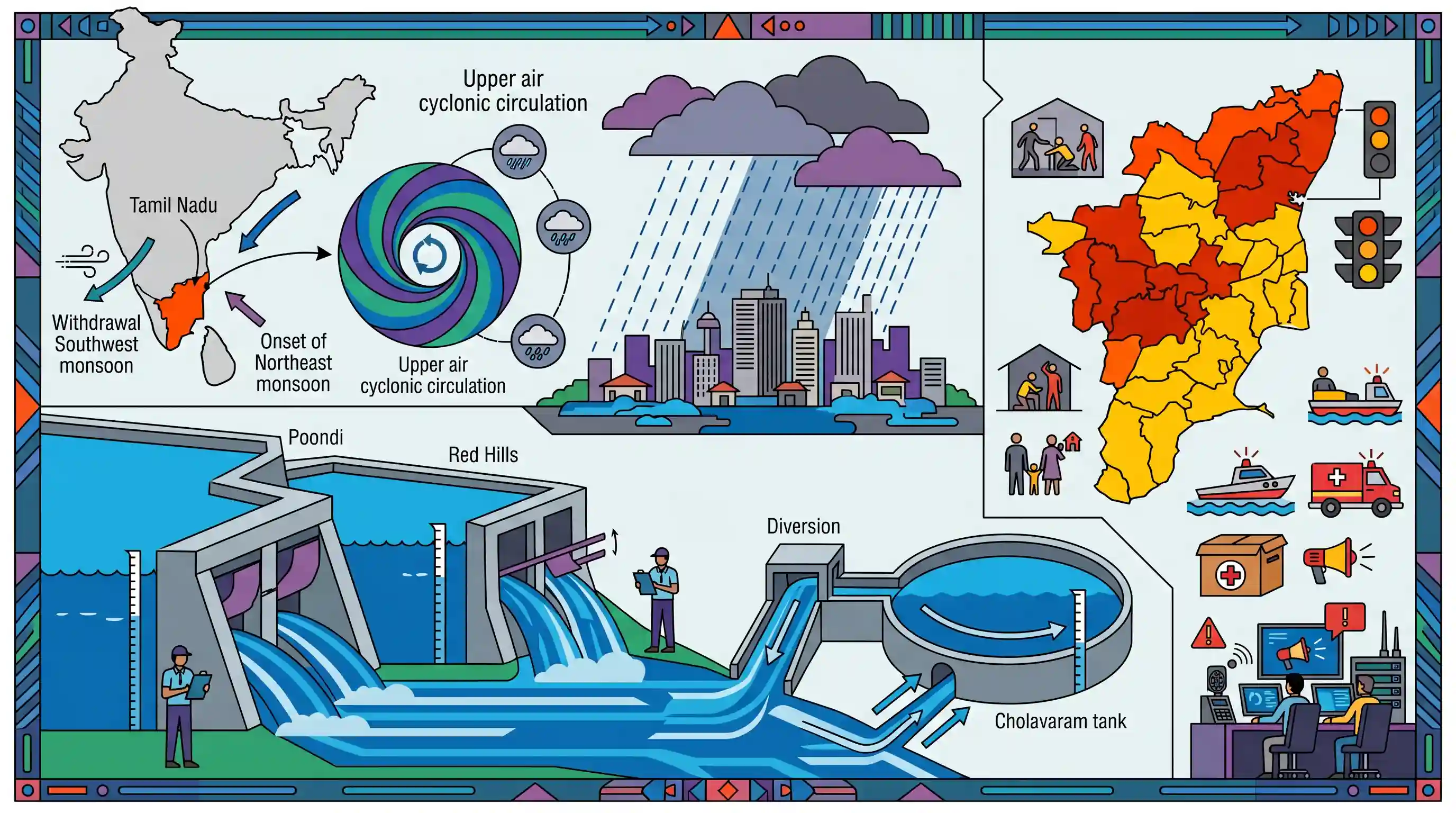
The article serves as a practical example of the transition between the Southwest and Northeast monsoons and the impact of cyclonic circulations. It also provides a vital case study for urban disaster management, demonstrating how IMD's colour-coded warnings and proactive reservoir management are used to mitigate urban flooding and optimize drinking water storage.
Summary
Heavy rainfall has lashed various parts of Tamil Nadu, particularly Chennai and its neighboring districts, ahead of the onset of the Northeast monsoon. The downpour is driven by an upper air cyclonic circulation over the southwest Bay of Bengal, coinciding with the withdrawal of the Southwest monsoon. In response to the heavy rains and to manage reservoir levels efficiently, the Water Resources Department (WRD) initiated controlled water releases from major reservoirs like Poondi and Red Hills into the Kosasthalaiyar river, while diverting portions to the Cholavaram tank to optimize storage. The IMD has issued 'orange' and 'yellow' alerts for several districts to ensure disaster preparedness.
Key Points
- The onset of the Northeast monsoon in Tamil Nadu is preceded by heavy rainfall, influenced by an upper air cyclonic circulation over the southwest Bay of Bengal.
- This weather event coincides with the simultaneous withdrawal of the Southwest monsoon from the Indian subcontinent.
- The India Meteorological Department (IMD) has issued 'orange' and 'yellow' alerts across multiple districts in Tamil Nadu to alert authorities and the public.
- To prevent flooding and ensure optimal water conservation, the Water Resources Department (WRD) strategically released surplus water from the Poondi and Red Hills reservoirs.
- Water from the Poondi reservoir is being diverted into the Cholavaram tank to bolster drinking water storage for Chennai, showcasing integrated urban water management.
Important Terms
India Meteorological Department (IMD)

India's national agency under the Ministry of Earth Sciences responsible for meteorological observations, weather forecasting, and seismology, including issuing cyclone and monsoon alerts.
UPSC context
GS I (Climatology) and GS III (Disaster Management). Tests institutional frameworks for weather monitoring and early warning systems.
Northeast Monsoon (NEM)
A seasonal wind system (October–December) bringing primary rainfall to southeastern India; it gains moisture from the Bay of Bengal during the retreating phase.
UPSC context
GS I (Geography). Essential for understanding regional climatic variations and the agricultural cycle of South India.
Water Resources Department (WRD)
A state-level agency responsible for managing irrigation, surface/groundwater resources, and reservoir operations to ensure water supply and prevent flooding.
UPSC context
GS I (Resources) and GS III (Disaster Management). Focuses on governance in water management and flood mitigation.
Upper Air Cyclonic Circulation
A swirling atmospheric pattern in the upper troposphere (above 1.5 km) that influences cloud formation and drives weather systems like depressions and rainfall.
UPSC context
GS I (Geography). Tests advanced climatology concepts regarding dynamic factors that trigger localized extreme weather events.
Regional Meteorological Centre (RMC)
One of six regional IMD branches (e.g., Chennai) providing specialized regional forecasts, agromet advisories, and disaster warnings for specific state clusters.
UPSC context
GS III (Disaster Management). Relevant for understanding the decentralized early-warning infrastructure and regional coordination in disaster response.
Urban Flooding
The inundation of property in a built-up environment caused by heavy rain exceeding the capacity of drainage systems and impermeable surfaces.
UPSC context
GS III (Disaster Management/Urbanization). Focuses on anthropogenic causes of disasters and the need for resilient urban planning.
Prelims Trap
Tamil Nadu receives precipitation exclusively from the Northeast Monsoon due to the rain-shadow effect.
Aspirants often assume TN gets zero rain from the SW monsoon. While the Northeast monsoon provides the bulk (~48%), the SW monsoon still contributes significantly.
Static Concepts Connected
How does the Northeast (Retreating) Monsoon generate rainfall?
- Wind Reversal: As the ITCZ shifts southwards, winds reverse direction, blowing from land to sea (northeast to southwest) over the subcontinent.
- Moisture Absorption: These northeast winds are dry over land but pick up substantial moisture while crossing the Bay of Bengal.
- Coastal Orography: The moisture-laden winds strike the Eastern Ghats and the Coromandel Coast, causing heavy rainfall in Tamil Nadu and coastal Andhra Pradesh.
What do the IMD's colour-coded weather warnings signify?
- Yellow (Alert): Signifies 'Be Updated'. Indicates severely bad weather spanning several days; advises authorities and public to stay alert.
- Orange (Warning): Signifies 'Be Prepared'. Warns of extremely bad weather with potential for transport disruptions, flooding, and power outages.
- Red (Action): Signifies 'Take Action'. Highest alert for extreme weather posing high risk to life; demands immediate preventive/evacuation measures.
Cross-Topic Patterns
Urban Flooding & Sponge Cities
Dynamic water transfer between Poondi and Cholavaram tanks exemplifies integrated urban water management—a core case study for Mains GS3 urban flooding answers.
ENSO impact on NE Monsoon
UPSC frequently tests the contrast: El Niño typically suppresses India's Southwest monsoon but generally enhances the Northeast monsoon rainfall over Tamil Nadu.

Urban reservoir linkages like Poondi and IMD colour-code definitions are highly probable as a combined 2026 Prelims geography question.
Linked PYQs · 5
Linked PYQs · 5
- 2022MainsGS1
Discuss the meaning of colour-coded weather warnings for cyclone prone areas given by India Meteorological Department.
- 2024MainsGS1
What is sea surface temperature rise? How does it affect the formation of tropical cyclones?
- 2015MainsGS1
How far do you agree that the behaviour of the Indian monsoon has been changing due to humanizing landscapes? Discuss.
- 2024MainsGS3
Flooding in urban areas is an emerging climate-induced disaster. Discuss the causes of this disaster. Mention the features of two such major floods in the last two decades in India. Describe the policies and frameworks in India that aim at tackling such floods.
- 2020MainsGS3
Suggest measures to improve water storage and irrigation system to make its judicious use under depleting scenario.
