Kasaragod Coastal Erosion and Disaster Mitigation Challenges
Source:The Hindu ↗
Why It Matters
This article serves as a critical case study for UPSC aspirants on the intersection of disaster management (coastal erosion) and federal fiscal relations. It highlights the practical challenges states face when disaster mitigation infrastructure needs (like tetrapods) outstrip state fiscal capacity due to a lack of central funding.
Summary
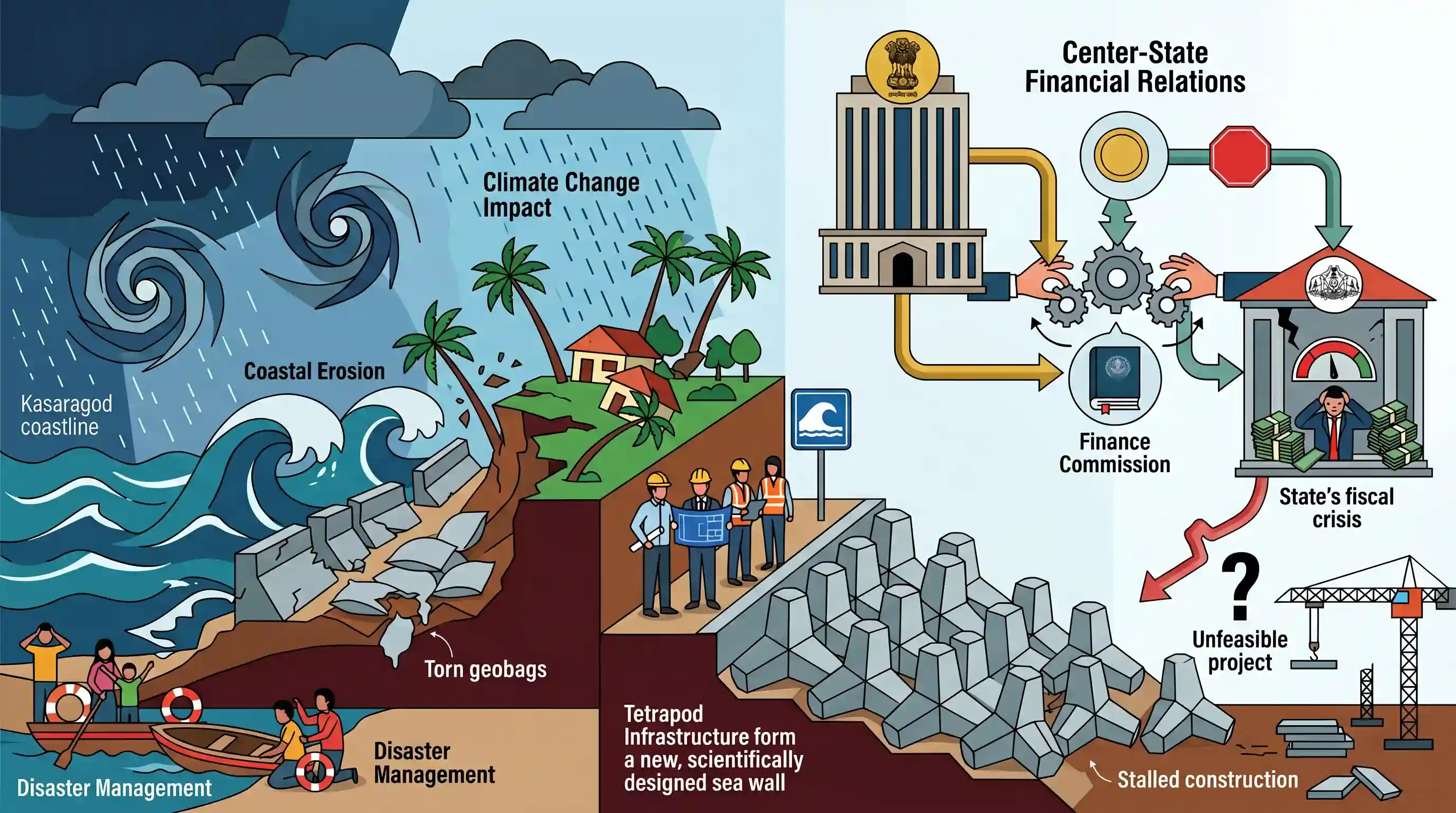
Heavy rain, low-pressure formations, and turbulent sea waves have caused severe coastal erosion along the Kasaragod coast in Kerala, breaching existing sea walls and geobags. The crisis threatens local lives and livelihoods, prompting the Irrigation Department to propose scientifically designed tetrapod sea walls. However, the shift of financial responsibility from the Centre to the State—due to changes in Central Coastal protection schemes under the Finance Commission—has sparked concerns over the feasibility of these infrastructure projects amid the state's fiscal crisis.
Key Points
- Severe sea erosion and heavy rains have devastated an 87.65 km stretch of the Kasaragod coast in Kerala, displacing residents and destroying property.
- Existing coastal protection structures, including unscientifically built sea walls and geobags, have failed to withstand wave surges advancing up to 300 meters inland.
- The Meteorological Department attributes the intensified wave surges to low-pressure formations over the sea.
- The Irrigation Department has proposed constructing scientifically designed tetrapod sea walls to mitigate the erosion.
- The financial burden for coastal protection has shifted to the State government following changes to Central Coastal protection schemes under the Finance Commission, raising concerns about project feasibility amid fiscal constraints.
Important Terms
Finance Commission

A constitutional body (Article 280) that recommends the distribution of tax revenues between the Union and States. The 15th Finance Commission specifically introduced funding for coastal and river erosion mitigation.
UPSC context
Crucial for GS-II (Constitutional Bodies) and GS-III (Fiscal Federalism), testing knowledge of resource allocation and disaster risk financing.
Disaster Management
A statutory framework under the Disaster Management Act, 2005, focusing on a proactive 'prevention-mitigation-response' cycle. It involves a three-tier institutional structure (National, State, and District levels).
UPSC context
A core GS-III topic; candidates must understand institutional roles, the Sendai Framework, and the shift from relief-centric to mitigation-centric approaches.
Central Coastal protection schemes
Primarily the 'Flood Management and Border Areas Programme' (FMBAP), a Centrally Sponsored Scheme providing financial assistance to states for flood control, drainage, and anti-sea erosion works.
UPSC context
Relevant for GS-III (Environment and Infrastructure) and Government Schemes, focusing on Center-State cost-sharing models for environmental resilience.
Local Self-Governments
Institutions of grassroots democracy established by the 73rd (Panchayati Raj) and 74th (Municipalities) Constitutional Amendment Acts, responsible for local service delivery and community-level disaster preparedness.
UPSC context
Fundamental to GS-II (Polity), testing decentralization, devolution of powers, and the principle of subsidiarity in governance.
District Collector
The administrative head of a district and ex-officio Chairperson of the District Disaster Management Authority (DDMA), serving as the frontline coordinator for crisis response and relief.
UPSC context
Significant for GS-II (Governance) and Ethics (Case Studies), highlighting the administrative pivot between state policy and field-level implementation.
Meteorological department
The India Meteorological Department (IMD), under the Ministry of Earth Sciences, which provides weather forecasts and early warnings for cyclones, heavy rain, and other climate-related hazards.
UPSC context
Key for GS-I (Geography) and GS-III (Science & Technology), focusing on early warning systems and technological interventions in disaster management.
Irrigation department
A state-level agency responsible for managing water resources, constructing flood-control infrastructure like sea walls, and implementing technical solutions for coastal erosion.
UPSC context
Pertains to GS-II (State Administration) and GS-III (Infrastructure), reflecting the state's functional responsibility for land and water management.
Prelims Trap
"Coastal erosion infrastructure projects are fully funded by the Centre under the National Disaster Response Fund (NDRF)."
The 15th FC earmarked funds for resettling erosion-displaced populations under NDMF/SDMF, but it shifted the primary burden for heavy coastal protection infrastructure to States.
Static Concepts Connected
What is the difference between hard and soft coastal engineering?
- Hard Engineering: Uses artificial, permanent structures like tetrapods, sea walls, and groynes to absorb wave energy. It is highly durable but can disrupt natural sediment transport.
- Soft Engineering: Uses natural or adaptable methods like geobags, mangrove planting, and beach nourishment. It is ecologically friendly but less resilient against extreme wave surges.
How did the 15th Finance Commission alter disaster funding for coastal erosion?
- Mitigation Funds: Mandated the operationalization of National and State Disaster Mitigation Funds (NDMF/SDMF) to build local-level climate resilience, rather than just response.
- Resettlement Focus: Earmarked specific funds under the disaster management architecture exclusively for resettling communities displaced by coastal erosion and river shifting.
- Infrastructure Burden: Shifted the primary financial and implementation burden of constructing large-scale coastal protection infrastructure to state governments.
Cross-Topic Patterns
Climate impacts on Centre-State fiscal ties
Increased Arabian Sea cyclogenesis stresses coastal states' finances, exacerbating tensions over the devolution of disaster mitigation funds and state borrowing limits under the FRBM Act.
Coastal infrastructure vs. CRZ norms
Deploying heavy engineering like tetrapods must align with Shoreline Management Plans under Coastal Regulation Zone (CRZ) rules to prevent exacerbating erosion in adjacent zones via littoral drift disruption.

Expect a 2026 prelims multi-statement question combining NCCR shoreline vulnerability data with 15th Finance Commission NDMF/SDMF rules.
Linked PYQs · 3
Linked PYQs · 3
- 2022MainsGS3
Explain the causes and effects of coastal erosion in India. What are the available coastal management techniques for combating the hazard?
- 2025MainsGS1
How are climate change and the sea level rise affecting the very existence of many island nations? Discuss with examples.
- 2021MainsGS2
How have the recommendations of the 14th Finance Commission of India enabled the States to improve their fiscal position?
