Jammu and Kashmir Floods and Landslides Claim Twelve Lives
Source:The Hindu ↗
Why It Matters
This incident serves as a practical case study for GS3 Disaster Management, illustrating the combined challenges of hydro-meteorological hazards (flash floods) and geophysical hazards (landslides) in vulnerable Himalayan topographies. It also highlights the operational reality of multi-agency rescue efforts and the financial mechanisms (SDRF under the Disaster Management Act, 2005) used for victim compensation.
Summary
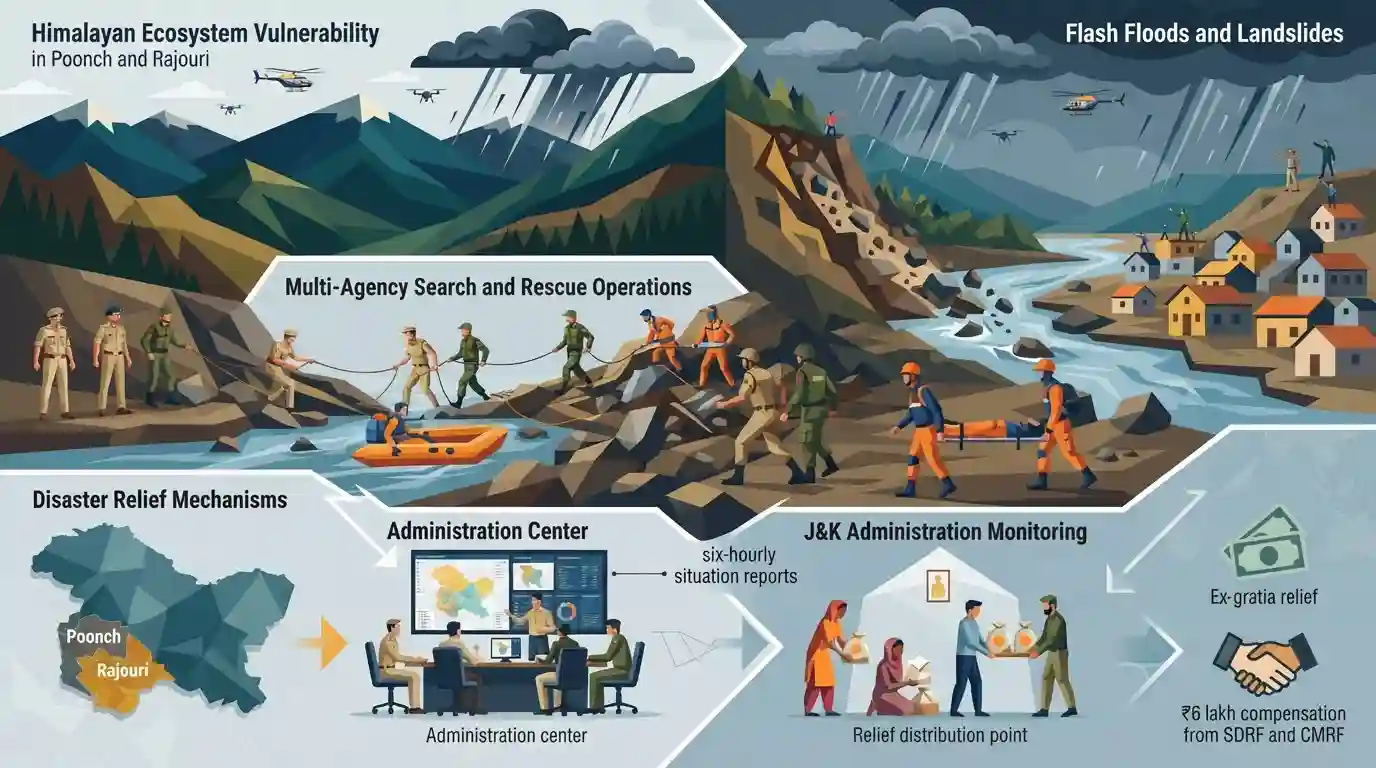
Torrential rains in Jammu and Kashmir's Poonch and Rajouri districts have caused devastating flash floods and landslides, claiming 12 lives. Multi-agency search and rescue operations, involving the Army, SDRF, Police, and Civil Defence, are underway but face significant challenges due to ongoing rainfall, slippery terrain, and swollen water bodies. The J&K administration has stepped up monitoring, with Chief Minister Omar Abdullah mandating six-hourly situation reports and announcing an ex-gratia relief of ₹6 lakh (₹4 lakh from SDRF and ₹2 lakh from CMRF) for the families of the victims. The event underscores the acute vulnerability of the Himalayan region to extreme weather events.
Key Points
- Heavy downpours in Jammu and Kashmir's Poonch and Rajouri districts triggered severe flash floods and landslides, resulting in 12 fatalities.
- Rescue operations are being jointly conducted by the Police, Army, SDRF, and Civil Defence, but are hampered by continuous rain, swollen streams, and poor visibility.
- J&K Chief Minister Omar Abdullah mandated six-hourly situation reports to ensure proactive administrative monitoring of the disaster.
- An ex gratia relief of ₹6 lakh was announced for the next of kin of the deceased, comprising ₹4 lakh from the SDRF and ₹2 lakh from the CMRF.
- The Meteorological Department has forecast continued moderate to heavy rainfall, prompting advisories for citizens to avoid water bodies.
Important Terms
State Disaster Response Fund (SDRF)

The primary financial reserve constituted under Section 48(1)(a) of the Disaster Management Act, 2005, enabling state governments to provide immediate relief to victims of notified disasters.
UPSC context
GS Paper 3: Disaster Management; tests funding mechanisms, Centre-State financial relations, and disaster response.
India Meteorological Department (IMD)
The principal government agency under the Ministry of Earth Sciences responsible for meteorological observations, weather forecasting, and seismology.
UPSC context
GS Paper 1: Geography and GS Paper 3: Disaster Management; tests climate monitoring and early warning systems.
Civil Defence
A volunteer-based program under the Civil Defence Act, 1968, tasked with protecting citizens, property, and infrastructure from hostile attacks and managing natural or man-made disasters.
UPSC context
GS Paper 3: Internal Security and Disaster Management; tests local administration support, preparedness, and security roles.
Chief Minister's Relief Fund (CMRF)
A state-level public trust fund used at the Chief Minister's discretion to provide immediate financial assistance to distress-affected persons, disaster victims, and for medical treatments.
UPSC context
GS Paper 2: Governance; tests welfare schemes, state-level discretionary relief funds, and emergency administrative powers.
Prelims Trap
States have complete autonomy to utilize up to 50% of their SDRF allocation for any localized disaster not listed by the Centre.
Under Ministry of Home Affairs (MHA) guidelines, states can utilize a maximum of 10% (not 50%) of their annual SDRF allocation for local, state-specific disasters that are not on the central notified list.
Static Concepts Connected
What is the structural and financial framework of the State Disaster Response Fund (SDRF)?
- Statutory & Account Location: Constituted under Section 48(1)(a) of the Disaster Management Act, 2005; it is audit-wise located in the 'Public Account' of the State.
- Funding Split: The Centre contributes 75% for General Category states and 90% for Special Category states/UTs (Himalayan, NE states, and J&K).
- Local Flexibility: States can use up to 10% of their annual allocation to provide immediate relief for locally declared disasters not on the MHA's national list.
What is the National Landslide Susceptibility Mapping (NLSM) program?
- Nodal Agency: A national initiative launched by the Geological Survey of India (GSI) to map landslide-prone regions across India.
- Target Area: Covers approximately 0.42 million sq km (about 12.6% of India's land area) highly prone to landslides, mostly in the Himalayas and Western Ghats.
- Objective: To generate macro-scale (1:50,000) landslide susceptibility maps and create a dynamic national GIS-based landslide inventory database.
Cross-Topic Patterns
Himalayan Development vs Ecological Stability
Unregulated construction and tourism expansion in fragile Himalayan terrains like J&K directly trigger catastrophic landslides, highlighting the conflict between developmental goals and environmental conservation.
Fiscal Federalism and Disaster Mitigation Funds
The 15th Finance Commission revamped disaster financing by splitting allocations into Response (SDRF/NDRF) and Mitigation (SDMF/NDMF) funds, emphasizing a structural shift from relief to prevention.

Prelims 2026 may test the exact statutory location of SDRF/NDRF in Public Accounts and the 10% ceiling limit for state-notified disasters.
Linked PYQs · 4
Linked PYQs · 4
- 2021MainsGS3
Describe the various causes and the effects of landslides. Mention the important components of the National Landslide Risk Management Strategy.
- 2019MainsGS3
Disaster preparedness is the first step in any disaster management process. Explain how hazard zonation mapping will help disaster mitigation in the case of landslides.
- 2024MainsGS3
Flooding in urban areas is an emerging climate-induced disaster. Discuss the causes of this disaster. Mention the features of two such major floods in the last two decades in India. Describe the policies and frameworks in India that aim at tackling such floods.
- 2024MainsGS3
What is disaster resilience? How is it determined? Describe various elements of a resilience framework. Also mention the global targets of Sendai Framework for Disaster Risk Reduction (2015–2030).
