Heatwave Impact on India Power Demand and Fossil Fuel Reliance
Source:The Hindu ↗
Why It Matters
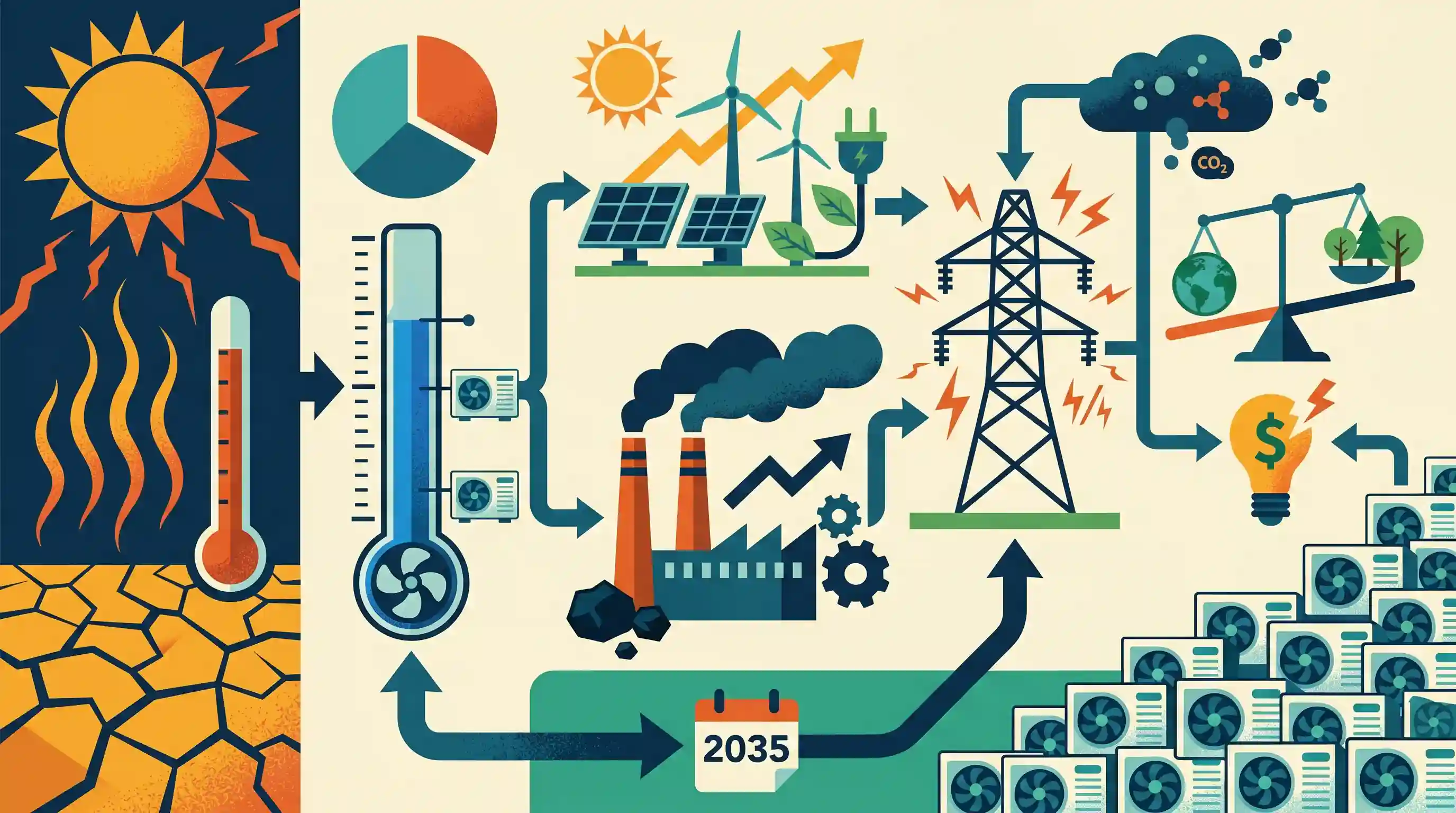
It illustrates the dangerous feedback loop of climate change: global warming leads to intense heatwaves, which drastically increase energy demand for cooling, often met by coal-fired plants, thereby causing more greenhouse gas emissions. This is highly relevant for questions on India's energy transition, climate vulnerability, and grid stability.
Summary
According to the "Global Electricity Review" by Ember, severe heatwaves during the summer of 2024 drove nearly a third of the 10.4% rise in India's power demand. This surge was primarily fueled by an increased need for cooling, particularly air conditioning. Although clean energy sources saw significant growth, coal-based generation still had to increase by 6.4% to meet the peak demand. The growing share of household electricity consumption and the projected addition of up to 150 million new air conditioners by 2035 pose significant challenges to India's energy transition, power grid infrastructure, and climate mitigation goals as extreme heat events become more frequent.
Key Points
- Heatwaves during April-June 2024 were responsible for about one-third of the 10.4% increase in India's power demand compared to the previous year.
- The spike in electricity demand was largely driven by the use of air conditioners and cooling appliances to combat extreme temperatures.
- While clean energy generation rose by 33%, the base load was met by coal, whose generation increased by 6.4%, underscoring a continued reliance on fossil fuels.
- India is projected to add 130-150 million new room ACs over the next decade, which could push peak power demand by over 180 GW by 2035.
- Climate change threatens to increase the frequency of heatwaves globally, creating a feedback loop where rising cooling demand increases fossil fuel emissions.
Important Terms
Ember

A global independent energy think tank that uses data-driven research to accelerate the transition from coal to clean electricity. It produces the influential "Global Electricity Review."
UPSC context
GS Paper III (Energy/Environment); relevant for tracking India's decarbonization progress and global power sector emissions trends.
India Meteorological Department (IMD)
India's principal agency for meteorological observations and weather forecasting. It establishes the official scientific criteria for declaring heatwaves based on regional temperature thresholds and departures from normal.
UPSC context
GS Paper I (Geography) and GS Paper III (Disaster Management); tests understanding of domestic climate monitoring and extreme weather protocols.
International Energy Agency (IEA)
An autonomous intergovernmental organization that provides authoritative energy data and policy analysis. It projects that India’s cooling demand will drive massive future electricity consumption.
UPSC context
GS Paper II (International Institutions) and GS Paper III (Energy); tests knowledge of global energy governance and India's energy security outlook.
Energy Transition
The strategic shift of the global energy sector from fossil-based systems (coal, oil, gas) to zero-carbon energy sources like solar, wind, and green hydrogen to mitigate climate change.
UPSC context
GS Paper III (Economic Development & Environment); a core theme for questions on Net Zero targets and renewable energy infrastructure.
Heatwave (IMD Criteria)
A period of abnormally high temperatures. The IMD declares a heatwave when a station's maximum temperature reaches 40°C (Plains) or 30°C (Hills), with a departure from normal of 4.5°C–6.4°C.
UPSC context
GS Paper I (Physical Geography); essential for explaining the increasing frequency of extreme weather events in India.
Oxford India Centre for Sustainable Development (OICSD)
A multidisciplinary research hub at Somerville College, Oxford, focusing on India's sustainable development. It bridges academic research and policy on climate, energy, and water management.
UPSC context
GS Paper II (International Relations/Education); highlights the role of global academic partnerships in addressing India's developmental challenges.
Prelims Trap
"Surging summer peak electricity demand in India is now primarily met by the rapid expansion of solar and wind energy."
While clean energy is growing fast, India's grid still heavily relies on coal to manage peak baseload demands during extreme weather events.
Static Concepts Connected
What are the core targets of the India Cooling Action Plan (ICAP)?
- Demand reduction: Reduce overall cooling demand across sectors by 20% to 25% by 2037-38.
- Energy reduction: Reduce cooling energy requirements by 25% to 40% by 2037-38.
- Refrigerant reduction: Reduce refrigerant demand by 25% to 30% by 2037-38.
- Skill development: Train and certify 100,000 servicing sector technicians to ensure efficient deployment.
What is the 'duck curve' challenge in renewable energy grid management?
- Solar peak: High solar power generation during midday drops net demand from conventional baseload sources to its lowest.
- Evening spike: As the sun sets, solar generation vanishes precisely when residential power demand (like ACs) sharply peaks.
- Ramp-up necessity: Grid operators must rapidly ramp up flexible conventional power plants (often fossil fuels) to prevent blackouts.
Cross-Topic Patterns
ICAP + Kigali Amendment HFC phase-down
The projected addition of 150 million ACs forces India to balance immediate extreme-heat adaptation with its Kigali Amendment obligations to phase down potent greenhouse gases like hydrofluorocarbons (HFCs).
Climate Adaptation vs Mitigation Paradox
The 'heat-power trap' highlights a textbook adaptation-mitigation conflict: adapting to extreme heat via ACs surges coal-reliant power demand, accelerating the very emissions causing the heatwaves.

The 'heat-power trap' paradox and ICAP targets are ripe for a 2026 Mains question linking climate adaptation directly to energy security.
Linked PYQs · 4
Linked PYQs · 4
- 2022MainsGS3
Do you think India will meet 50 percent of its energy needs from renewable energy by 2030 ? Justify your answer. How will the shift of subsidies from fossil fuels to renewables help achieve the above objective ? Explain.
- 2020PrelimsGS1
Consider the following statements: 1. Coal ash contains arsenic, lead and mercury. 2. Coal-fired power plants release sulphur dioxide and oxides of nitrogen into the environment. 3. High ash content is observed in Indian coal. Which of the statements given above is/are correct?
- 2023MainsGS1
Discuss the consequences of climate change on the food security in tropical countries.
- 2025PrelimsGS1
Consider the following statements : I. Carbon dioxide (CO2) emissions in India are less than 0.5 t CO2/ capita. II. In terms of CO2 emissions from fuel combustion, India ranks second in Asia-Pacific region. III. Electricity and heat producers are the largest sources of CO2 emissions in India. Which of the statements given above is/are correct?
