Combined impact of heatwaves and surface ozone on cardiac health
Source:The Hindu ↗
Why It Matters
This article bridges the gap between environmental chemistry (formation of secondary pollutants like ground-level ozone), public health (cardiac and COPD mortalities), and governance (disaster management funding mechanisms). It is highly relevant for GS-3 (Environment, Disaster Management) and GS-1 (Geography - atmospheric phenomena).
Summary
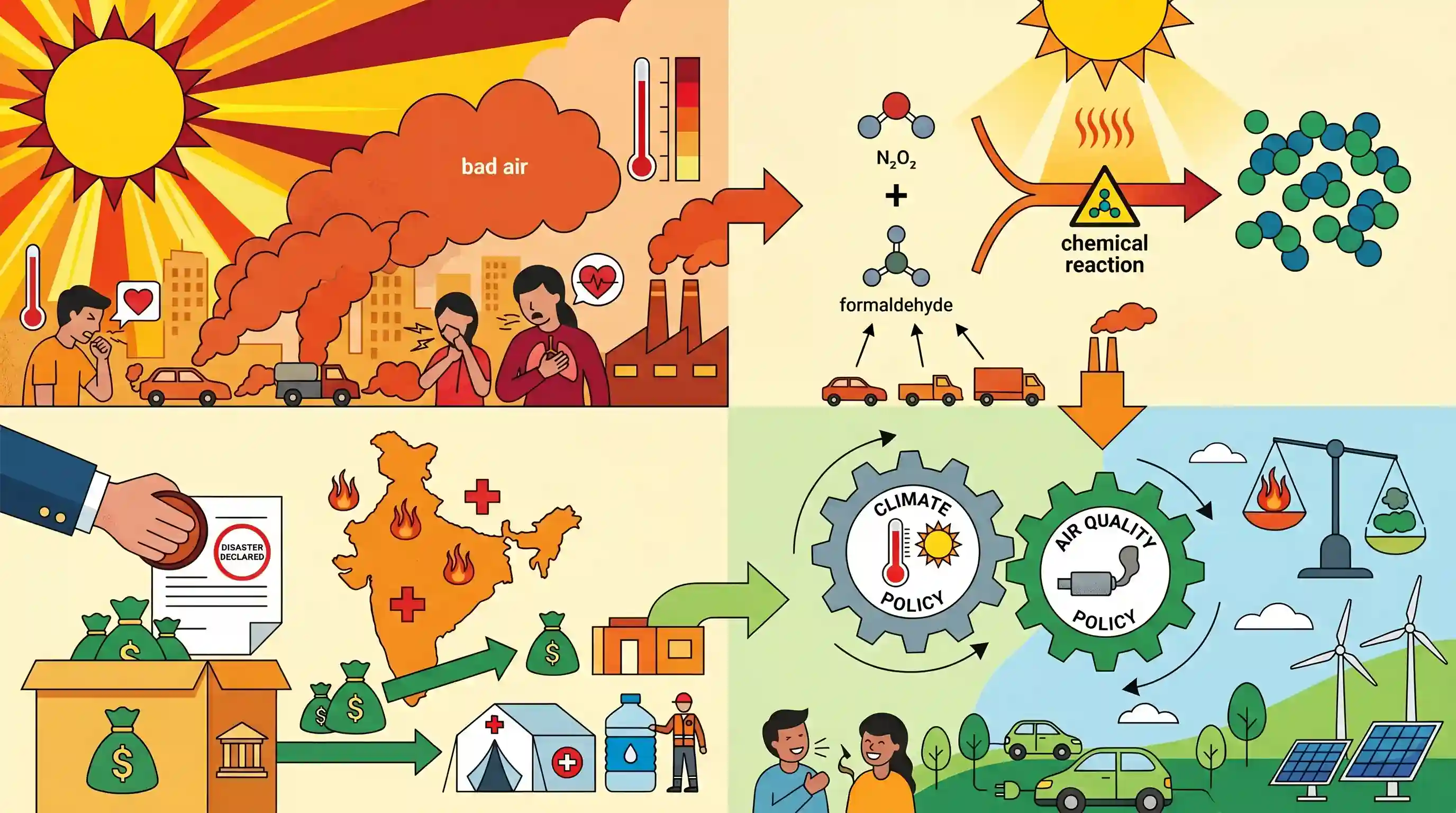
A recent study reveals a deadly synergy between heatwaves and surface ozone pollution in India, leading to a rise in cardiovascular and respiratory deaths. During heatwaves, high temperatures and sunlight accelerate the photochemical reactions among precursor pollutants (like nitrogen dioxide and formaldehyde) to create dangerous levels of surface ozone, often exceeding WHO guidelines. The crisis has prompted the 16th Finance Commission to recommend classifying heatwaves as a nationally notified disaster to release State Disaster Response Fund (SDRF) resources. The findings emphasize the need for combined climate and air quality policies, addressing both extreme heat and precursor emissions.
Key Points
- A peer-reviewed study published in 'npj Clean Air' found that the combination of heatwaves and elevated surface ozone has significantly increased deaths from ischaemic heart disease and COPD in India.
- During recent heatwaves, surface ozone levels in northern India reached 85-110 μg/m³, well above the WHO safe limit of 70 μg/m³.
- Surface ozone is a secondary pollutant that forms via a photochemical reaction when sunlight acts on pollutants like nitrogen dioxide (NO2) and formaldehyde (HCHO). Heatwaves accelerate this reaction.
- The Western Himalayas region has recorded the steepest long-term rise in ozone levels, highlighting geographical vulnerabilities.
- In November 2025, the 16th Finance Commission recommended adding heatwaves and lightning to India’s list of nationally notified disasters, allowing states to deploy the State Disaster Response Fund (SDRF) for relief operations.
Important Terms
Surface Ozone

A secondary air pollutant formed when nitrogen oxides (NOx) and volatile organic compounds (VOCs) react chemically in the presence of sunlight.
UPSC context
GS Paper III (Environment); focuses on photochemical smog, health impacts, and the distinction between tropospheric and stratospheric ozone.
16th Finance Commission
A constitutional body (Article 280) chaired by Arvind Panagariya, tasked with recommending the tax-sharing formula and disaster management grants for the 2026-2031 period.
UPSC context
GS Paper II (Polity) and Paper III (Economy/Disaster Management); tests knowledge of fiscal federalism and statutory resource allocation.
State Disaster Response Fund (SDRF)
The primary statutory fund available to states under the Disaster Management Act, 2005, for providing immediate relief during disasters officially notified by the Union Government.
UPSC context
GS Paper III (Disaster Management); tests understanding of institutional funding mechanisms and Centre-State cost-sharing ratios (75:25 or 90:10).
Nationally Notified Disaster
Calamities officially recognized under the Disaster Management Act (e.g., floods, cyclones) that qualify for predictable, formula-based relief funding from the SDRF and NDRF.
UPSC context
GS Paper III (Disaster Management); critical for understanding legal frameworks and the ongoing policy debate to include heatwaves in this list.
WHO Air Quality Guidelines
Evidence-based thresholds for key air pollutants (like PM2.5 and ozone) updated in 2021 to provide global benchmarks for protecting public health.
UPSC context
GS Paper III (Environment/Health); used as a standard to evaluate India's National Clean Air Programme (NCAP) and urban pollution levels.
Heatwave
A period of abnormally high temperatures, defined by the IMD when maximum temperatures reach 40°C in plains or 30°C in hilly regions with specific deviations from normal.
UPSC context
GS Paper I (Geography) and Paper III (Environment); involves climate change impacts, thermal stress, and administrative criteria for disaster declaration.
Prelims Trap
Surface ozone is a primary pollutant directly emitted by industrial and vehicular exhausts during heatwaves.
Surface (tropospheric) ozone is a secondary pollutant. It is never emitted directly but forms when precursor gases (NOx and VOCs) react in the presence of sunlight and heat.
Static Concepts Connected
How is surface (tropospheric) ozone formed and why does it spike?
- Secondary pollutant: It is not emitted directly but forms via photochemical reactions between nitrogen oxides (NOx) and volatile organic compounds (VOCs).
- Heatwave catalyst: Intense sunlight and high temperatures accelerate these photochemical reactions, making heatwaves a critical driver of dangerous surface ozone spikes.
- Health & Agri impact: High tropospheric ozone exacerbates respiratory illnesses (like COPD) and cardiovascular diseases, and also significantly damages crop yields.
How does "notified disaster" status impact State Disaster Response Fund (SDRF) utilization?
- Previous 10% cap: Before the 16th FC's recommendation, heatwaves were classified as 'local disasters', restricting states to using only up to 10% of their SDRF.
- Full fund access: Central notification under the DMA 2005 allows states full access to their SDRF and potential NDRF support for mitigation and relief operations.
- SDRF mechanism: The SDRF is the primary fund available with state governments, typically funded 75:25 by the Centre and general category states.
Cross-Topic Patterns
Climate change as a public health crisis
The deadly synergy between heatwaves and ozone pollution shifts climate change from an environmental issue to a core public health emergency, aligning with 'One Health' approaches.
Ozone surges in Himalayan ecosystems
Rising ozone levels in the Western Himalayas connect tropospheric pollution with rapid glacial melt, altitudinal warming, and the region's broader ecological vulnerability.

Expect a 2026 prelims question linking secondary pollutant formation (tropospheric O3) with heatwaves and the 16th FC's disaster norms.
Linked PYQs · 4
Linked PYQs · 4
- 2022PrelimsGS1
In the context of WHO Air Quality Guidelines, consider the following statements: 1. The 24-hour mean of PM2.5 should not exceed 15 µg/m³ and annual mean of PM2.5 should not exceed 5 µg/m³. 2. In a year, the highest levels of ozone pollution occur during the periods of inclement weather. 3. PM10 can penetrate the lung barrier and enter the bloodstream. 4. Excessive ozone in the air can trigger asthma. Which of the statements given above are correct?
- 2013PrelimsGS1
Photochemical smog is a resultant of the reaction among
- 2020MainsGS3
Discuss the recent measures initiated in disaster management by the Government of India departing from the earlier reactive approach.
- 2023MainsGS1
Discuss the consequences of climate change on the food security in tropical countries.
