IMD Heatwave Norms And El Nino Impact On Indian Weather
Source:Indian Express ↗
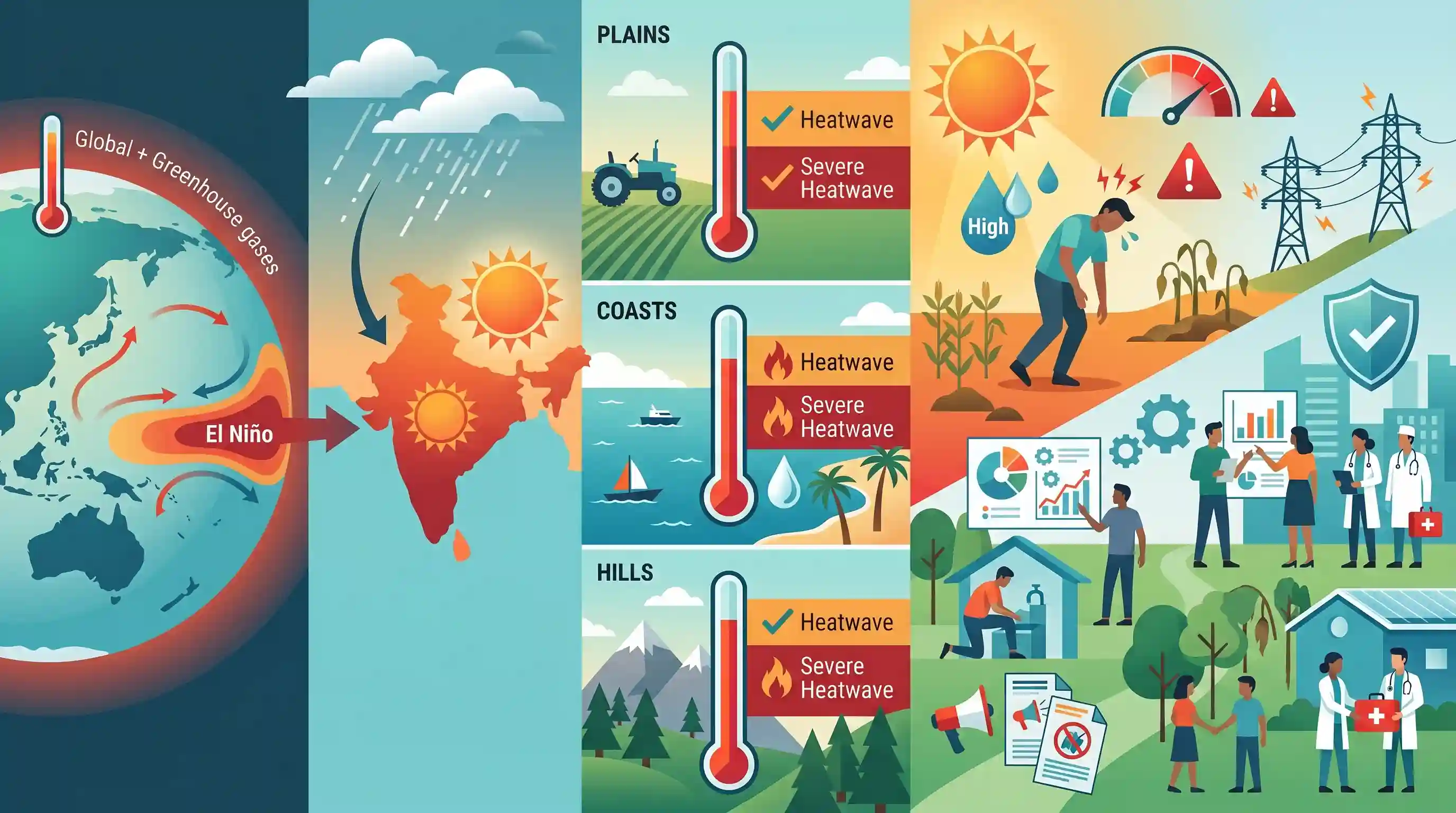
Why It Matters
Heatwaves are becoming India's most pressing recurring natural hazard. Understanding the technical IMD thresholds for extreme heat is highly relevant for Prelims, while analyzing the interplay between global oceanic phenomena (El Niño) and local weather extremes is critical for Mains Geography and Disaster Management.
Summary
The article breaks down the rising frequency and intensity of heatwaves in India, identifying key drivers like global climate change and the El Niño phenomenon. It outlines the specific thresholds used by the India Meteorological Department (IMD) to officially declare heatwaves and severe heatwaves across plains, coastal, and hilly regions. With extreme heat increasingly intersecting with high humidity to breach critical physiological limits (wet-bulb temperatures), the piece underscores the urgent need for robust Heat Action Plans and climate adaptation measures to protect public health and the economy.
Key Points
- IMD declares a heatwave when the maximum temperature reaches at least 40°C in plains, 37°C in coastal areas, and 30°C in hilly regions.
- A standard heatwave involves a departure of 4.5°C to 6.4°C from normal temperatures, whereas a severe heatwave requires a departure >6.4°C or an absolute maximum ≥ 47°C in plains.
- The El Niño phenomenon (warming of the equatorial Pacific) suppresses Indian monsoon rainfall, leading to hotter, more prolonged summer heatwaves.
- Extreme heat combined with high humidity (high wet-bulb temperatures) poses critical threats to human survival by limiting perspiration, while also depressing agricultural yields and labor productivity.
Important Terms
Heatwave

A period of abnormally high temperatures. Criteria: Plains ≥40°C, Coastal ≥37°C, Hills ≥30°C. Defined by a departure of 4.5°C to 6.4°C from the normal maximum.
UPSC context
GS Paper 1 (Climatology) and GS Paper 3 (Disaster Management); essential for understanding climate-induced extreme weather events.
Heat Action Plans (HAPs)
Localized policy tools outlining preparedness and response measures (early warnings, public awareness, healthcare readiness) to mitigate heat-related health risks and fatalities.
UPSC context
GS Paper 3 (Disaster Management); tests knowledge of institutional frameworks for climate adaptation and urban resilience.
Wet-bulb Temperature
A metric combining air temperature and humidity. It represents the lowest temperature a surface can reach via evaporation; 35°C is considered the limit for human survival.
UPSC context
GS Paper 3 (Environment); critical for analyzing the physiological impacts of climate change in humid tropical regions like India.
El Niño
The occasional warming of equatorial Pacific waters that disrupts global weather patterns, typically resulting in weaker monsoons and more frequent, intense heatwaves in India.
UPSC context
GS Paper 1 (World Physical Geography); fundamental to understanding the Indian Monsoon's variability and atmospheric circulation.
India Meteorological Department (IMD)
India's principal agency for meteorological observations and weather forecasting. It sets the official criteria and color-coded alerts (Yellow, Orange, Red) for heatwaves.
UPSC context
GS Paper 1 (Geography); responsible for monitoring weather phenomena affecting agriculture and disaster preparedness.
National Disaster Management Authority (NDMA)
The apex body for disaster management in India, headed by the Prime Minister. It issues national guidelines for managing heatwaves under the Disaster Management Act, 2005.
UPSC context
GS Paper 3 (Disaster Management); central to the governance and administrative response to natural and man-made disasters.
Prelims Trap
IMD declares a heatwave whenever maximum temperature crosses 40°C uniformly across all regions of India.
The 40°C threshold applies only to the plains. Coastal areas have a 37°C threshold, and hilly regions use 30°C. Departure from normal is also required to declare a standard heatwave.
Static Concepts Connected
What is the difference between Dry-bulb and Wet-bulb temperatures?
- Dry-bulb Temp: Measures ambient air temperature freely without factoring in atmospheric moisture (this is what standard thermometers display).
- Wet-bulb Temp: Accounts for both heat and humidity; it reflects the lowest temperature achievable solely through evaporative cooling.
- Physiological Limit: When wet-bulb approaches 35°C, human sweat cannot evaporate, leading to fatal heatstroke even in healthy, resting adults in the shade.
How does the El Niño phenomenon suppress the Indian Summer Monsoon?
- Pacific Warming: Abnormal warming of the central and eastern equatorial Pacific Ocean causes the atmospheric Walker Circulation to shift eastward.
- Pressure Shift: This shift creates higher atmospheric pressure over the western Pacific and the Indian Ocean, weakening the prevailing monsoon winds.
- Subsiding Air: Descending (subsiding) air over the Indian subcontinent restricts cloud formation, causing dry conditions and intensifying pre-monsoon heatwaves.
Cross-Topic Patterns
Heat Action Plans & NDMA Framework
Heatwaves are not legally notified as a "national disaster" under the Disaster Management Act. This means State Disaster Response Funds (SDRF) cannot directly compensate heatwave victims, highlighting a critical policy gap.
Terminal Heat Stress on Rabi Crops
High temperatures during the grain-filling stage of wheat cause severe yield losses, directly linking El Niño-driven heat anomalies to domestic food inflation and sudden agricultural export bans.

Expect a multi-statement question pairing IMD's region-specific heatwave thresholds with the physiological limits of wet-bulb temperatures.
Linked PYQs · 4
Linked PYQs · 4
- 2025PrelimsGS1
The World Bank warned that India could become one of the first places where wet-bulb temperatures routinely exceed 35 °C. Which of the following statements best reflect(s) the implication of the above-said report? I. Peninsular India will most likely suffer from flooding, tropical cyclones and droughts. II. The survival of animals including humans will be affected as shedding of their body heat through perspiration becomes difficult. Select the correct answer using the code given below.
- 2014MainsGS3
Drought has been recognized as a disaster in view of its spatial expanse, temporal duration, slow onset and lasting effects on vulnerable sections. With a focus on the September 2010 guidelines from the National Disaster Management Authority (NDMA), discuss the mechanisms for preparedness to deal with likely El Niño and La Niña fallouts in India.
- 2011PrelimsGS1
La Nina is suspected to have caused recent floods in Australia. How is La Nina different from El Nino? 1. La Nina is characterised by unusually cold ocean temperature in equatorial Indian Ocean whereas El Nino is characterised by unusually warm ocean temperature in the equatorial Pacific Ocean. 2. El Nino has adverse effect on south-west monsoon of India, but La Nina has no effect on monsoon climate. Which of the statements given above is/are correct?
- 2017PrelimsGS1
With reference to 'Indian Ocean Dipole (IOD)' sometimes mentioned in the news while forecasting Indian monsoon, which of the following statements is/are correct? 1. IOD phenomenon is characterised by a difference in sea surface temperature between tropical Western Indian Ocean and tropical Eastern Pacific Ocean. 2. An IOD phenomenon can influence an El Nino's impact on the monsoon. Select the correct answer using the code given below:
