European Heatwaves and Climate Resilient Public Healthcare
Source:The Hindu ↗
Why It Matters
The intersection of climate change and public health is a critical emerging topic for UPSC. Heatwaves are becoming frequent disasters globally and in India, requiring multi-sectoral disaster management strategies, including building climate-resilient healthcare infrastructure and raising public awareness about heat-related illnesses.
Summary
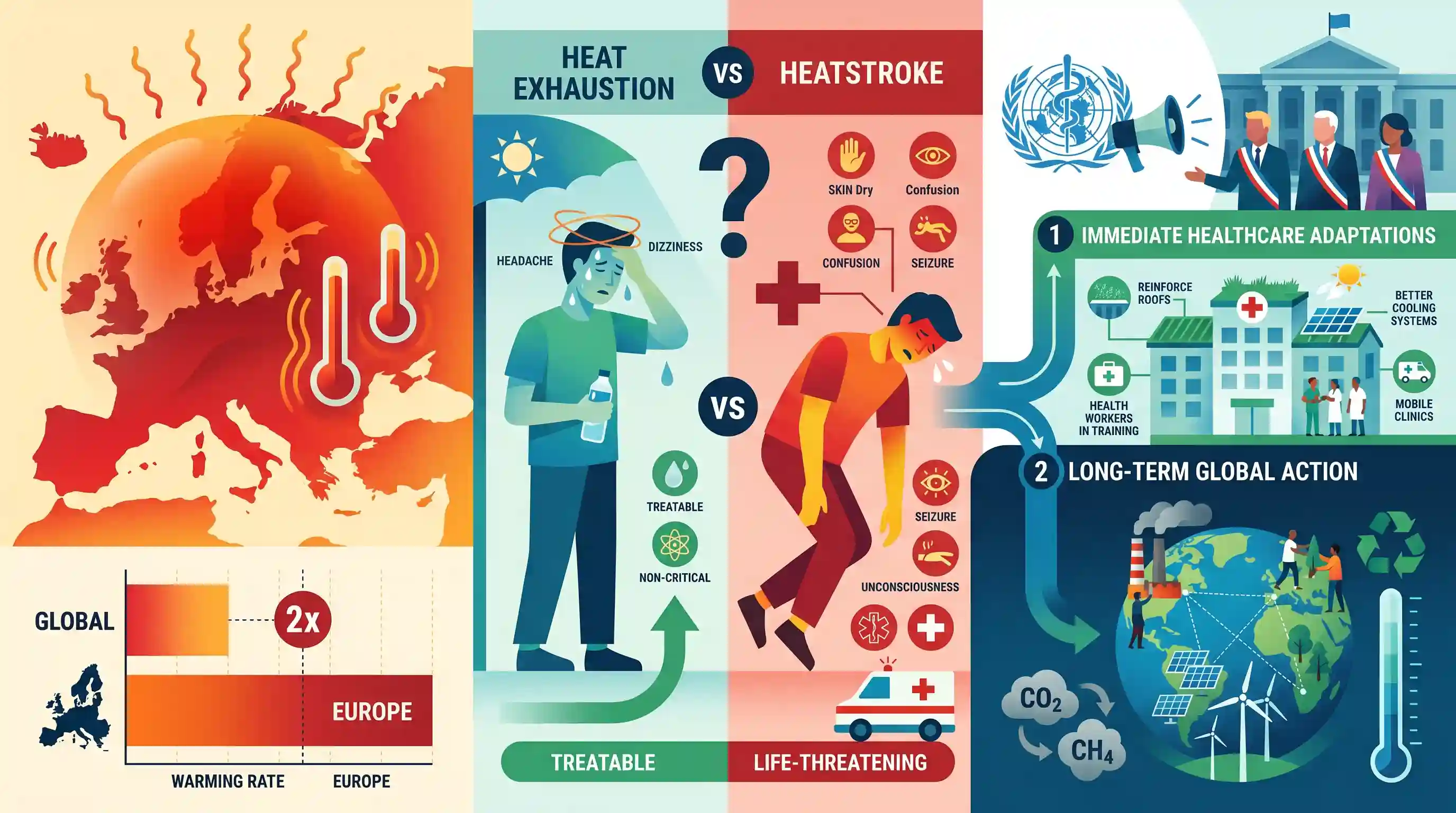
As Europe faces severe and deadly heatwaves, the World Health Organization (WHO) has called on European leaders to adapt their healthcare systems to become more climate-resilient. Noting that Europe is warming at roughly twice the global average rate, the WHO underscored the health dangers posed by extreme heat, distinguishing between treatable heat exhaustion and life-threatening heatstroke. The agency emphasized that alongside immediate healthcare adaptations, long-term global action is required to drastically reduce greenhouse gas emissions and combat the underlying driver of such extreme weather events.
Key Points
- The WHO Director-General urged European countries to build climate-resilient healthcare systems to cope with intensifying heatwaves.
- Europe is experiencing extreme heat (such as the Cerberus heatwave), with temperatures rising at approximately twice the global average rate.
- The WHO emphasized the need to distinguish between heat exhaustion, which can be managed with cooling and hydration, and heatstroke, which is a life-threatening medical emergency.
- Beyond immediate adaptation, the WHO stressed the critical necessity of reducing greenhouse gas emissions to mitigate the root causes of extreme weather events.
Important Terms
Heatwave

A period of abnormally high temperatures exceeding region-specific thresholds. In India, the IMD declares it when plains reach ≥40°C and deviate 4.5°C–6.4°C from normal climatological values.
UPSC context
GS Paper 1 (Geophysical phenomena) and GS Paper 3 (Disaster Management); tests knowledge of environmental hazards and mitigation.
World Health Organization (WHO)
A specialized UN agency responsible for international public health. It advocates for 'climate-resilient health systems' to combat the estimated 250,000 additional annual deaths expected from climate change by 2030.
UPSC context
GS Paper 2 (International Organizations, Issues relating to Health); tests understanding of global health governance.
Climate Resilience
The capacity of social, economic, and environmental systems to withstand and recover from climate-related shocks while maintaining the ability to adapt and grow.
UPSC context
GS Paper 3 (Environment and Disaster Management); focuses on sustainable development and risk reduction strategies.
Heatstroke
A life-threatening medical emergency occurring when the body's temperature regulation fails, causing internal temperatures to exceed 40°C (104°F). It can lead to organ failure or death.
UPSC context
GS Paper 3 (Disaster Management); concerns public health responses to extreme weather events.
Climate Adaptation
Adjustments in ecological, social, or economic systems in response to actual or expected climatic stimuli. It aims to moderate harm or exploit beneficial opportunities arising from climate change.
UPSC context
GS Paper 3 (Environment/Pollution); distinguishes between mitigation (stopping the cause) and adaptation (managing the result).
Greenhouse Gas (GHG) Emissions
Atmospheric gases (e.g., CO2, Methane, Nitrous Oxide) that trap infrared radiation emitted from Earth's surface, causing the greenhouse effect and subsequent global warming.
UPSC context
GS Paper 3 (Environmental Pollution and Degradation); central to climate change policy and international treaties.
Prelims Trap
"Due to its temperate latitude, Europe is warming at a slower rate than the global average."
Despite its temperate latitude, Europe is actually warming at twice the global average rate due to atmospheric circulation changes and soil moisture feedbacks.
Static Concepts Connected
What are the IMD criteria for declaring a heatwave in India?
- Plains: Maximum temperature reaches at least 40°C.
- Coastal Regions: Maximum temperature reaches at least 37°C.
- Hilly Regions: Maximum temperature reaches at least 30°C.
- Departure Criteria: A departure of 4.5°C to 6.4°C from normal constitutes a heatwave; >6.4°C is severe.
How do anticyclones create extreme heatwaves or "Heat Domes"?
- High Pressure: A persistent high-pressure system forces air downwards, clearing skies and preventing cloud formation.
- Compressional Warming: As the sinking air compresses, it warms significantly, trapping heat near the Earth's surface.
- Blocking Pattern: The system acts like a lid, stalling other weather fronts and prolonging the extreme temperatures.
Cross-Topic Patterns
Anticyclones & Heat Domes
The 'Cerberus' heatwave underscores the role of high-pressure anticyclone systems (heat domes) blocking weather patterns, directly linking GS1 Physical Geography to GS3 Disaster Management.
Climate-Health Nexus
The WHO's push for 'climate-resilient healthcare' connects environmental degradation to systemic health vulnerabilities, paralleling the 'One Health' and NDMA Heat Action Plan frameworks.

Linking extreme heat events (heat domes) to the urgent need for climate-resilient public health systems will likely be a mains question.
Linked PYQs · 5
Linked PYQs · 5
- 2022MainsGS3
Discuss global warming and mention its effects on the global climate. Explain the control measures to bring down the level of greenhouse gases which cause global warming, in the light of the Kyoto Protocol, 1997.
- 2017MainsGS3
'Climate change' is a global problem. How India will be affected by climate change? How Himalayan and coastal states of India will be affected by climate change?
- 2013MainsGS1
Bring out the causes for the formation of heat islands in the urban habitat of the world.
- 2021MainsGS2
“Besides being a moral imperative of a Welfare State, primary health structure is a necessary precondition for sustainable development.” Analyze.
- 2024MainsGS2
In a crucial domain like the public healthcare system the Indian State should play a vital role to contain the adverse impact of marketisation of the system. Suggest some measures through which the State can enhance the reach of public healthcare at the grassroots level.
