Impact of Extreme Heatwaves on Global Food Security and Health
Source:Indian Express ↗
Why It Matters
With the increasing frequency of extreme weather events, understanding the intersection of climate change, agricultural productivity, and public health is vital for policy formulation and disaster preparedness. This multi-dimensional issue is highly relevant across GS1 (Geography), GS2 (Health), and GS3 (Agriculture & Environment).
Summary
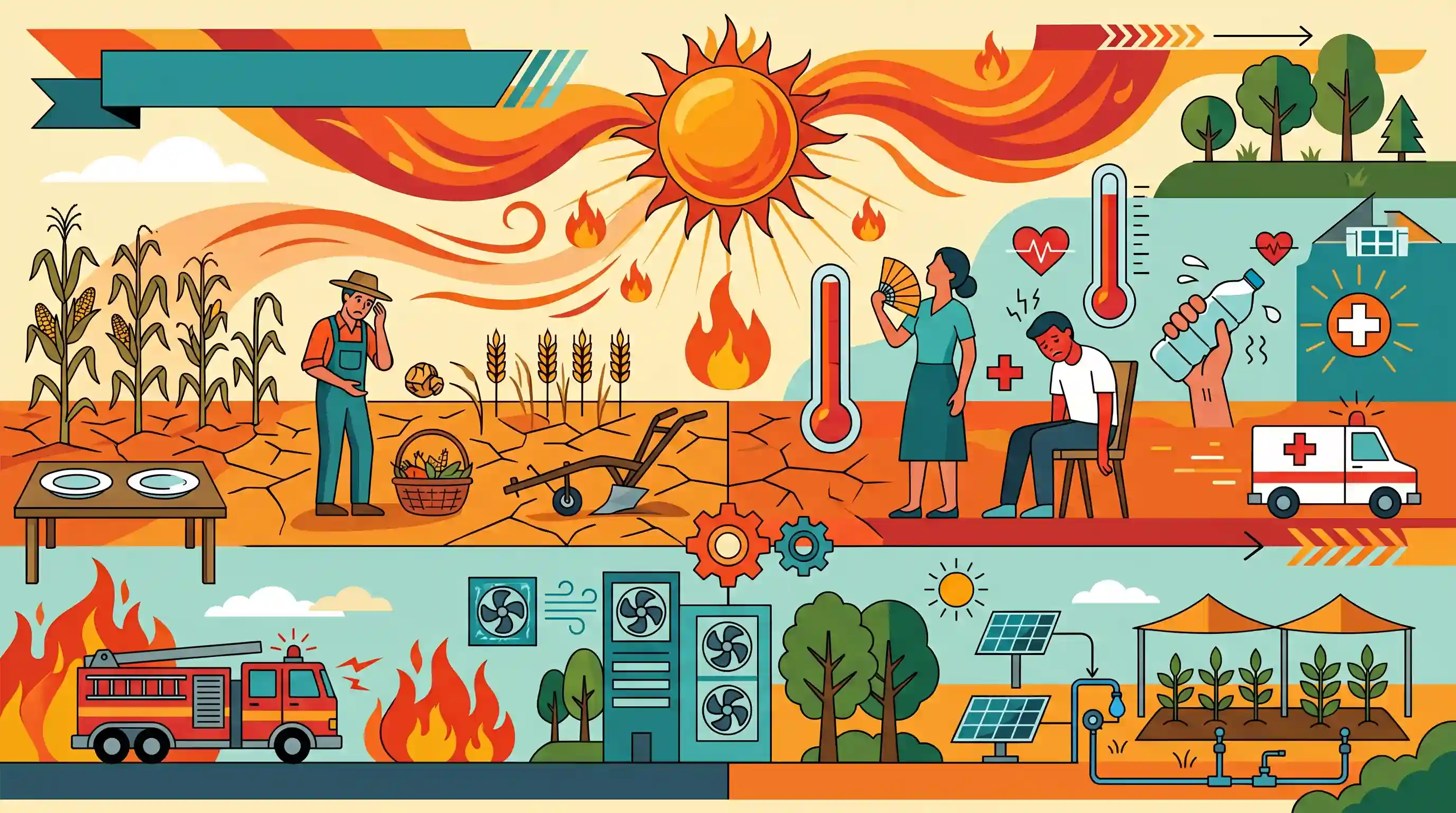
The article analyzes the escalating threat of extreme heatwaves driven by the broader climate crisis, highlighting their interconnected and detrimental impacts on global food security and public health. It emphasizes the urgent need for adaptive strategies to protect agricultural yields and vulnerable populations.
Key Points
- Extreme heat severely impacts agricultural productivity by reducing staple crop yields and stressing livestock, thereby threatening global food security.
- The climate crisis poses direct threats to public health, leading to increased incidences of heatstrokes, cardiovascular stress, and respiratory issues.
- Vulnerable populations, including the elderly, children, and outdoor workers, disproportionately bear the brunt of extreme temperature anomalies.
- Rising temperatures and altered climate patterns expand the geographical reach and transmission window of vector-borne diseases.
- Mitigation and adaptation require comprehensive strategies, including developing heat-resilient crops, improving early warning systems, and upgrading urban infrastructure to counter heat island effects.
Important Terms
Paris Agreement

A legally binding 2015 international treaty aiming to limit global warming to well below 2°C, preferably 1.5°C, through country-specific climate targets known as Nationally Determined Contributions (NDCs).
UPSC context
GS Paper 3 (Environment); tests international conventions, climate finance, and India’s specific climate commitments (NDCs).
IPCC
The United Nations body established in 1988 to assess climate change science. It synthesizes global research into Assessment Reports to guide international policy and disaster mitigation strategies.
UPSC context
GS Paper 3 (Environment/Science); focuses on scientific evidence for warming and its impacts on global policy.
Food and Agriculture Organization (FAO)
A specialized UN agency established in 1945 to lead international efforts to defeat hunger. It supports sustainable agriculture, improves nutrition, and ensures global food security through data and policy.
UPSC context
GS Paper 3 (Agriculture/Food Security); tests hunger eradication efforts and sustainable farming systems.
World Health Organization (WHO)
The specialized UN agency for international public health, founded in 1948. It sets global health standards, monitors trends, and coordinates responses to health emergencies and pandemics.
UPSC context
GS Paper 2 (Health/International Bodies); tests global health governance, disease control, and the role of international organizations.
Prelims Trap
Rising global temperatures generally decrease the spread of vector-borne diseases by drying up mosquito breeding grounds.
Aspirants assume extreme heat destroys mosquito habitats. While temporary droughts reduce standing water, long-term warming actually expands the habitable geographic range (altitude/latitude) and transmission windows for vectors.
Static Concepts Connected
What are the IMD criteria for declaring a heatwave in India?
- Base Threshold: The maximum temperature of a station must reach at least 40°C for plains, 37°C for coastal areas, and 30°C for hilly regions.
- Departure Criterion: A heatwave is declared if the departure from normal temperature is 4.5°C to 6.4°C. A severe heatwave requires a departure of >6.4°C.
- Absolute Criterion: Regardless of the normal temperature, a heatwave is declared if the absolute maximum temperature hits 45°C, and a severe heatwave at 47°C.
What causes the Urban Heat Island (UHI) effect?
- Surface Materials: Concrete and asphalt have low albedo and high thermal capacity, absorbing solar radiation during the day and releasing it slowly at night.
- Urban Canyons: Tall buildings create canyon-like structures that trap long-wave outgoing radiation and severely restrict wind flow, preventing natural cooling.
- Anthropogenic Heat: Waste heat generated by vehicular emissions, air conditioning units, and industrial activities directly raises local ambient temperatures.
Cross-Topic Patterns
Heatwaves driving Food Inflation
Terminal heat stress reduces wheat yields, prompting protective export bans. This directly links climate anomalies to macroeconomic inflation targeting and global food supply chain disruptions.
Urban Heat and NDMA funding
Despite severe health and economic impacts, heatwaves are not currently a notified disaster at the national level under the Disaster Management Act, restricting SDRF fund usage.
Climate Change & Disease Vectors
Warming temperatures allow vectors to survive at higher altitudes and latitudes, linking climate change directly to the expansion of malaria and dengue into previously untouched hilly regions.

Expect a 2026 multi-statement question linking IMD heatwave criteria, terminal heat stress on rabi crops, and the Miyawaki method.
Linked PYQs · 3
Linked PYQs · 3
- 2023MainsGS1
Discuss the consequences of climate change on the food security in tropical countries.
- 2017MainsGS3
'Climate change' is a global problem. How India will be affected by climate change? How Himalayan and coastal states of India will be affected by climate change?
- 2013MainsGS1
Bring out the causes for the formation of heat islands in the urban habitat of the world.
