Heatwave Crisis Management: Urban Planning and Climate Resilience
Source:Indian Express ↗
Why It Matters
Heatwaves have emerged as a critical climate-induced disaster in India, heavily impacting labor productivity, public health, and the economy. The shift from reactive policies to proactive disaster resilience is directly relevant to GS3 (Disaster Management) and GS1 (Urbanization/Geography).
Summary
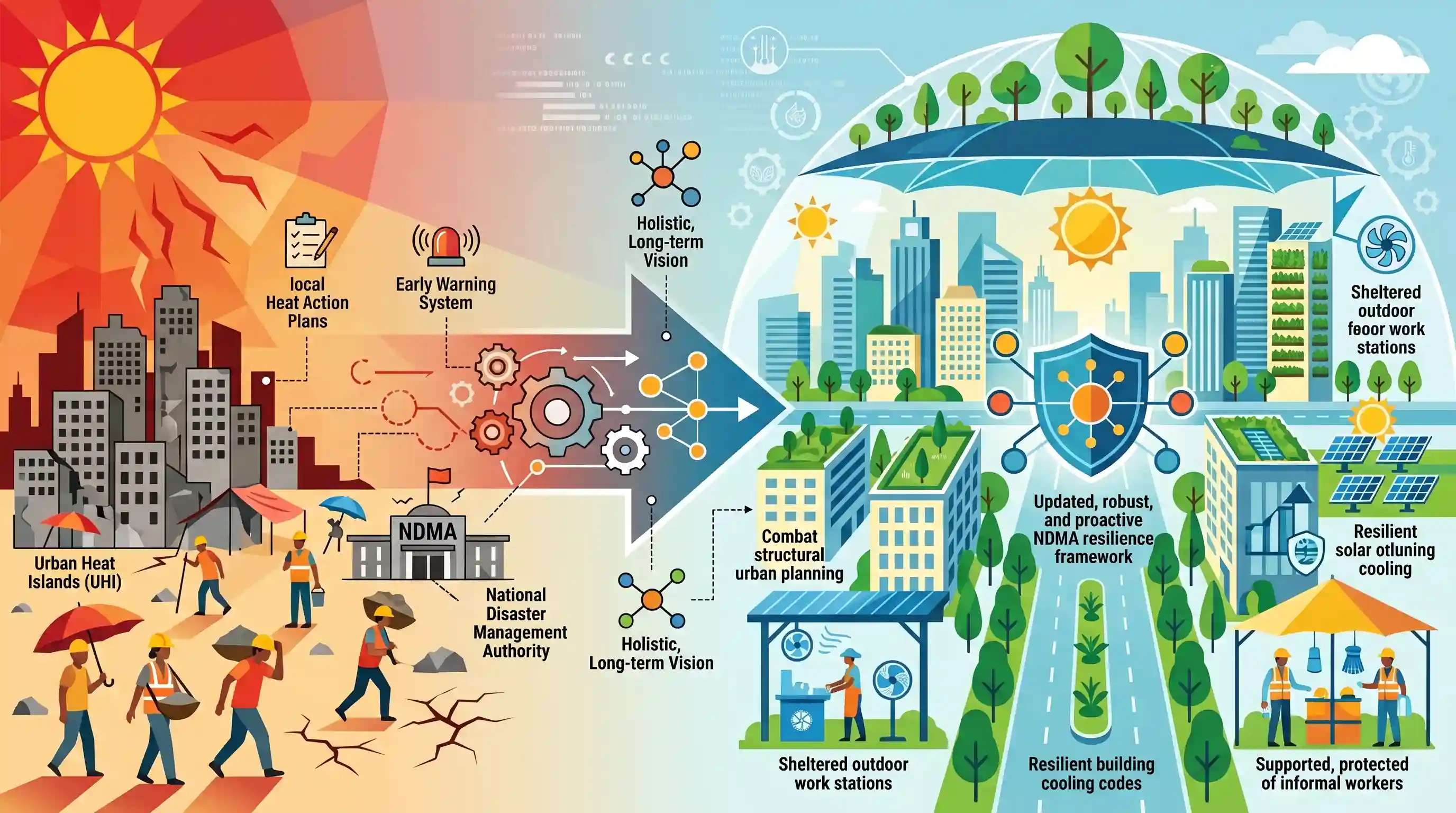
The article argues that mitigating India's escalating heatwave crisis requires a paradigm shift from ad-hoc policy interventions to a holistic, long-term vision. While local Heat Action Plans (HAPs) and early warning systems exist, they often remain reactive. A visionary approach demands integrating structural urban planning to combat Urban Heat Islands, updating the National Disaster Management Authority (NDMA) framework for proactive resilience, and addressing deep socio-economic vulnerabilities. Ensuring the protection of informal and outdoor workers through social safety nets, sustainable cooling strategies, and resilient building codes is essential for comprehensive disaster risk reduction.
Key Points
- The escalating frequency and intensity of heatwaves in India necessitate a shift from short-term policy fixes to a comprehensive, long-term climate resilience vision.
- Current Heat Action Plans (HAPs) often function as reactive, isolated policies rather than proactive, structural adaptations, highlighting a gap in disaster preparedness.
- Urban planning must structurally address the Urban Heat Island (UHI) effect through green spaces, improved building codes for passive cooling, and ecological conservation.
- Heatwaves disproportionately impact socio-economically vulnerable groups, particularly informal sector and outdoor workers, demanding robust social safety nets and occupational health safeguards.
- The National Disaster Management Authority (NDMA) framework must evolve to treat heatwaves as complex, slow-onset disasters with cascading impacts on the economy, agriculture, and public health.
Important Terms
Heat Action Plans (HAPs)

Local-level strategies designed to mitigate heatwave impacts through early warnings, public awareness, and inter-agency coordination. They provide specific protocols for health departments to protect vulnerable populations.
UPSC context
GS Paper 3: Disaster Management. Tests knowledge of local climate adaptation strategies and institutional response mechanisms to extreme weather events.
Urban Heat Island (UHI)
A phenomenon where urban regions experience significantly higher temperatures than rural surroundings due to heat-trapping concrete structures, low albedo, and lack of vegetation or evapotranspiration.
UPSC context
GS Paper 1 (Geography) and GS Paper 3 (Environment). Tests understanding of urbanization impacts and micro-climatic shifts.
National Disaster Management Authority (NDMA)
India’s apex statutory body for disaster management, established under the DM Act 2005. It formulates national policies, guidelines, and coordinates disaster response and mitigation efforts.
UPSC context
GS Paper 2 (Governance) and GS Paper 3 (Disaster Management). Tests institutional frameworks and statutory bodies for crisis governance.
Sendai Framework for Disaster Risk Reduction
A 2015–2030 international agreement aiming to reduce disaster risk and losses. It shifts the focus from managing disasters to risk governance and "Build Back Better" principles.
UPSC context
GS Paper 3: Disaster Management. Tests knowledge of international disaster risk reduction frameworks and India’s global commitments.
India Meteorological Department (IMD)
The nodal agency for meteorological observations and forecasting in India. It issues color-coded heatwave warnings (Yellow, Orange, Red) based on temperature thresholds and departures from normal.
UPSC context
GS Paper 1 (Geography) and GS Paper 3 (S&T). Tests understanding of meteorological mechanisms and early warning systems.
Prelims Trap
Heatwaves are a nationally 'Notified Disaster' under the Disaster Management Act, 2005, eligible for NDRF assistance.
Heatwaves are NOT currently among the 12 nationally notified disasters. While states can use up to 10% of SDRF for local disasters, heatwaves lack national notified status, restricting NDRF access.
Static Concepts Connected
What factors contribute to the Urban Heat Island (UHI) effect in cities?
- Material composition: Concrete and asphalt absorb, store, and radiate significantly more solar energy than natural vegetation and soil.
- Urban geometry: Tall, tightly packed buildings block natural wind flow and trap outgoing longwave radiation in street canyons.
- Anthropogenic heat: Waste heat is actively generated from vehicle exhausts, industrial processes, and air conditioning units.
- Loss of vegetation: Reduced tree cover limits evapotranspiration, a natural process that cools the surrounding air.
How does the Disaster Management Act framework fund specific disasters?
- Statutory classification: The Ministry of Home Affairs notifies specific disasters (e.g., cyclones, earthquakes) eligible for standardized central relief mechanisms.
- NDRF financing: The National Disaster Response Fund (NDRF) is strictly for emergency response and is financed by the National Calamity Contingent Duty (NCCD).
- State flexibility: States are permitted to utilize up to 10% of their State Disaster Response Fund (SDRF) for 'state-specific' unnotified disasters.
Cross-Topic Patterns
Heat stress & gig worker protections
Heatwave impacts on informal labor connect disaster resilience directly to the Occupational Safety, Health and Working Conditions Code and the ILO's Decent Work agenda.
UHI effect & Sponge City concepts
Mitigating urban heat islands naturally pairs with the 'Sponge City' model—using permeable pavements and green spaces to handle both extreme heat and urban flooding.

Expect a 2026 GS3 question evaluating why heatwaves lack national 'Notified Disaster' status and how UHI exacerbates urban vulnerability.
Linked PYQs · 5
Linked PYQs · 5
- 2013MainsGS1
Bring out the causes for the formation of heat islands in the urban habitat of the world.
- 2024MainsGS3
What is disaster resilience? How is it determined? Describe various elements of a resilience framework. Also mention the global targets of Sendai Framework for Disaster Risk Reduction (2015–2030).
- 2020MainsGS3
Discuss the recent measures initiated in disaster management by the Government of India departing from the earlier reactive approach.
- 2014MainsGS3
Drought has been recognized as a disaster in view of its spatial expanse, temporal duration, slow onset and lasting effects on vulnerable sections. With a focus on the September 2010 guidelines from the National Disaster Management Authority (NDMA), discuss the mechanisms for preparedness to deal with likely El Niño and La Niña fallouts in India.
- 2019MainsGS3
Vulnerability is an essential element for defining disaster impacts and its threat to people. How and in what ways can vulnerability to disasters be characterized? Discuss different types of vulnerability with reference to disasters.
