Summer Heatwave Projections and Disaster Management Preparedness
Source:Indian Express ↗
Why It Matters
Heatwaves are becoming a recurring extreme weather event in India due to climate change. Understanding their implications on health, agriculture, and water resources is crucial for UPSC aspirants, as it directly links to disaster management preparedness, environmental ecology, and food security vulnerabilities.
Summary
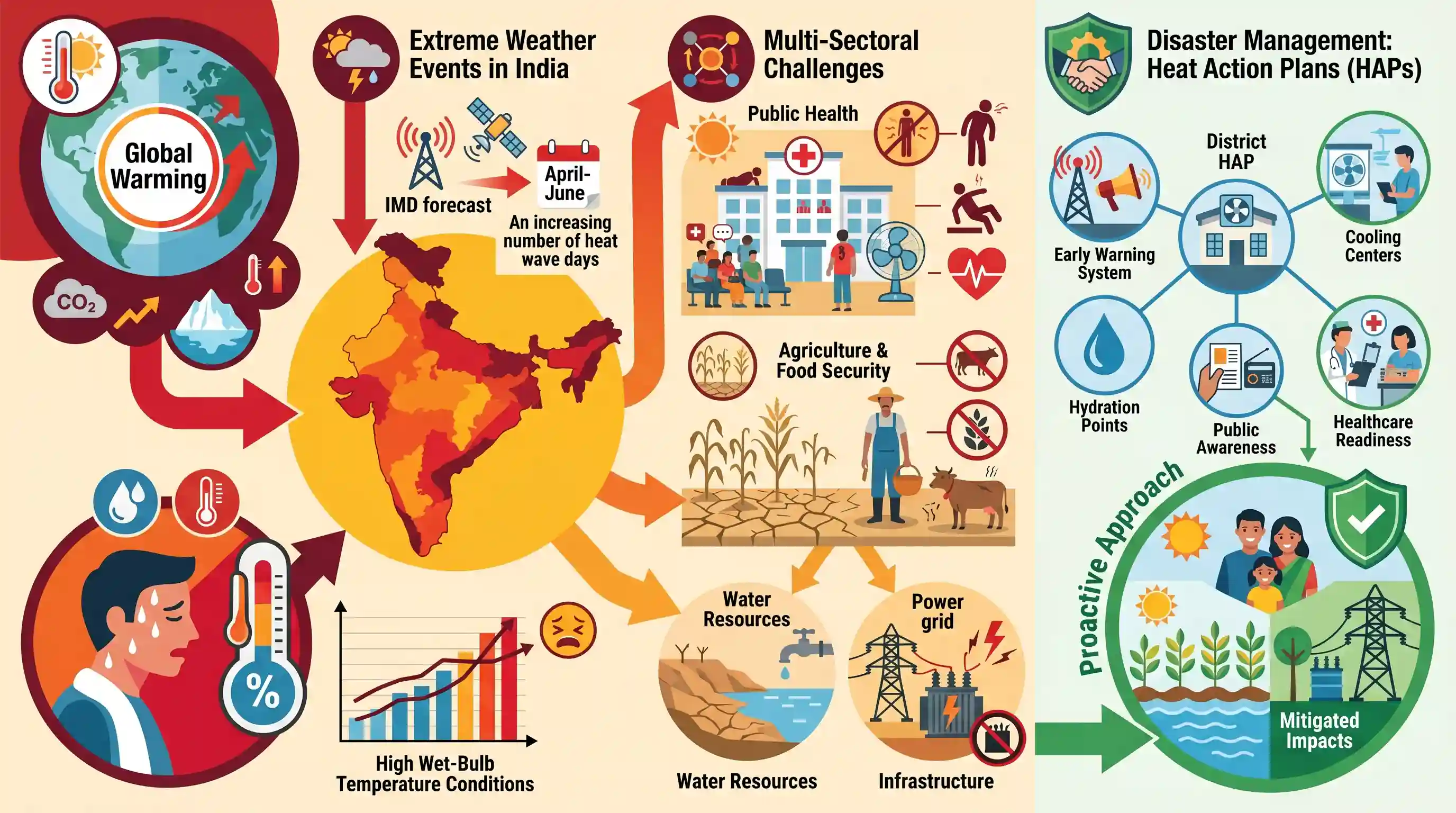
The India Meteorological Department (IMD) has forecast above-normal temperatures and an increased number of heatwave days for the upcoming summer season (April to June). Driven by shifting climatic patterns and global warming, these extreme weather events pose significant multi-sectoral challenges for India. Prolonged heatwaves elevate the risk of heat-related illnesses and fatalities, particularly under high wet-bulb temperature conditions. Furthermore, extreme heat stresses the agricultural sector, affecting crop yields and threatening food security, while simultaneously increasing the load on power grids and depleting water resources. This scenario underscores the urgent need for a proactive disaster management approach, highlighting the critical role of well-implemented District Heat Action Plans (HAPs) in mitigating health and socio-economic impacts.
Key Points
- The India Meteorological Department (IMD) predicts above-normal temperatures and a higher frequency of heatwave days across India during the April-June summer period.
- Intensifying heatwaves present severe public health risks, including heatstrokes, particularly when combined with high humidity (wet-bulb temperatures).
- Extreme summer temperatures threaten agricultural output, straining crop resilience, increasing irrigation needs, and impacting overall food security.
- The forecasted extreme weather highlights the necessity for proactive disaster management strategies, specifically the rigorous implementation of localized Heat Action Plans (HAPs).
Important Terms
Heatwave (IMD Criteria)

Meteorological condition where maximum temperatures reach ≥40°C (plains), ≥37°C (coastal), or ≥30°C (hills), with a departure from normal of 4.5°C–6.4°C or an actual temperature ≥45°C.
UPSC context
GS Paper 1 (Geography) and GS Paper 3 (Disaster Management). Tests understanding of extreme weather thresholds and local climatic variations.
Heat Action Plans (HAPs)
Comprehensive state or city-level strategies (pioneered by Ahmedabad in 2013) involving early warnings, inter-agency coordination, and public health measures to mitigate heat-related mortality and socio-economic distress.
UPSC context
GS Paper 3 (Disaster Management). Focuses on institutional preparedness, policy implementation, and administrative response to climate-induced disasters.
Wet-bulb Temperature
The lowest temperature reached by evaporative cooling; it combines heat and humidity to measure human heat stress. A threshold of 35°C is considered the limit of human survivability.
UPSC context
GS Paper 3 (Environment/Climate Change). Vital for discussing health impacts of 'humid heat' and vulnerabilities of outdoor workers in South Asia.
India Meteorological Department (IMD)
The principal agency under the Ministry of Earth Sciences (MoES) responsible for meteorological observations, weather forecasting, and seismology. Established in 1875 and headquartered in New Delhi.
UPSC context
GS Paper 1 (Geography) and GS Paper 3 (S&T). Crucial for questions on early warning systems and monsoon monitoring.
National Disaster Management Authority (NDMA)
The apex statutory body for disaster management in India, chaired by the Prime Minister. It issues national guidelines for managing disasters, including heatwaves, under the DM Act, 2005.
UPSC context
GS Paper 3 (Disaster Management). Tests knowledge of India's disaster governance framework and the role of constitutional/statutory bodies.
Food Security
Ensuring physical, social, and economic access to sufficient, safe, and nutritious food. Heatwaves threaten this by causing 'heat shock' in crops, leading to yield losses.
UPSC context
GS Paper 3 (Agriculture/Economy). Relevant for discussing the impact of climate change on crop productivity and agricultural sustainability.
Prelims Trap
Heatwaves are officially classified as 'notified national disasters' under the Disaster Management Act, 2005.
UPSC frequently tricks aspirants into thinking severe recurring events (heatwaves, lightning) are centrally notified disasters. They are not; states declare them as 'local disasters' using up to 10% of SDRF.
Static Concepts Connected
What are the IMD's geographical criteria for declaring a heatwave in India?
- Plains: The maximum temperature must reach at least 40°C.
- Coastal Regions: The maximum temperature must reach at least 37°C.
- Hilly Regions: The maximum temperature must reach at least 30°C.
- Departure from Normal: A heatwave is declared if the departure from normal is 4.5°C to 6.4°C; severe heatwave if >6.4°C.
What is Wet-Bulb Temperature and why is it critical for human survival?
- Definition: It measures heat stress by combining dry air temperature with humidity, indicating the lowest temperature attainable via water evaporation.
- Survivability Threshold: At a wet-bulb temperature of 35°C, the human body can no longer cool itself through sweating, leading to rapid, fatal heatstroke.
Cross-Topic Patterns
Climate-induced food inflation
Heatwaves occurring during the critical crop-filling stage (terminal heat stress in wheat) severely reduce yields, directly linking GS1/GS3 climate events to macroeconomic food inflation and export bans.
Urban Heat Islands + HAPs
The concrete and lack of green cover in cities exacerbate heatwaves, making UHI mitigation (like 'cool roofs' in local Heat Action Plans) a critical intersection of Disaster Management and Urbanization.

IMD heatwave criteria, wet-bulb physics, and the NDMA notified disaster list are prime targets for a multi-statement Prelims 2026 question.
Linked PYQs · 4
Linked PYQs · 4
- 2025PrelimsGS1
The World Bank warned that India could become one of the first places where wet-bulb temperatures routinely exceed 35 °C. Which of the following statements best reflect(s) the implication of the above-said report? I. Peninsular India will most likely suffer from flooding, tropical cyclones and droughts. II. The survival of animals including humans will be affected as shedding of their body heat through perspiration becomes difficult. Select the correct answer using the code given below.
- 2023MainsGS1
Discuss the consequences of climate change on the food security in tropical countries.
- 2020MainsGS3
Discuss the recent measures initiated in disaster management by the Government of India departing from the earlier reactive approach.
- 2022MainsGS3
Discuss global warming and mention its effects on the global climate. Explain the control measures to bring down the level of greenhouse gases which cause global warming, in the light of the Kyoto Protocol, 1997.
