Socioeconomic impacts of heatwaves and inclusive action plans
Source:Indian Express ↗
Why It Matters
Understanding the socio-economic dimensions of climate-induced disasters is crucial for UPSC aspirants. It bridges the gap between environmental science (GS3) and social justice (GS2/GS1), highlighting the need for inclusive policy-making in urban planning and disaster management.
Summary
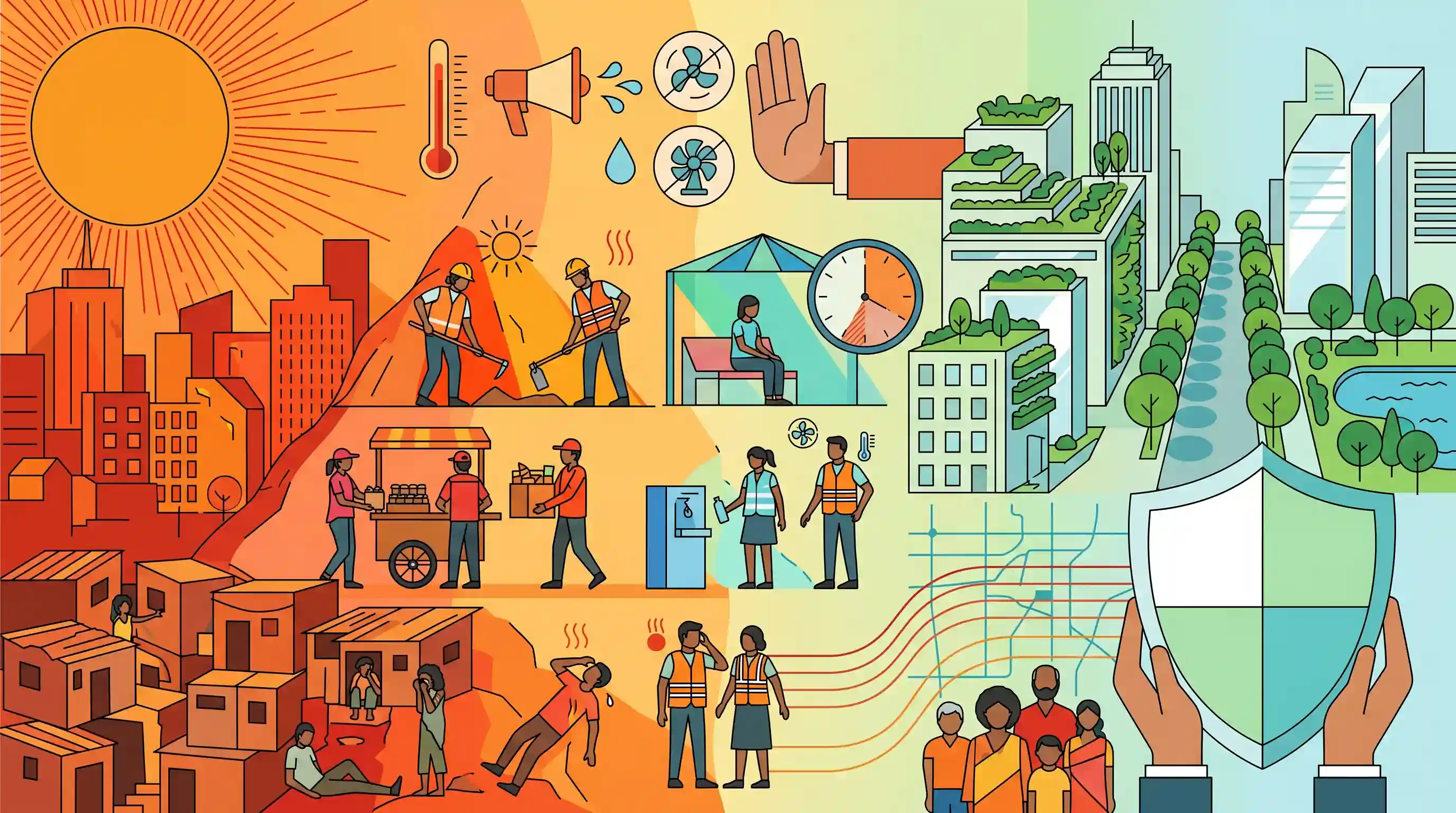
Heatwaves are escalating in intensity due to climate change, presenting a severe public health and economic challenge. The impacts are disproportionately borne by vulnerable populations, notably informal workers, slum dwellers, and outdoor laborers. To effectively address this, adaptation measures and Heat Action Plans (HAPs) must move beyond generic advisories to incorporate targeted, inclusive interventions. This necessitates systemic changes in urban planning, mitigating the urban heat island effect, and ensuring marginalized groups are counted and protected in climate resilience strategies.
Key Points
- Escalating Threat: Heatwaves are becoming more frequent and severe, exacerbated by global warming and the urban heat island effect.
- Disproportionate Vulnerability: Marginalized communities, including outdoor workers and the urban poor, face the highest risks due to limited access to cooling and inadequate housing.
- Need for Inclusive Heat Action Plans (HAPs): Current adaptation strategies often fail to account for the informal sector; solutions must be localized to protect both health and livelihoods.
- Urban Planning Deficits: Concrete-heavy infrastructure, shrinking green spaces, and poor housing design worsen heat stress in Indian metropolises.
- Data and Policy Integration: Accurate tracking of heat-related morbidity and mortality is vital for designing evidence-based, equitable climate adaptation policies.
Important Terms
Heat Action Plans (HAPs)

Comprehensive, localized strategies designed to mitigate heatwave impacts through early warnings, public awareness, and healthcare preparedness. Ahmedabad launched India's first HAP in 2013 following a deadly 2010 heatwave.
UPSC context
GS Paper III: Disaster Management; critical for evaluating climate adaptation and urban resilience strategies in India.
India Meteorological Department (IMD)
India's principal meteorological agency responsible for weather forecasting. It defines a heatwave when maximum temperatures reach 40°C in plains, 37°C in coasts, or 30°C in hilly regions.
UPSC context
GS Paper I: Geography (Climatology); GS Paper III: Disaster Management (Early Warning Systems).
National Disaster Management Authority (NDMA)
The statutory body, headed by the Prime Minister, responsible for laying down policies and guidelines for disaster management in India under the Disaster Management Act, 2005.
UPSC context
GS Paper II: Governance and Statutory Bodies; GS Paper III: Disaster Management framework.
Urban Heat Island (UHI) Effect
A phenomenon where urban areas experience significantly higher temperatures than surrounding rural areas due to concretization, lack of vegetation, and human-generated waste heat.
UPSC context
GS Paper I: Geography (Urbanization); GS Paper III: Environmental Degradation and Climate Change.
Vulnerability Assessment
A systematic study to identify populations (e.g., informal workers, elderly) and areas most susceptible to climate-related hazards, helping prioritize targeted disaster interventions.
UPSC context
GS Paper III: Social Justice and Disaster Management; tests inclusive policy-making for marginalized sections.
Heat Index
A tool introduced by the IMD that combines air temperature and relative humidity to determine the "apparent temperature" or how hot it actually feels to the human body.
UPSC context
GS Paper III: Environment and Disaster Management; assesses physiological stress and public health risks of humid heat.
Prelims Trap
Heatwaves are a notified national disaster under the Disaster Management Act, allowing states to utilize NDRF funds.
Heatwaves are NOT currently classified as a notified national disaster under the central DMA framework, restricting direct NDRF/SDRF access.
Static Concepts Connected
What are the IMD criteria for declaring a heatwave in India?
- Plains threshold: Maximum temperature reaches at least 40°C.
- Coastal threshold: Maximum temperature reaches at least 37°C.
- Hilly regions: Maximum temperature reaches at least 30°C.
- Normal departure: Temperature departs from normal by 4.5°C to 6.4°C (severe if >6.4°C).
What are the primary drivers of the Urban Heat Island (UHI) effect?
- Low Albedo: Concrete and asphalt absorb more solar radiation instead of reflecting it.
- Reduced Evapotranspiration: Loss of green cover and water bodies eliminates natural cooling mechanisms.
- Urban Canyons: Tall, dense buildings trap heat and restrict wind flow, reducing ventilation.
Cross-Topic Patterns
Climate stress + Informal labour productivity
Heat stress connects physical geography to the economy. The ILO warns that escalating temperatures severely diminish working hours in construction and agriculture, directly impacting India's GDP and informal sector livelihoods.
UHI + Urban Flooding linkages
Poor urban planning (concretization, loss of wetlands) acts as a risk multiplier, causing both the Urban Heat Island effect in summer and severe urban flooding during monsoons.

Expect a 2026 multi-statement Prelims question merging IMD heatwave criteria, UHI causes, and its non-notified status under DMA.
Linked PYQs · 3
Linked PYQs · 3
- 2013MainsGS1
Bring out the causes for the formation of heat islands in the urban habitat of the world.
- 2023MainsGS1
Does urbanization lead to more segregation and/or marginalization of the poor in Indian metropolises?
- 2024MainsGS3
Flooding in urban areas is an emerging climate-induced disaster. Discuss the causes of this disaster. Mention the features of two such major floods in the last two decades in India. Describe the policies and frameworks in India that aim at tackling such floods.
