Climate Change Adaptation: Knowledge Systems for Extreme Weather
Source:Indian Express ↗
Why It Matters
It provides a critical analytical lens for GS3 (Disaster Management and Environment) and GS1 (Urbanization), shifting the focus from 'what' needs to be done to 'how' we must generate and utilize local knowledge, data, and forecasting to combat climate extremes.
Summary
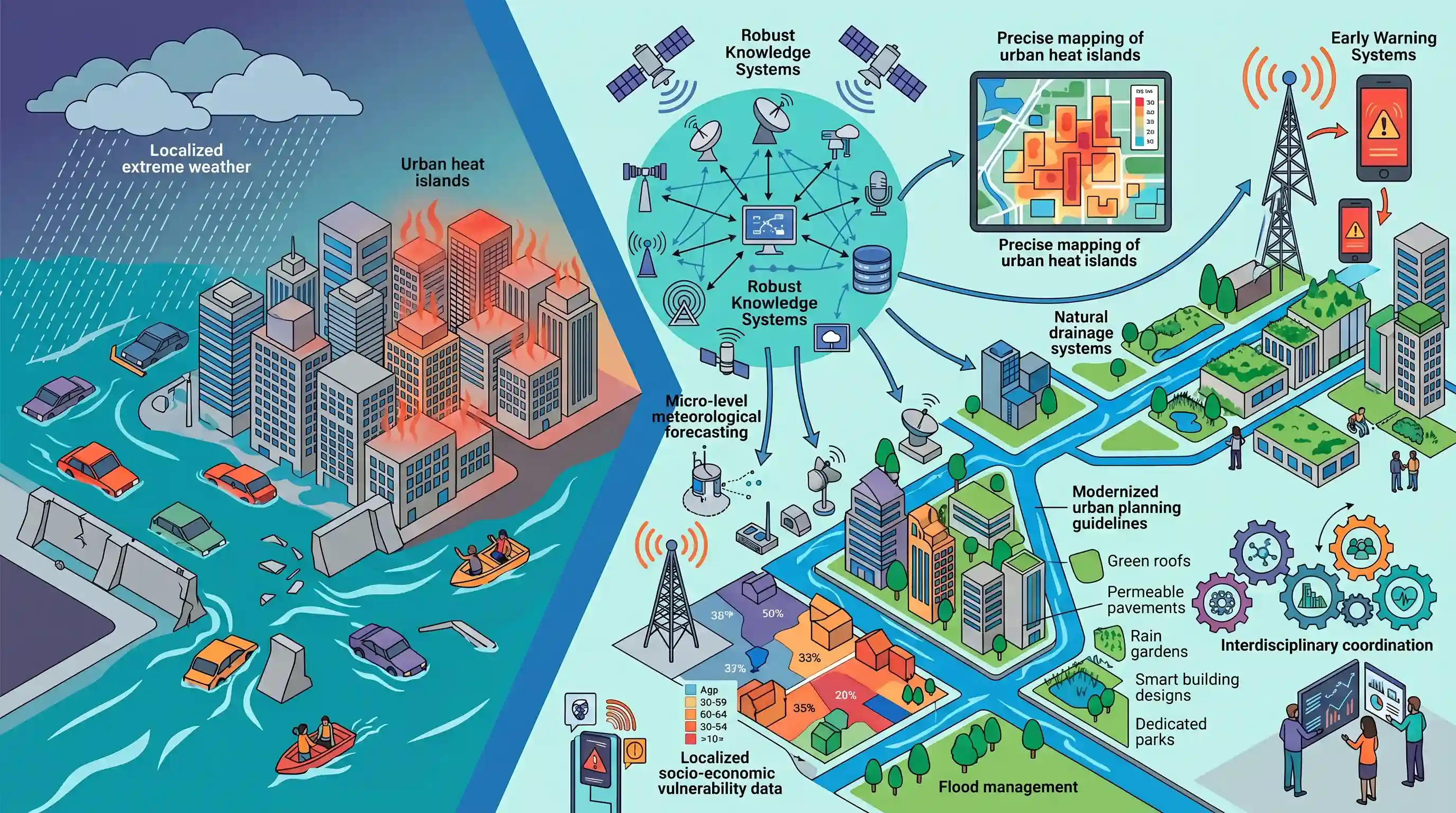
The article argues that tackling contemporary climate-induced disasters like heat waves and urban floods extends beyond financial or infrastructural deficits to become fundamentally a 'knowledge challenge.' Traditional, reactive disaster management and purely engineering-based approaches are increasingly inadequate in the face of unpredictable, highly localized extreme weather. The piece emphasizes the urgent need for robust knowledge systems, including micro-level meteorological forecasting, the precise mapping of urban heat islands and natural drainage systems, and the integration of localized socio-economic vulnerability data. Enhancing early warning systems, modernizing urban planning guidelines, and fostering interdisciplinary coordination are identified as critical steps to transition from reactive relief to proactive adaptation and resilience-building.
Key Points
- The increasing severity and frequency of climate-induced disasters like heat waves and floods pose a significant challenge to existing management frameworks.
- Addressing these crises is primarily a 'knowledge challenge', requiring a shift from purely infrastructure-heavy and reactive approaches to proactive, data-driven strategies.
- Micro-level climate forecasting and localized early warning systems are essential to predict highly localized extreme weather events and urban flooding.
- Effective urban planning demands accurate mapping of urban heat islands and the modernization of drainage systems based on contemporary hydrological data.
- Formulating and implementing localized Heat Action Plans (HAPs) requires a comprehensive understanding of the socio-economic vulnerabilities of affected populations.
- Building resilience necessitates interdisciplinary coordination, bridging gaps between meteorologists, urban planners, policymakers, and local communities.
Important Terms
Sendai Framework for Disaster Risk Reduction

A 15-year, voluntary UN agreement (2015–2030) aimed at reducing global disaster risk and losses. It prioritizes understanding risk, strengthening governance, investing in resilience, and "Building Back Better" during recovery.
UPSC context
GS Paper 3 (Disaster Management); tests knowledge of global governance frameworks and India's shift from reactive to proactive disaster mitigation.
National Disaster Management Authority (NDMA)
The apex statutory body for disaster management in India, established under the Disaster Management Act, 2005. Headed by the Prime Minister, it formulates national policies and guidelines for disaster prevention and response.
UPSC context
GS Paper 3 (Disaster Management); essential for understanding India’s institutional disaster architecture and the execution of the National Disaster Management Plan.
India Meteorological Department (IMD)
The principal government agency under the Ministry of Earth Sciences responsible for weather forecasting, seismology, and meteorological observations. It issues critical early warnings for cyclones, floods, and heatwaves.
UPSC context
GS Paper 1 (Geography) & GS Paper 3 (Disaster Management); vital for topics on monsoons, extreme weather events, and early warning technologies.
Heat Action Plans (HAPs)
Localized policy frameworks in India that coordinate inter-departmental responses to mitigate heatwave impacts. They integrate IMD forecasts with public health alerts, cooling center management, and long-term urban heat-mitigation strategies.
UPSC context
GS Paper 3 (Disaster Management & Climate Change); tests understanding of decentralized adaptation strategies and urban climate resilience.
Prelims Trap
"The Sendai Framework is legally binding, and Heat Action Plans are formulated and enforced centrally by the NDMA."
The Sendai Framework is voluntary, not legally binding. Furthermore, the NDMA only issues guidelines for Heat Action Plans; formulation and execution are handled by state and municipal governments.
Static Concepts Connected
What causes the Urban Heat Island (UHI) effect and how does it alter local weather?
- Surface Modification: Replacing natural vegetation with heat-absorbing asphalt and concrete drastically increases daytime heat retention and slows nighttime cooling.
- Waste Heat: Anthropogenic emissions from vehicles, air conditioning units, and industrial activities inject continuous waste heat into the micro-climate.
- Thermal Instability: Intense localized heat creates strong thermal updrafts, triggering convective clouds and causing sudden, high-intensity, short-duration rainfall.
What are the four priorities of the Sendai Framework for Disaster Risk Reduction (2015-2030)?
- Understanding Disaster Risk: Emphasizes micro-level data collection, hazard mapping, and vulnerability assessment across all dimensions of disaster risk.
- Risk Governance: Strengthening institutional frameworks at national and local levels to manage and govern disaster risks effectively.
- Investing in Reduction: Prioritizing public and private investments in structural and non-structural measures to enhance economic and environmental resilience.
- Build Back Better: Enhancing early warning systems and ensuring post-disaster recovery reconstructs infrastructure to higher resilience standards.
Cross-Topic Patterns
UHI-induced localized urban flooding
Urban heat islands create localized thermal convection, triggering intense, short-duration rainfall. This connects GS1 urban geography (concrete expansion) directly with GS3 disaster management (flash floods).
Decentralized disaster governance via HAPs
Shifting from centralized NDMA guidelines to localized municipal mapping of socio-economic vulnerability demonstrates a real-world application of the 74th Amendment in building urban disaster resilience.

Expect a multi-statement Prelims question linking the physics of Urban Heat Islands to the rising frequency of localized urban floods.
Linked PYQs · 4
Linked PYQs · 4
- 2024MainsGS3
Flooding in urban areas is an emerging climate-induced disaster. Discuss the causes of this disaster. Mention the features of two such major floods in the last two decades in India. Describe the policies and frameworks in India that aim at tackling such floods.
- 2013MainsGS1
Bring out the causes for the formation of heat islands in the urban habitat of the world.
- 2020MainsGS1
Account for the huge flooding of million cities in India including the smart ones like Hyderabad and Pune. Suggest lasting remedial measures.
- 2020MainsGS3
Discuss the recent measures initiated in disaster management by the Government of India departing from the earlier reactive approach.
