Climate change heat stress impacts child stunting in South Asia
Source:The Hindu ↗
Why It Matters
Provides empirical evidence connecting climate change (specifically wet-bulb temperatures) to deteriorating social development indicators such as child stunting and maternal health issues. This is highly relevant for GS2 questions on health and poverty, and GS3 questions on the socio-economic impacts of global warming.
Summary
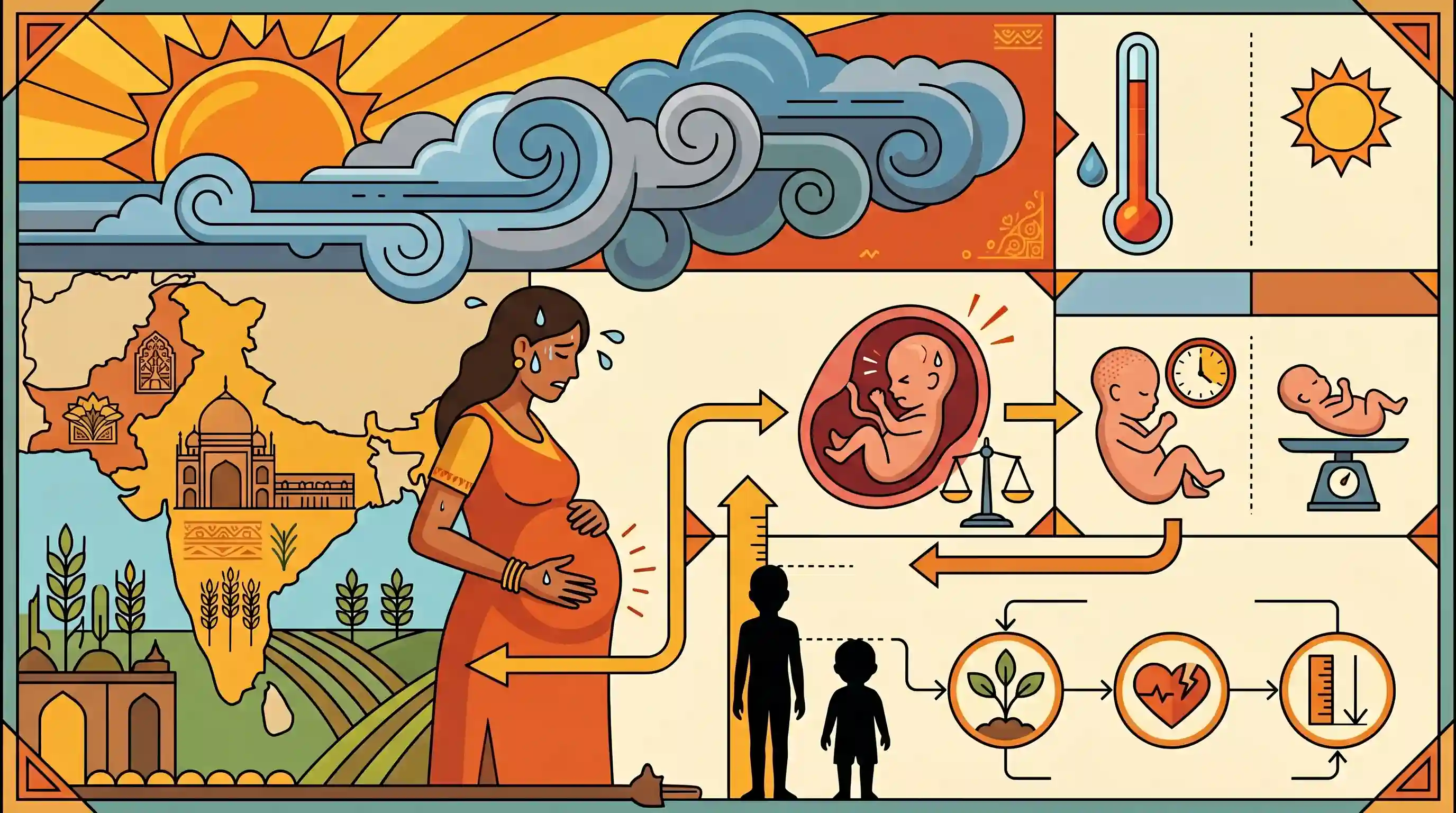
A recent study highlights that climate change-induced increases in heat and humidity could significantly worsen child stunting in South Asia by 2050. The research demonstrates that maternal exposure to high wet-bulb temperatures during pregnancy adversely affects fetal development more than dry heat alone, leading to lower birth weights and premature births. This exacerbates chronic health issues, reflected in lower 'height-for-age' indicators among children under five. The findings underscore the critical intersection of environmental degradation, maternal health, and child nutrition, emphasizing the heightened vulnerability of developing regions to climate-induced physiological stress.
Key Points
- A study published in the 'Science' journal warns that rising heat and humidity due to climate change could increase cases of stunting among children in South Asia by 2050.
- The research links maternal exposure to high 'wet-bulb globe temperatures' (which combine heat and humidity) during pregnancy to adverse fetal development.
- High wet-bulb temperatures pose severe physiological stress on pregnant women, impacting birth weights and increasing the likelihood of premature births.
- The combination of extreme heat and humidity was found to be far more damaging to a child's 'height-for-age' indicator than exposure to dry heat alone.
Important Terms
Stunting

A nutritional condition where a child has a low height-for-age (at least two standard deviations below the WHO median). It indicates chronic undernutrition and long-term developmental failure.
UPSC context
GS Paper 2: Issues relating to Health and Hunger. Tests knowledge of public health indicators and NFHS data.
Wet-bulb Temperature (WBT)
The lowest temperature air can reach via evaporation; it measures heat stress by accounting for humidity, indicating the body's limited ability to cool itself through sweat.
UPSC context
GS Paper 3: Environment and Disaster Management. Vital for understanding climate change thresholds and human survivability.
Height-for-age (HFA)
A primary indicator of stunting used to assess a child's linear growth. It reflects cumulative health deficits and nutritional deprivation over a long period.
UPSC context
GS Paper 2: Health indicators and Governance. Used to evaluate the effectiveness of schemes like POSHAN Abhiyaan.
Maternal Heat Stress
Physiological strain on pregnant women caused by high temperatures, leading to adverse birth outcomes like low birth weight and preterm delivery due to impaired thermoregulation.
UPSC context
GS Paper 1 & 2: Social Empowerment and Vulnerable Sections. Highlighting gendered impacts of climate change on health.
Climate Vulnerability
The degree to which a region's social and biological systems are susceptible to, or unable to cope with, the adverse effects of climate change, specifically extreme heat.
UPSC context
GS Paper 3: Environmental Degradation. Specifically focuses on South Asia's high risk due to population density and geography.
Prelims Trap
"Stunting is defined as low weight-for-height, reflecting acute short-term malnutrition."
UPSC frequently swaps the definitions of stunting (height-for-age, chronic) and wasting (weight-for-height, acute) to trick aspirants in nutrition and health-based questions.
Static Concepts Connected
What is Wet-Bulb Globe Temperature (WBGT) and its human threshold?
- Composite measure: It measures heat stress in direct sunlight by combining temperature, humidity, wind speed, and solar radiation into a single index.
- Evaporation limits: High environmental humidity prevents human sweat from evaporating, making wet-bulb heat significantly more dangerous to physiology than dry heat.
- Threshold of 35°C: A sustained wet-bulb temperature of 35°C is the theoretical limit beyond which humans cannot naturally cool themselves, risking fatal heatstroke.
What are the primary WHO indicators for child malnutrition?
- Stunting: Low height-for-age. It indicates chronic, long-term undernutrition and prolonged physiological or environmental stress.
- Wasting: Low weight-for-height. It points to acute, severe, and immediate short-term weight loss or sudden starvation.
- Underweight: Low weight-for-age. It is a composite indicator that can reflect both chronic stunting and acute wasting.
Cross-Topic Patterns
Climate Change and Demographic Dividend
Stunting irreversibly impairs cognitive capacity. Climate-induced physiological stress threatens India's demographic dividend by structurally reducing future workforce productivity and human capital.
Feminization of Agriculture + Heat Stress
With growing female participation in Indian agriculture, pregnant rural women face disproportionate outdoor heat-humidity exposure, inextricably linking climate vulnerability to maternal and fetal health.

Expect a multi-statement Prelims question linking wet-bulb temperature limits (35°C) directly to human capital and stunting metrics.
Linked PYQs · 4
Linked PYQs · 4
- 2025PrelimsGS1
The World Bank warned that India could become one of the first places where wet-bulb temperatures routinely exceed 35 °C. Which of the following statements best reflect(s) the implication of the above-said report? I. Peninsular India will most likely suffer from flooding, tropical cyclones and droughts. II. The survival of animals including humans will be affected as shedding of their body heat through perspiration becomes difficult. Select the correct answer using the code given below.
- 2017MainsGS3
'Climate change' is a global problem. How India will be affected by climate change? How Himalayan and coastal states of India will be affected by climate change?
- 2020MainsGS2
In order to enhance the prospects of social development, sound and adequate health care policies are needed particularly in the fields of geriatric and maternal health care. Discuss.
- 2024MainsGS2
Poverty and malnutrition create a vicious cycle, adversely affecting human capital formation. What steps can be taken to break the cycle ?
