West Bengal Progresses With Citizenship Amendment Act Verification
Source:theprint ↗
Why It Matters
Implementation of the CAA touches upon core constitutional tenets of citizenship and fundamental rights. Furthermore, state-level legislation targeting public property damage emphasizes the constitutional separation of powers where 'Law and Order' falls under the State List.
Summary
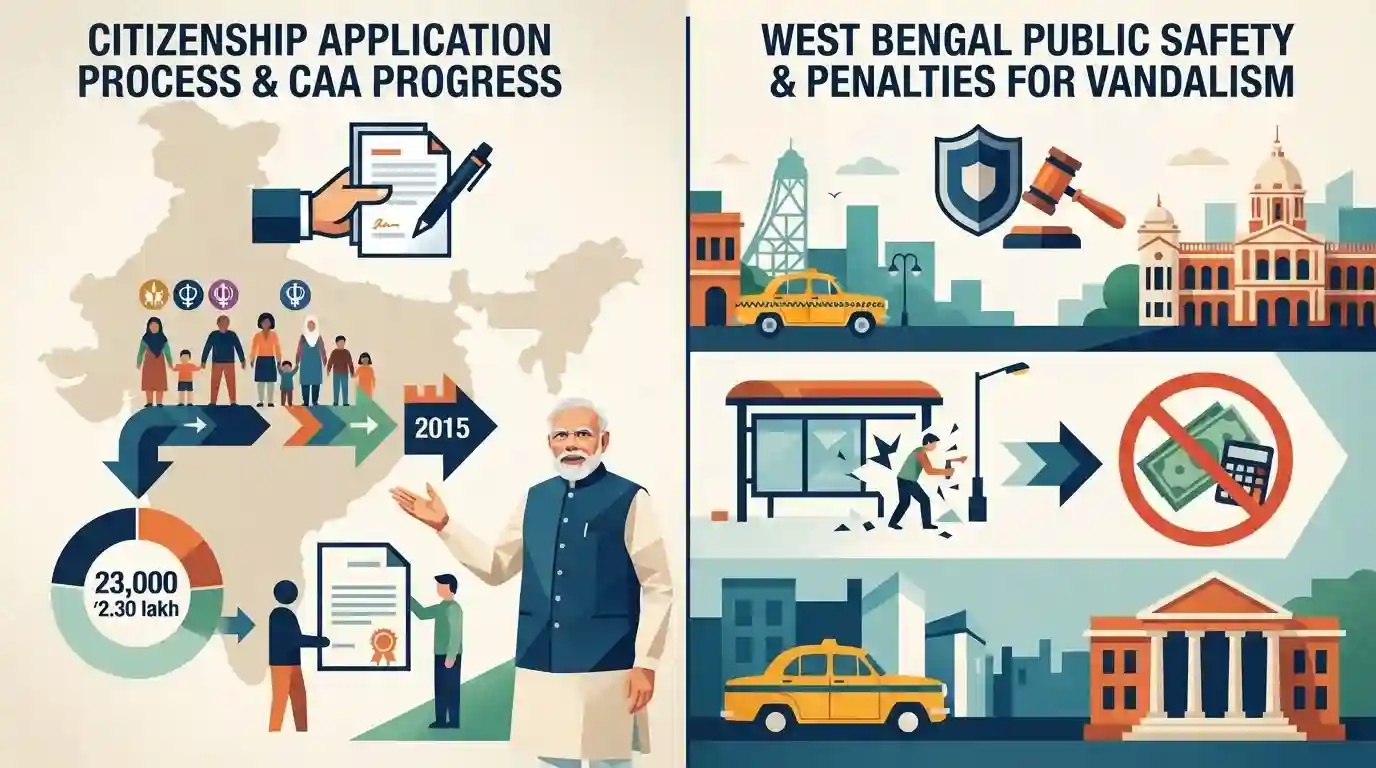
West Bengal BJP leader Suvendu Adhikari stated that citizenship hearings under the Citizenship Amendment Act (CAA) will soon conclude, with 23,000 certificates already issued out of 2.30 lakh applications nationwide. The CAA facilitates citizenship for persecuted minorities from three neighboring countries who entered India before 2015. Additionally, Adhikari addressed the newly passed West Bengal Public Safety and Control of Anti-Social Activities Bill, 2026, cautioning against the vandalism of public property, as the new law mandates severe financial penalties for such damages.
Key Points
- Leader of the Opposition in West Bengal, Suvendu Adhikari, confirmed that the processing of citizenship applications under the CAA is being expedited.
- Currently, 23,000 citizenship certificates have been issued from a total of 2.30 lakh applications across India.
- The CAA provides citizenship to refugees of six minority communities from Pakistan, Bangladesh, and Afghanistan who arrived in India before December 31, 2014.
- Adhikari also highlighted the new West Bengal Public Safety and Control of Anti-Social Activities Bill, 2026, which aims to curb vandalism of government property by imposing stringent fines on offenders.
Important Terms
Citizenship Amendment Act (CAA), 2019

A 2019 law expediting Indian citizenship for persecuted non-Muslim minorities (Hindus, Sikhs, Buddhists, Jains, Parsis, Christians) fleeing Pakistan, Bangladesh, and Afghanistan who entered India before December 31, 2014.
UPSC context
Crucial for WBCS Paper V (Polity). Tests Citizenship (Part II of the Constitution) and India's framework for refugee integration.
West Bengal Public Safety and Control of Anti-Social Activities Bill, 2026
A 2026 state law introducing strict preventive detention for up to 12 months, property confiscation, and making broad anti-social offenses non-bailable to control organized crime and public property damage.
UPSC context
Highly relevant for WBCS Paper II (Current Affairs) and Paper V. Tests Article 22 (Preventive Detention) and state law-and-order powers.
Bharatiya Janata Party (BJP)
A major national political party in India. As of 2026, it leads the National Democratic Alliance (NDA) at the Union level and forms the ruling government in West Bengal.
UPSC context
Relates to WBCS Paper V (Political System). Highlights India's multi-party democracy, electoral dynamics, and shifting state-level political paradigms.
Trinamool Congress (TMC)
A prominent Indian regional political party founded by Mamata Banerjee. It is currently the primary opposition party in the West Bengal state legislature following the 2026 assembly elections.
UPSC context
Relevant for WBCS Paper V (State Politics) and Current Affairs, testing knowledge of regional parties and opposition dynamics.
Prelims Trap
"The CAA grants Indian citizenship to all persecuted religious minorities from India's neighboring countries."
It strictly limits eligibility to six specific communities from only three countries (Pakistan, Bangladesh, Afghanistan) entering on or before December 31, 2014. Minorities from Myanmar or Sri Lanka are entirely excluded.
Static Concepts Connected
What are the constitutional provisions regulating citizenship in India?
- Part II: Articles 5 to 11 govern citizenship at the Constitution's commencement, but rely on statutory law for subsequent regulation.
- Article 11: Empowers Parliament to regulate the right of citizenship by law, resulting in the Citizenship Act, 1955 (amended by CAA).
- Article 9: Voluntary acquisition of foreign citizenship automatically terminates Indian citizenship, upholding the framework of single citizenship.
Under which constitutional list does the regulation of public property and policing fall?
- State List: 'Public Order' and 'Police' fall under the exclusive legislative jurisdiction of state governments.
- Legislative Competence: Because public order is a State subject, laws like the West Bengal Public Safety Bill are enacted by the state legislature to penalize local vandalism.
Cross-Topic Patterns
Public Safety Bill & Fundamental Duties
The WB Public Safety Bill directly enforces Article 51A(i)—the fundamental duty to safeguard public property—by shifting it from a moral obligation to a statutory framework with severe financial penalties for vandalism.
CAA and Article 14 Reasonable Classification
CAA is frequently analyzed alongside Article 14 in Mains, focusing on the debate of whether specifying three countries and six religions constitutes a valid 'reasonable classification' or violates the Right to Equality.

Expect a multi-statement question on CAA eligibility (Dec 31, 2014 cut-off, specific countries) paired with Parliament's power under Art 11.
Linked PYQs · 2
Linked PYQs · 2
- 2024WBCS_PRELIMSGS1
Which one of the following is included in acquiring foreign citizenship?
- 2017WBCS_PRELIMSGS1
'Law and Order' is included in the
