Green hospitals and climate resilience in the healthcare sector
Source:The Hindu ↗
Why It Matters
This article links environmental sustainability with healthcare delivery—two critical GS3 and GS2 themes. It demonstrates how climate change directly impacts health infrastructure, while also highlighting the sector's own carbon footprint. It provides excellent fodder for Mains answers on practical climate mitigation strategies (green hospitals, EMRs, waste reduction) and the intersection of environmental policy with public health.
Summary
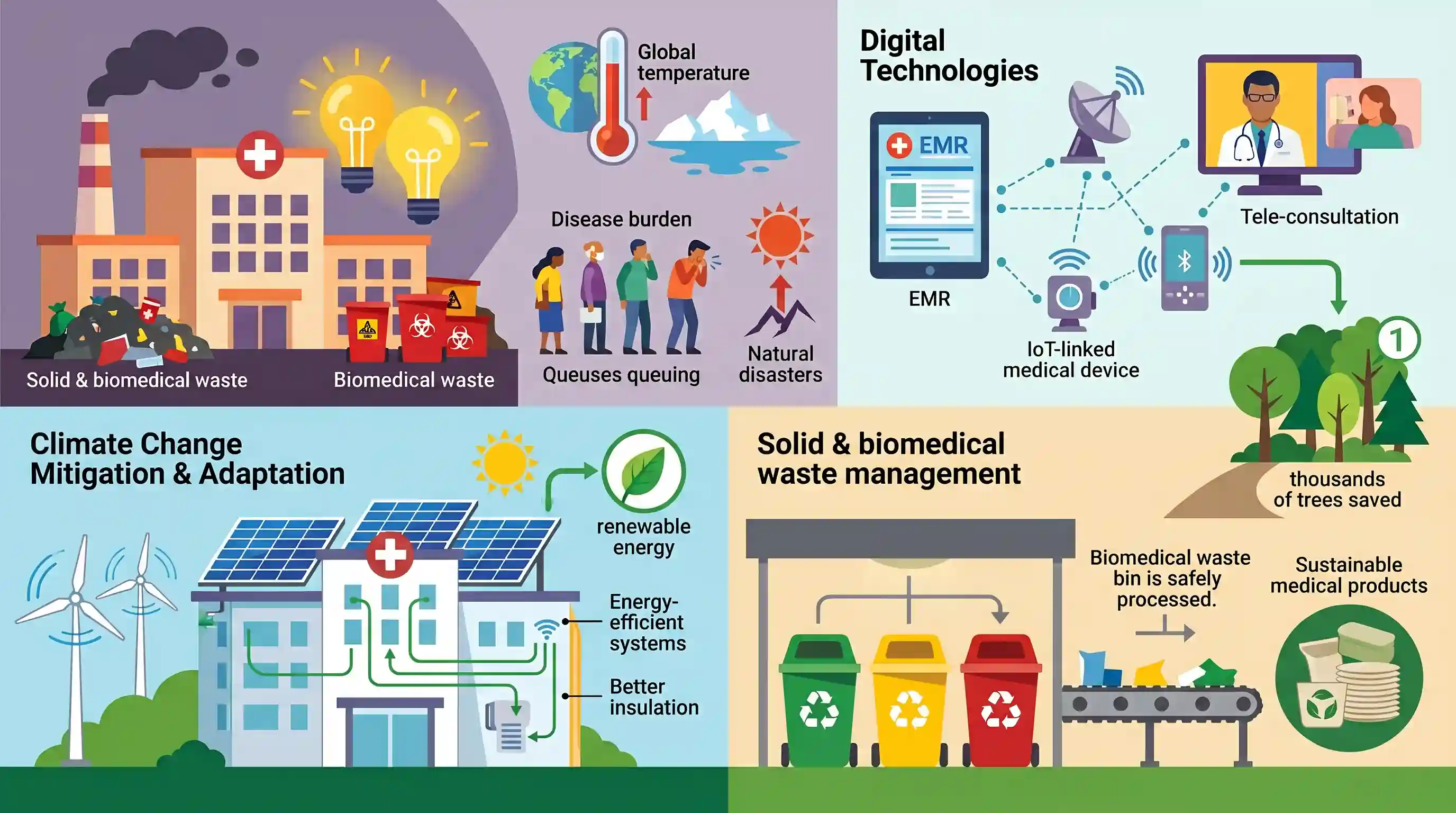
The healthcare industry must undergo a functional readjustment to mitigate its substantial carbon footprint and effectively manage the health challenges exacerbated by climate change. At a recent conference in Chennai, experts emphasized that healthcare facilities, which account for significant energy consumption and waste generation, need to adopt 'green hospital' practices. This includes transitioning to renewable energy like solar power, implementing energy-efficient systems, and promoting sustainable medical products to reduce solid and biomedical waste. Additionally, leveraging digital technologies such as Electronic Medical Records (EMRs), IoT, and tele-consultations can enhance patient care resilience while minimizing environmental impacts, such as saving thousands of trees annually.
Key Points
- Healthcare systems contribute substantially to carbon emissions due to high energy use and resource-intensive operations.
- Climate change is simultaneously accelerating the burden of both non-communicable and infectious diseases, requiring healthcare to build systemic resilience.
- Experts advocate for green hospital operations, including the use of solar power, energy-efficient equipment, water recycling, and strict switch-off policies.
- Shifting to reusable medical and sanitary products (such as menstrual cups and washable pads) can significantly reduce biomedical and solid waste.
- Digital interventions like Electronic Medical Records (EMRs), IoT devices, and tele-consultations are critical for reducing paper use and moving patient care from hospitals to homes.
Important Terms
National Green Tribunal (NGT)

A statutory body established under the NGT Act 2010 for the specialized handling of environmental disputes, including the enforcement of Bio-medical Waste Management Rules within the healthcare sector.
UPSC context
Relevant for GS Paper III (Environment and Statutory Bodies) regarding judicial oversight of industrial and healthcare pollution.
Indian Medical Association (IMA)
The largest voluntary professional organization for modern medicine doctors in India, which advocates for medical ethics, healthcare policy, and sustainable practices like scientific biomedical waste disposal.
UPSC context
Relevant for GS Paper II (Health Governance) as a key stakeholder in national health policy and professional regulation.
National Health Mission-Tamil Nadu
The state-level execution wing of India's flagship health scheme, which in Tamil Nadu integrates climate resilience into public health through initiatives like 'One Health' hubs and green hospital infrastructure.
UPSC context
Significant for GS Paper II (Social Justice/Health) regarding state-specific implementation of climate-sensitive healthcare strategies.
Commonwealth Medical Association (CMA)
A non-governmental organization founded in 1962 that strengthens the capacity of national medical associations across Commonwealth nations to promote health equity, human rights, and professional medical standards.
UPSC context
Relevant for GS Paper II (International Institutions) concerning global health diplomacy and collaborative climate mitigation in medicine.
SRMIST
A prominent private research university in Chennai that serves as a hub for interdisciplinary conferences, focusing on translating climate research into actionable "green hospital" operations and policies.
UPSC context
Mentioned as an academic partner in healthcare policy development and climate-resilient infrastructure research.
Prelims Trap
The Bio-Medical Waste Management Rules mandate the complete phase-out of all chlorinated plastic bags, including blood bags.
The 2016 Rules (and amendments) mandate the phase-out of chlorinated plastic bags and gloves, but explicitly exclude blood bags due to medical necessity.
Static Concepts Connected
How is biomedical waste segregated under the BMWM Rules, 2016?
- Yellow Category: Human and animal anatomical waste, soiled waste, and expired medicines. Destined for incineration or deep burial.
- Red Category: Contaminated recyclable waste made of plastics like IV tubes, bottles, and syringes (without needles). Autoclaved and recycled.
- White Category: Waste sharps including needles, scalpels, and blades in puncture-proof translucent containers. Handled via dry heat sterilization or shredding.
- Blue Category: Broken or discarded contaminated glassware and metallic body implants. Disinfected and recycled.
How does climate change act as a 'threat multiplier' for health?
- Vector Expansion: Warmer temperatures expand the geographical range of vectors like mosquitoes, introducing diseases like Dengue to higher altitudes and new latitudes.
- NCD Exacerbation: Extreme heat and shifting weather patterns exacerbate chronic non-communicable diseases, particularly cardiovascular and respiratory conditions.
- Pathogen Incubation: Increased ambient temperatures can accelerate pathogen replication within vectors, shortening the extrinsic incubation period of diseases.
Cross-Topic Patterns
Digital Public Infrastructure (DPI) as climate action
The Ayushman Bharat Digital Mission (ABDM) and platforms like eSanjeevani reduce transport emissions and physical waste, perfectly linking Digital Public Infrastructure (DPI) with climate mitigation goals.
One Health approach to climate-induced diseases
The expansion of vector habitats due to warming necessitates a 'One Health' approach, bridging environmental conservation, animal health, and human epidemiology to build systemic resilience.

Expect a 2026 question linking the carbon footprint of healthcare delivery with specific color-coding provisions of the BMWM Rules, 2016.
Linked PYQs · 5
Linked PYQs · 5
- 2022MainsGS3
Discuss global warming and mention its effects on the global climate. Explain the control measures to bring down the level of greenhouse gases which cause global warming, in the light of the Kyoto Protocol, 1997.
- 2022MainsGS3
The increase in life expectancy in the country has led to newer health challenges in the community. What are those challenges and what steps need to be taken to meet them?
- 2017MainsGS3
'Climate change' is a global problem. How India will be affected by climate change? How Himalayan and coastal states of India will be affected by climate change?
- 2020MainsGS3
Describe the benefits of deriving electric energy from sunlight in contrast to the conventional energy generation. What are the initiatives offered by our Government for this purpose?
- 2018MainsGS3
What are the impediments in disposing the huge quantities of discarded solid wastes which are continuously being generated? How do we remove safely the toxic wastes that have been accumulating in our habitable environment?
