Medical Education Expansion and Public Healthcare Deficits in India
Source:Indian Express ↗
Why It Matters
Crucial for understanding the gap between medical education quantity and healthcare quality, linking human resource development with public health delivery under GS Paper II.
Summary
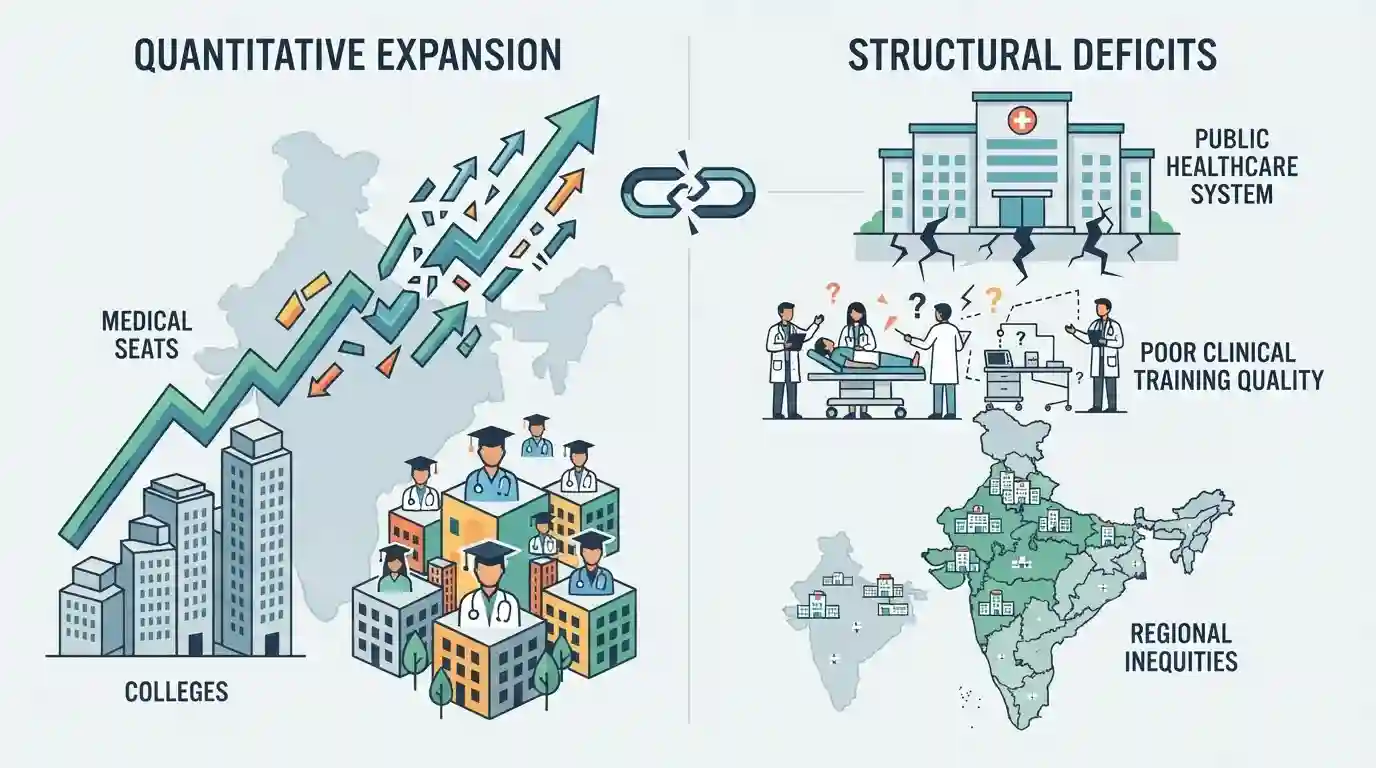
The article examines India's rapid expansion of medical education seats and colleges, noting that this quantitative boom masks deeper structural deficits in the public healthcare system, clinical training quality, and regional inequities. It emphasizes the need for qualitative reforms and public system integration over mere seat proliferation.
Key Points
- India's recent boom in medical seats and colleges hides a critical deficit in the public healthcare system and clinical training quality.
- The private sector dominates new medical college expansions, often lacking adequate patient footfall and clinical material essential for proper training.
- Merely increasing seat numbers without expanding functional district hospitals or teaching infrastructure leads to a dilution of education quality.
- Policy interventions must focus on strengthening public health infrastructure, district hospitals, and qualitative metrics rather than raw quantitative expansion.
Important Terms
National Medical Commission Act

A landmark 2019 legislation that replaced the corruption-plagued Medical Council of India with the National Medical Commission to reform medical education, regulate professional conduct, and ensure quality healthcare standards.
UPSC context
UPSC GS Paper II (Social Sector - Health). Tests understanding of regulatory reforms in medical education and governance of health human resources.
National Medical Commission
Apex regulatory body established under the NMC Act 2019 to determine standards of medical education, oversee medical institutions, and regulate medical professionals in India.
UPSC context
UPSC GS Paper II (Governance & Health). Important for questions on institutional oversight, regulatory bodies, and human resources for health.
Prelims Trap
The National Medical Commission directly finances the conversion of district hospitals into medical colleges to bridge regional gaps.
Aspirants often assume the National Medical Commission (NMC) directly funds district hospital upgrades, whereas it is primarily a regulatory body while funding flows through Centrally Sponsored Schemes.
Static Concepts Connected
What are the key statutory bodies and governance frameworks regulating medical education in India?
- NMC Act 2019: Replaced MCI in 2020 to bring transparency, reduce regulatory burden, and promote affordable medical education.
- MARB (Medical Assessment and Rating Board): Autonomous board under NMC responsible for assessing and approving medical institutions and monitoring standards.
- UG/PGMEB: Autonomous board under NMC that determines UG and PG medical curricula, standards, and guidelines.
Cross-Topic Patterns
Medical Education + Centrally Sponsored Schemes
The expansion of medical colleges via district hospitals directly intersects with federal fund-sharing patterns and state-level capital expenditure priorities in social sectors.
Medical Workforce Marketisation + Health Economics
Private sector dominance in medical education feeds directly into out-of-pocket expenditure and catastrophic health spending trends in India.

Quantitative seat expansion vs clinical quality in medical education is high-yield for Mains GS-2 (Health/Human Resources) and prelims conceptual traps.
Linked PYQs · 3
Linked PYQs · 3
- 2024MainsGS2
In a crucial domain like the public healthcare system the Indian State should play a vital role to contain the adverse impact of marketisation of the system. Suggest some measures through which the State can enhance the reach of public healthcare at the grassroots level.
- 2018MainsGS2
Appropriate local community-level healthcare intervention is a prerequisite to achieve 'Health for All' in India. Explain.
- 2016MainsGS2
Professor Amartya Sen has advocated important reforms in the realms of primary education and primary health care. What are your suggestions to improve their status and performance?
