Healthcare Boom and Public Medical Education Deficits
Source:Indian Express ↗
हे का महत्त्वाचे आहे
It addresses the critical tension between commercialized healthcare expansion and public health delivery deficits, directly relevant to GS Paper 2 (Health, Social Sector, Human Resources) and inclusive development.
सारांश
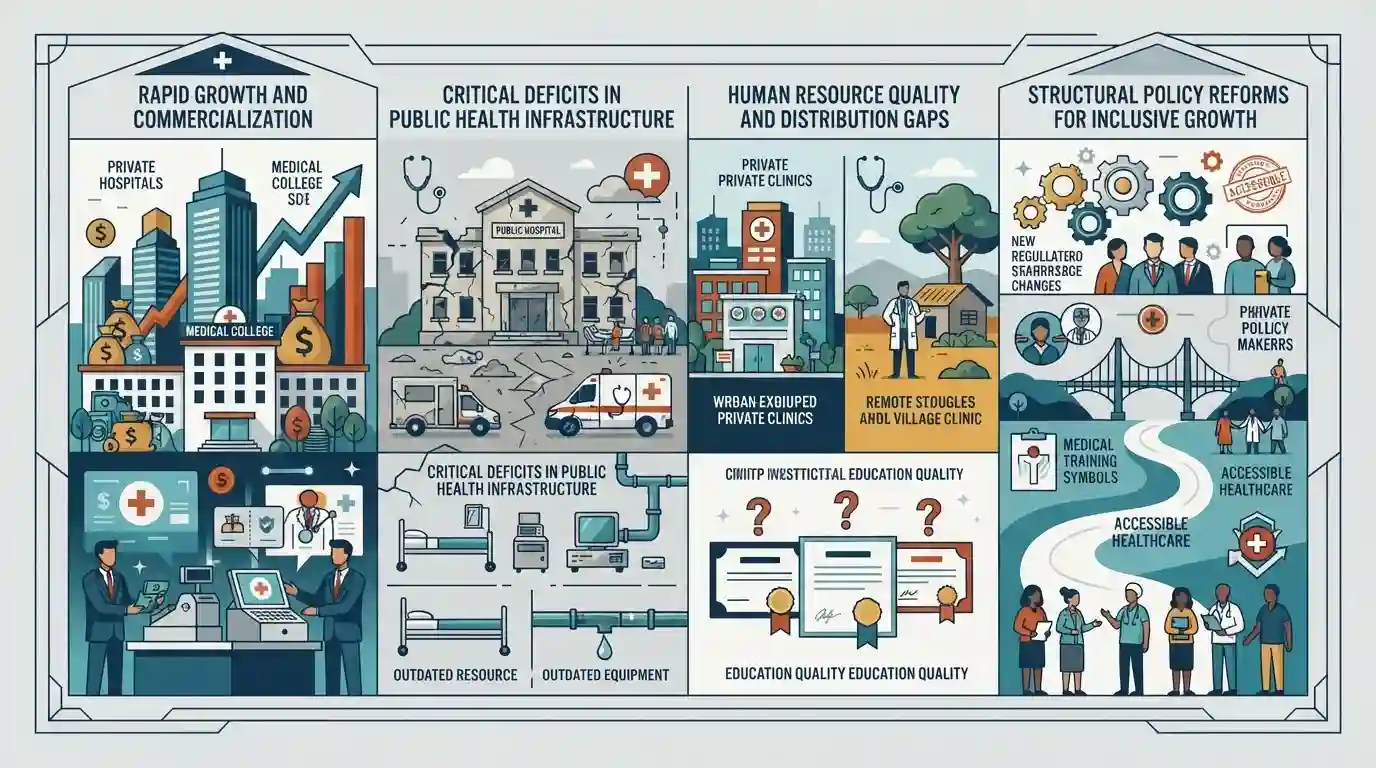
The article highlights how the rapid growth and commercialization of healthcare and medical education in India conceal critical deficits in public health infrastructure and human resource quality, necessitating structural policy reforms to ensure inclusive growth and accessible healthcare.
मुख्य मुद्दे
- The private healthcare boom in India often masks a deep-seated deficit in the public health system, particularly in basic medical education and infrastructure.
- Rapid expansion of medical colleges without adequate faculty, clinical material, and standardized training compromises the quality of medical graduates.
- Disparities in healthcare access persist between urban centers and rural areas, aggravating health inequities.
- Reforming medical education requires strengthening public institutions, ensuring equitable resource distribution, and aligning training with actual public health needs.
महत्त्वाच्या संज्ञा
National Medical Commission

A statutory body established under the National Medical Commission Act, 2019, to replace the Medical Council of India (MCI) and regulate medical education and professional standards nationwide.
UPSC context
Crucial for GS Paper II (Health, Governance, Human Resources). Tests knowledge of statutory bodies reforming medical education and healthcare regulation in India.
पूर्वपरीक्षा सापळा
India has successfully achieved the National Health Policy 2017 goal of spending 2.5% of GDP on public health.
Aspirants often assume India has reached the National Health Policy 2017 target of 1.5% to 2.5% of GDP for public health expenditure, whereas actual expenditure hovers around 1.4-1.5%.
संबंधित स्थिर संकल्पना
What are the key governance and regulatory bodies governing medical education and public health in India?
- National Medical Commission:: Replaced the Medical Council of India (MCI) to regulate medical education and medical professionals, ensuring standards and transparency.
- National Health Policy 2017:: Envisages a progressive increase in public health expenditure to 2.5% of GDP by 2025 and universal access to good quality healthcare services.
- District Residency Programme:: Mandates post-graduate medical students to serve for a specified period in district hospitals to bridge rural healthcare gaps.
आंतर-विषय नमुने
Medical Expansion + Federal Fiscal Architecture
The expansion of medical colleges intersects with federal fiscal governance and Centre-State allocations, as health is a State subject under the Seventh Schedule while central bodies set standardizations.
Human Capital Quality vs. Quantitative Expansion
Commercialization of medical education ties directly into the 'Skill India' and human capital dividend debates, examining whether quantitative expansion compromises quality.

Expect questions linking National Health Policy targets (2.5% GDP) with structural deficits in medical education and rural-urban inequities.
संबंधित PYQ · 3
संबंधित PYQ · 3
- 2024MainsGS2
In a crucial domain like the public healthcare system the Indian State should play a vital role to contain the adverse impact of marketisation of the system. Suggest some measures through which the State can enhance the reach of public healthcare at the grassroots level.
- 2023MainsGS2
The crucial aspect of development process has been the inadequate attention paid to Human Resource Development in India. Suggest measures that can address this inadequacy.
- 2024MainsGS3
Examine the pattern and trend of public expenditure on social services in the post-reforms period in India. To what extent this has been in consonance with achieving the objective of inclusive growth?
