Study Reveals Clinical Deskilling Risks from Overreliance on AI
Source:The Hindu ↗
Why It Matters
The article provides a crucial, evidence-based example of 'deskilling' caused by AI in a critical sector like healthcare. It is highly relevant for GS3 (Science & Technology - applications and effects of AI) and GS4 (Ethics - reliance on machines vs human competency), offering a nuanced counterpoint to narratives that focus solely on the benefits of technological integration.
Summary
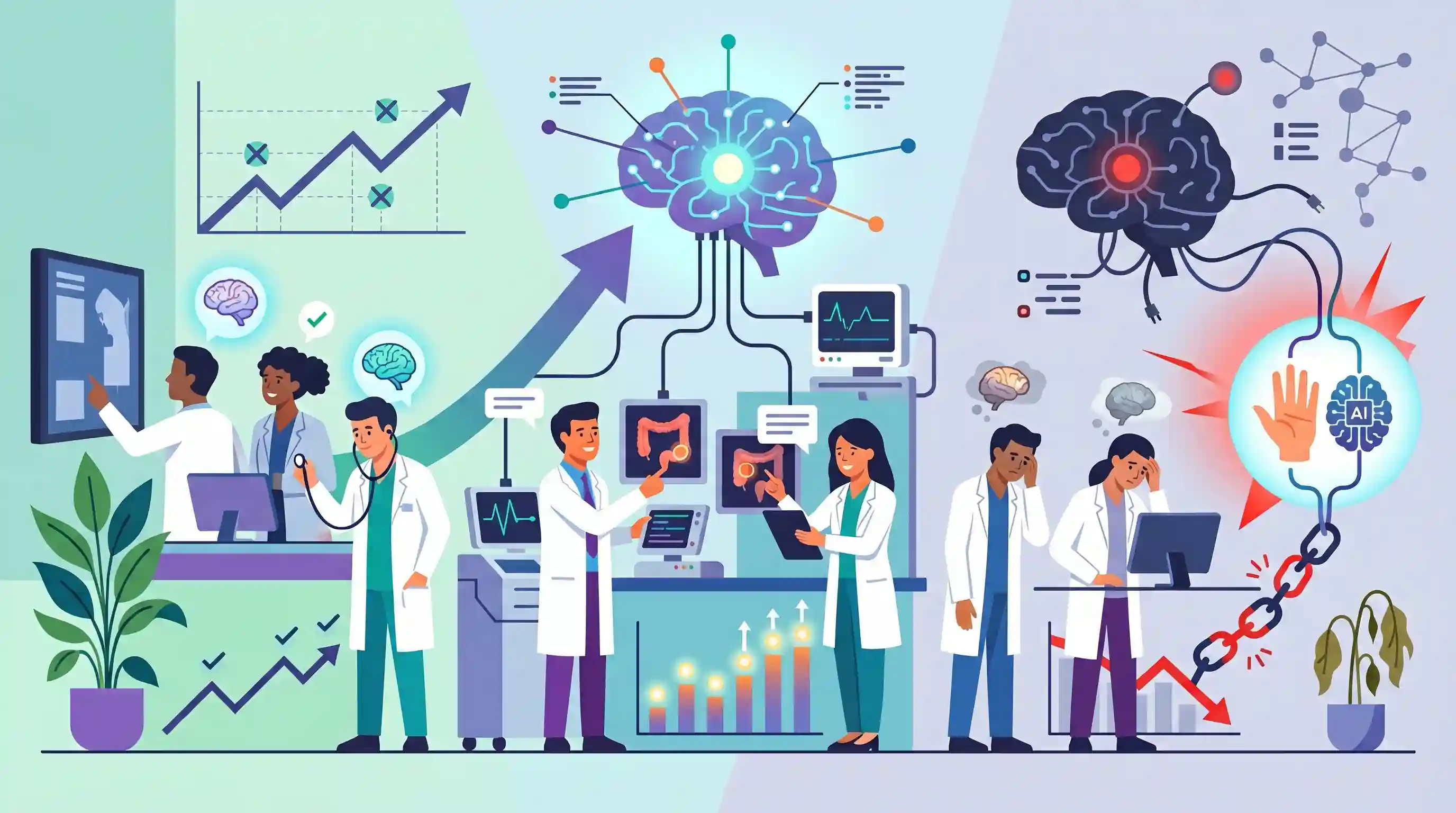
A new study reveals that integrating Artificial Intelligence (AI) in medical diagnostics can lead to a 'deskilling' of healthcare professionals. Researchers at the University Hospital Würzburg found that doctors' ability to detect benign colon tumours independently dropped by 20% after they relied on an AI assistance system for three months. While AI improved detection rates during its active use, its removal exposed a concerning decline in the doctors' inherent diagnostic capabilities. This study serves as a critical warning about the unintended consequences of AI reliance in healthcare, highlighting the need for balanced integration that preserves and enhances human clinical expertise rather than replacing it.
Key Points
- A recent study published in Gastroenterology found that health professionals' skills to independently detect benign tumours (adenomas) during colonoscopies dropped by 20% after using AI assistance for three months.
- The randomized control trial involved doctors first conducting colonoscopies independently, then using an AI system (CADe) for a period, and finally returning to independent screening.
- While AI temporarily boosted the detection rate when active, doctors demonstrated 'deskilling' once the AI was removed, exhibiting a significant decrease in their diagnostic abilities.
- The study highlights the 'unintended clinical consequences' of reliance on AI in healthcare, warning that overdependence might compromise the foundational diagnostic skills of medical professionals in the long run.
- This phenomenon raises critical concerns for healthcare regulations, suggesting that safeguards and continuous independent training are necessary to prevent the erosion of human medical expertise as AI integration increases.
Important Terms
Deskilling

The loss of practical skills or expertise by human professionals due to over-reliance on automated systems or AI, potentially leading to diagnostic errors when technology is absent.
UPSC context
Relevant for GS Paper 3 (S&T) and GS Paper 4 (Ethics) regarding the impact of automation on labor and professional accountability.
German Research Foundation (DFG)
The central self-governing research funding organization in Germany; it maintains a center in Hyderabad and collaborates with India's Department of Science and Technology (DST).
UPSC context
Important for International Relations and S&T (GS Paper 2 & 3) concerning bilateral research cooperation between India and Germany.
Clinical Decision Support Systems (CDSS)
AI-powered tools designed to assist healthcare providers in making diagnostic or treatment decisions by analyzing patient data and providing evidence-based recommendations.
UPSC context
Significant for GS Paper 3 (S&T) as it represents a core application of AI in public healthcare delivery like India's e-Sanjeevani.
University Hospital Würzburg
A major European medical and research institution that conducted the landmark study on AI-induced deskilling in colonoscopy procedures.
UPSC context
Serves as a case study for GS Paper 3 (S&T) on the real-world clinical consequences of AI adoption in medicine.
Automation Bias
The tendency of humans to over-rely on automated systems, often ignoring contradictory information or failing to verify results independently.
UPSC context
Crucial for GS Paper 4 (Ethics) and S&T regarding human-machine interface risks and the need for human-in-the-loop oversight.
Medical Ethics
A framework of moral principles—including autonomy, accountability, and transparency—that governs the development and application of medical technologies and patient care.
UPSC context
Core topic for GS Paper 4 (Ethics) and Essay, focusing on balancing innovation with patient safety and human dignity.
Prelims Trap
Benign tumours, like adenomas, are completely harmless as they lack the ability to spread or mutate into cancer.
While benign tumours do not metastasize (spread to other organs), some, like adenomas, are 'premalignant' and carry a high risk of mutating into cancer.
Static Concepts Connected
What is the biological difference between benign and malignant tumours?
- Metastasis: Malignant tumours spread to other body parts via blood or lymph systems, while benign tumours remain strictly localized to their origin.
- Premalignant potential: Though initially non-cancerous, certain benign tumours (like adenomas) are 'premalignant' and can mutate into malignant cancers over time if not removed.
- Growth rate: Benign tumours generally grow slowly and have distinct boundaries, whereas malignant ones grow rapidly and aggressively invade adjacent tissues.
What are the core ethical concerns regarding AI integration in critical healthcare?
- Cognitive Deskilling: Prolonged reliance on AI diagnostic tools can erode the foundational, independent clinical capabilities of healthcare professionals over time.
- Automation Bias: The psychological tendency of human operators to unquestioningly favor suggestions from automated decision-making systems over their own clinical judgment.
- Algorithmic Accountability: The legal and moral dilemma of determining liability (doctor, hospital, or software developer) when an AI-assisted diagnostic error results in patient harm.
Cross-Topic Patterns
AI Ethics + Human Accountability
Links GS-3 AI applications with GS-4 ethics. The 'deskilling' phenomenon perfectly illustrates automation bias, raising debates on legal liability and clinical resilience if automated systems fail.
NCD Management + Preventative Tech
Connects CADe systems for tumour detection to India's NPCDCS framework, highlighting how AI could help tackle the rising Non-Communicable Disease burden if governed by human-in-the-loop safeguards.

Expect a GS-3 or GS-4 question on 'automation bias' and cognitive deskilling as unintended negative externalities of AI in public services.
Linked PYQs · 2
Linked PYQs · 2
- 2023MainsGS3
Introduce the concept of Artificial Intelligence (AI). How does Al help clinical diagnosis? Do you perceive any threat to privacy of the individual in the use of Al in healthcare?
- 2020PrelimsGS1
With the present state of development, Artificial Intelligence can effectively do which of the following? 1. Bring down electricity consumption in industrial units 2. Create meaningful short stories and songs 3. Disease diagnosis 4. Text-to-Speech Conversion 5. Wireless transmission of electrical energy Select the correct answer using the code given below:
