Tamil Nadu health officials probe illegal kidney sale racket
Source:The Hindu ↗
Why It Matters
The illicit trade of human organs highlights severe vulnerabilities among the poor and raises fundamental questions regarding medical ethics and the enforcement of the Transplantation of Human Organs and Tissues Act (THOTA). It is directly relevant to GS2 (issues relating to Health and vulnerable sections) and GS4 (Bioethics).
Summary
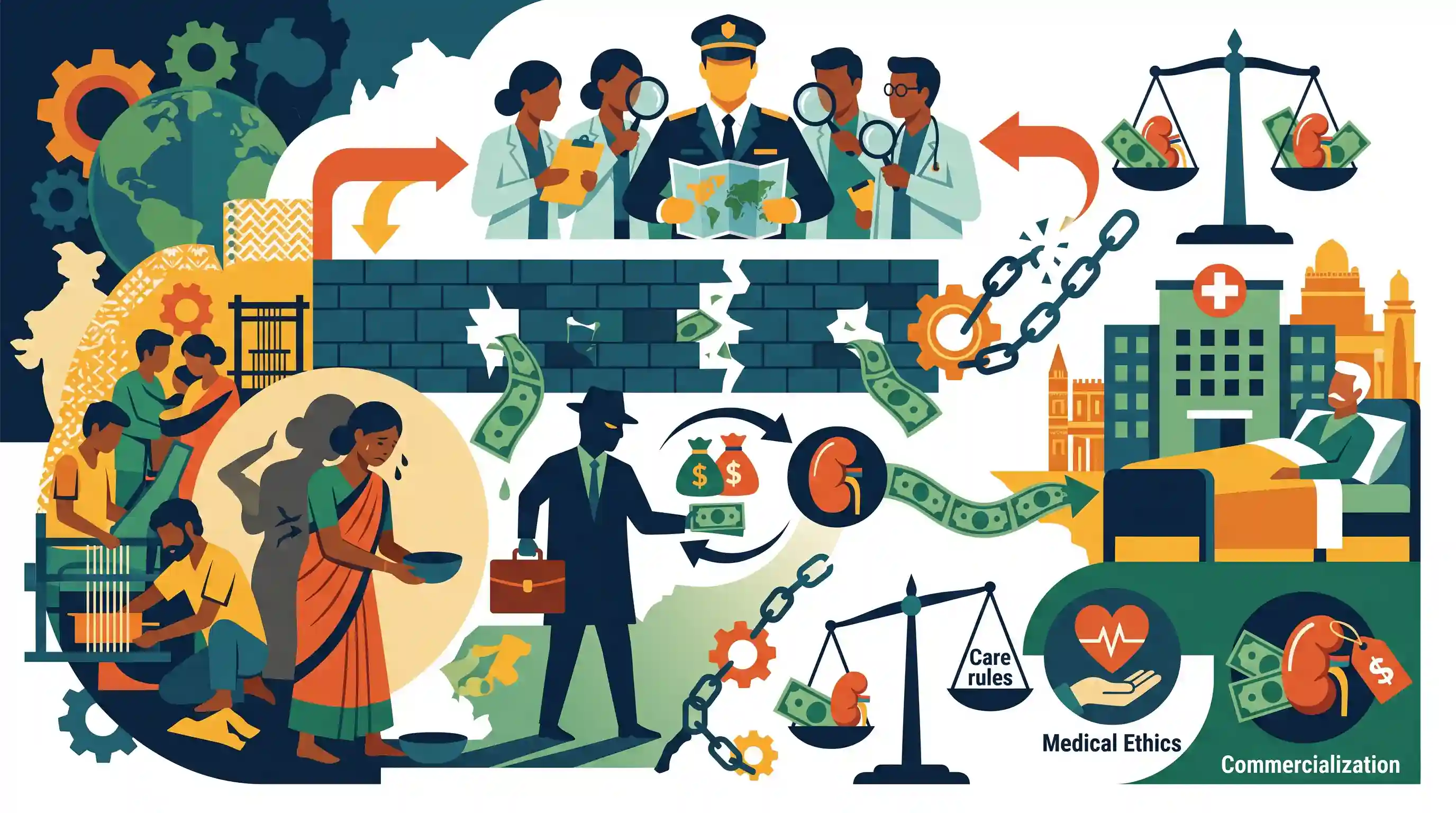
An investigation is underway in Namakkal, Tamil Nadu, following allegations of an illegal kidney sale racket targeting impoverished daily wage workers. Health officials, led by District Joint Director Rajmohan, are probing claims that a mediator facilitated the sale of a power loom worker's kidney to an Erode hospital, exploiting her financial distress. The incident highlights critical gaps in the enforcement of organ transplantation laws and the grave ethical implications of commercializing human organs among vulnerable populations.
Key Points
- Health officials in Tamil Nadu's Namakkal district have initiated an inquiry into an alleged illegal kidney sale racket in Pallipalayam.
- The racket allegedly targeted impoverished daily wage earners, such as power loom workers, exploiting their financial vulnerability.
- A victim claimed she received only a fraction of the promised compensation for her kidney, which was allegedly removed at a hospital in Erode.
- The authorities are investigating the involvement of a mediator and a potential larger network exploiting poor laborers for organ harvesting.
Important Terms
Transplantation of Human Organs and Tissues Act (THOTA), 1994

India's primary legislation regulating organ procurement and transplantation. It prohibits commercial trading, mandates informed consent, and recognizes brain stem death to ensure ethical medical practices.
UPSC context
GS Paper II (Governance/Health) and Paper IV (Ethics); tests legal frameworks and medical ethics.
National Organ and Tissue Transplant Organization (NOTTO)
The apex national body under the Ministry of Health and Family Welfare. It coordinates organ procurement, maintains a national registry, and ensures equitable organ allocation.
UPSC context
GS Paper II (Regulatory Bodies); tests institutional mechanisms for healthcare governance.
Authorisation Committee
A statutory body under THOTA that reviews transplant applications between non-related donors and recipients to verify the absence of commercial motives or coercion.
UPSC context
GS Paper II (Governance); relevant for regulatory oversight and preventing illegal organ rackets.
Brain Stem Death
A legal form of death recognized under THOTA where brain stem functions permanently cease, enabling the legal retrieval of vital organs for cadaveric donation.
UPSC context
GS Paper II/III (Health/S&T); tests legal-medical definitions facilitating organ donation.
Near Relative
A legal category under THOTA (spouse, parents, siblings, children, grandparents, and grandchildren). Donations from this group face less scrutiny than those from non-related donors.
UPSC context
GS Paper II (Social Justice); tests awareness of provisions preventing organ trafficking.
Swap Donation
A legal provision (introduced in 2011) allowing two incompatible donor-recipient pairs to exchange organs, effectively expanding the available organ pool while maintaining ethical safeguards.
UPSC context
GS Paper II (Health Policy); highlights legal solutions to address organ shortages.
Prelims Trap
Under THOTA, unrelated living donors are strictly prohibited from donating organs under any circumstances in India.
Unrelated donors can actually donate out of "affection and attachment," but they require mandatory approval from the Authorization Committee to rule out commercial motives.
Static Concepts Connected
How does THOTA regulate living organ donors in India?
- Near relatives: Includes spouses, siblings, parents, children, and (post-2011) grandparents and grandchildren; they can donate without prior Authorization Committee clearance.
- Unrelated donors: May donate solely out of "affection and attachment," requiring strict vetting and approval by an Authorization Committee to prevent commercialization.
- Commercial trade ban: THOTA strictly prohibits and penalizes commercial dealing in human organs to prevent the exploitation of socio-economically vulnerable populations.
Which core bioethics principles are violated by commercial organ trade?
- Informed consent: True autonomy is compromised because extreme poverty and financial distress act as coercive tools, effectively invalidating voluntary consent.
- Justice and equity: Commercialization turns destitute populations into 'spare part' banks for the wealthy, violating principles of distributive justice and inherent human dignity.
- Non-maleficence: Removing an organ from a healthy, destitute individual inflicts bodily harm without therapeutic benefit to the donor, violating the 'do no harm' mandate.
Cross-Topic Patterns
Health governance meets poverty alleviation
Unorganized sector workers being targeted for kidneys highlights how health legislation (THOTA) fails when extreme poverty and lack of social security push individuals into exploitative survival strategies.
Bioethics and bureaucratic loopholes
The reliance on Authorization Committees to verify donor 'altruism' frequently exposes bureaucratic corruption, linking GS2 statutory framework efficacy with GS4 probity and institutional ethics.

Expect a Prelims question on THOTA's exact definition of 'near relatives' or the mandate of NOTTO amidst rising illegal organ trade.
Linked PYQs · 3
Linked PYQs · 3
- 2012MainsGS2
In the context of Assisted Reproductive Technologies, India has emerged as a hub of commercial surrogacy. What key biological, legal and ethical issues merit consideration while framing the regulation to govern surrogacy in India?
- 2019MainsGS2
Performance of welfare schemes that are implemented for vulnerable sections is not so effective due to absence of their awareness and active involvement at all stages of policy process. Discuss.
- 2024MainsGS4
Sneha is a Senior Manager working for a big reputed hospital chain in a mid-sized city. She has been made in-charge of the new super speciality center that the hospital is building with state-of-the art equipment and world class medical facilities. The building has been reconstructed and she is starting the process of procurement for various equipment and machines. As the head of the committee responsible for procurement, she has invited bids from all the interested reputed vendors dealing in medical equipment. She notices that her brother, who is a well-known supplier in this domain, has also sent his expression of interest. Since the hospital is privately owned, it is not mandatory for her to select only the lower bidder. Also, she is aware that her brother's company has been facing some financial difficulties and a big supply order will help him recover. At the same time, allocating the contract to her brother might bring charges of favouritism against her and tarnish her image. The hospital management trusts her fully and would support any decision of hers. (a) What should be Sneha's course of action? (b) How would she justify what she chooses to do? (c) In this case, how is medical ethics compromised with vested personal interest?
