Health Security and National Security Cess Proposals
Source:The Hindu ↗
Why It Matters
Cesses and surcharges are a recurring theme in UPSC exams, especially concerning fiscal federalism as they are usually excluded from the divisible pool of taxes. A cess whose revenue is explicitly designated to be shared with States is a significant deviation from normal public finance practice, making it highly relevant for Mains (GS2 Governance/Health, GS3 Economy) and Prelims (Taxation concepts).
Summary
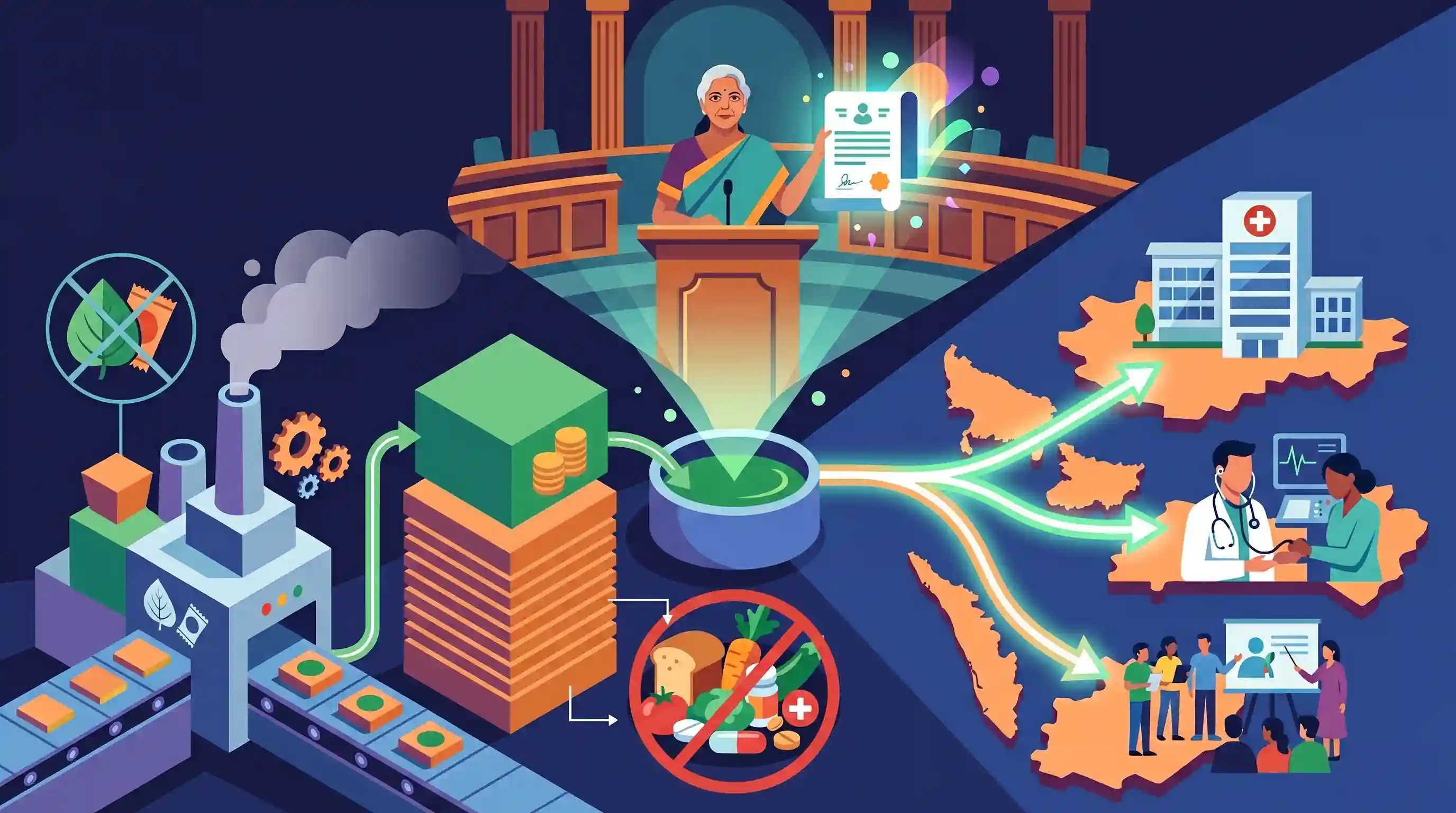
Finance Minister Nirmala Sitharaman introduced the 'Health Security se National Security Cess Bill, 2025' in the Lok Sabha. The proposed cess aims to fund public health initiatives and will notably not apply to any essential commodities. Instead, it targets the production capacity of pan masala units as a deterrent against the consumption of this demerit good, supplementing the existing 40% GST. In a rare departure from the standard financial structure where cesses are retained solely by the Centre and kept out of the divisible pool, the revenues generated from this new health cess will be shared with the States to implement health awareness and related activities.
Key Points
- The 'Health Security se National Security Cess Bill, 2025' was introduced in the Lok Sabha to fund health-related initiatives.
- Essential commodities are entirely exempt from this proposed cess.
- The cess will be levied on the production capacity of pan masala manufacturing units, targeting a demerit good to deter consumption.
- Unlike most cesses which remain exclusively with the Centre, the revenue from this cess will be shared with the States.
- The funds distributed to States must be utilized for health awareness and public health schemes.
Important Terms
Health Security se National Security Cess Bill, 2025

A 2025 legislative proposal taxing pan masala production capacity to fund health and defense. Revenues are uniquely shared with states, unlike standard cesses.
UPSC context
GS-II/III: Fiscal federalism, health financing, and legislative shifts in Centre-State financial devolution.
Cess
An additional tax levied for a specific purpose (e.g., health). Proceeds are earmarked for that purpose and usually not shared with state governments.
UPSC context
GS-III: Public Finance. Essential for understanding the Union’s revenue-generating powers and earmarked spending.
Divisible Pool
The portion of central tax revenue shared with states. Article 270 typically excludes cesses, making the new bill’s sharing provision a significant policy departure.
UPSC context
GS-II/III: Center-State relations. Key to understanding horizontal and vertical devolution of funds.
Demerit Goods
Products deemed harmful to society (e.g., pan masala). Higher taxes are applied to deter consumption and offset negative health or social costs.
UPSC context
GS-III: Economy/Taxation. Important for understanding 'sin taxes' and social objectives within the GST regime.
Fiscal Federalism
The economic framework governing the division of revenue-raising powers and expenditure responsibilities between central and state governments.
UPSC context
GS-II: Indian Constitution. Tests knowledge of Articles 268-293 and evolving financial partnerships.
Capacity-based Levy
A tax based on the production potential of manufacturing machinery rather than actual output, often used to prevent tax evasion.
UPSC context
GS-III: Economy. Relevant for understanding enforcement measures in indirect taxation and plugging revenue leakages.
Prelims Trap
Revenue from cesses is strictly kept out of the divisible pool and can never be shared with States.
While Article 270 generally excludes cesses from the divisible pool, Parliament can explicitly mandate sharing specific cess revenues with States through dedicated legislation.
Static Concepts Connected
How do cesses differ from standard taxes under Article 270?
- Specific Purpose: A cess is levied for a specific objective; revenues must be deposited into a dedicated reserve fund, not mixed with general tax revenues.
- Divisible Pool: By default under Article 270, cesses and surcharges levied by the Centre are excluded from the divisible pool of taxes shared with States.
What is capacity-based taxation and why is it used for demerit goods?
- Taxing Capacity: Levying a tax based on the maximum production capacity of installed machinery, rather than the actual reported sales volume or transaction value.
- Curbing Evasion: It is an anti-evasion tool used for fragmented sectors like pan masala, where under-reporting of production and clandestine cash sales are highly prevalent.
Cross-Topic Patterns
Fiscal Federalism + Health subjects
Health is a State List subject. Sharing this cess revenue addresses the structural mismatch between the Centre's broad taxation powers and the States' heavy healthcare expenditure burdens.
Independent Levies + GST Architecture
This cess operates outside the GST compensation cess structure, highlighting the Centre's retained sovereign power to impose specific targeted levies even post-GST implementation.

Expect a Prelims statement contrasting Article 270's default exclusion of cesses from the divisible pool with this explicitly shared cess.
Linked PYQs · 5
Linked PYQs · 5
- 2015PrelimsGS1
With reference to the Fourteenth Finance Commission, which of the following statements is/are correct? 1. It has increased the share of States in the central divisible pool from 32 percent to 42 percent. 2. It has made recommendations concerning sector-specific grants. Select the correct answer using the code given below.
- 2025PrelimsGS1
Which of the following statements with regard to recommendations of the 15th Finance Commission of India are correct? I. It has recommended grants of ₹ 4,800 crores from the year 2022-23 to the year 2025-26 for incentivizing States to enhance educational outcomes. II. 45% of the net proceeds of Union taxes are to be shared with States. III. ₹ 45,000 crores are to be kept as performance-based incentive for all States for carrying out agricultural reforms. IV. It reintroduced tax effort criteria to reward fiscal performance. Select the correct answer using the code given below.
- 2018PrelimsGS1
Consider the following items : 1. Cereal grains hulled 2. Chicken eggs cooked 3. Fish processed and canned 4. Newspapers containing advertising material Which of the above items is/are exempted under GST (Goods and Services Tax)?
- 2017PrelimsGS1
What is/are the most likely advantages of implementing 'Goods and Services Tax (GST)'? 1. It will replace multiple taxes collected by multiple authorities and will thus create a single market in India. 2. It will drastically reduce the 'Current Account Deficit' of India and will enable it to increase its foreign exchange reserves. 3. It will enormously increase the growth and size of economy of India and will enable it to overtake China in the near future. Select the correct answer using the code given below:
- 2020MainsGS3
Explain the rationale behind the Goods and Services Tax (Compensation to States) Act of 2017. How has COVID-19 impacted the GST compensation fund and created new federal tensions?
