West Bengal Health Minister Advises Prioritizing Organ Donation
Source:millennium-post ↗
Why It Matters
This issue highlights the legislative and administrative dynamics between public health policies (a state subject) and medical education standards (a concurrent subject). It also links contemporary state health administration with West Bengal's political history (Jyoti Basu's legacy).
Summary
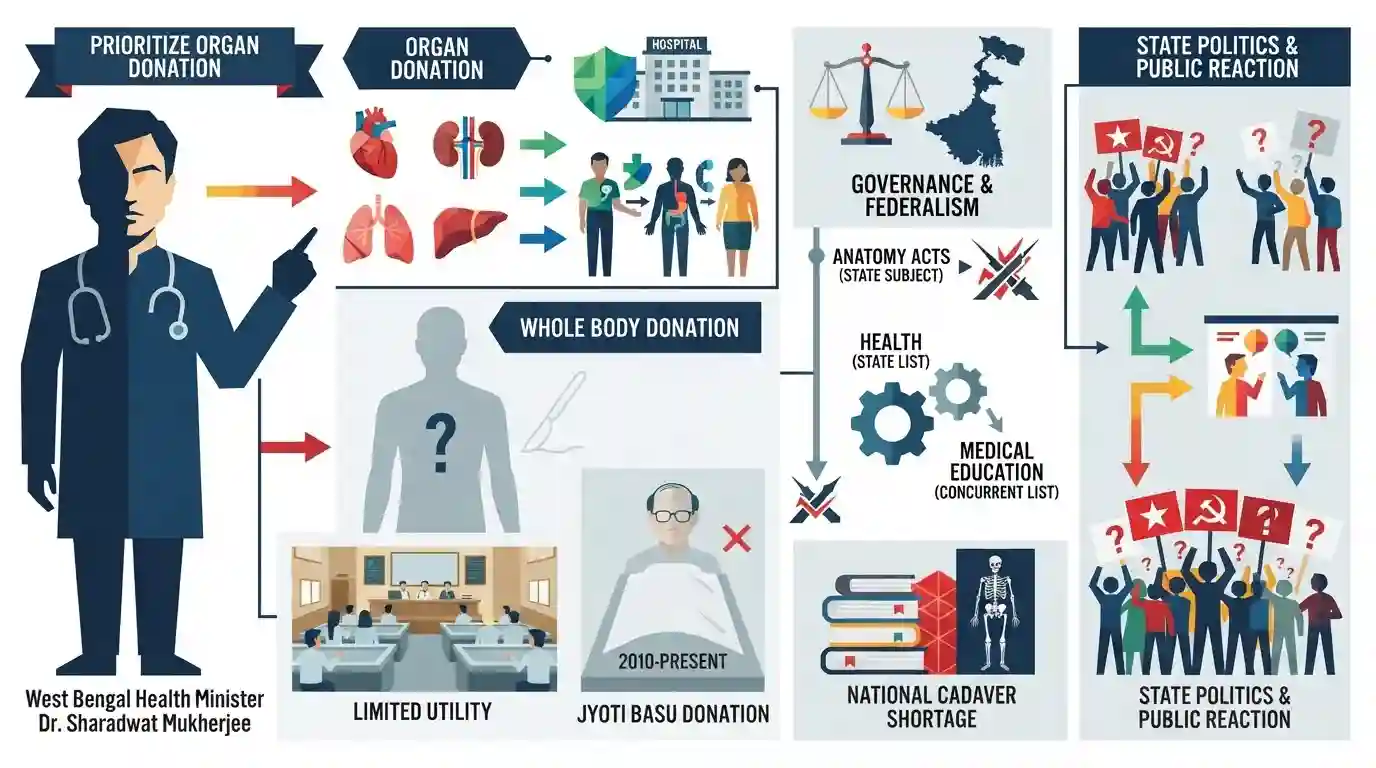
West Bengal Health Minister Dr. Sharadwat Mukherjee has urged the public to prioritize organ donation over whole-body donation, claiming that posthumous body donations have limited medical and educational utility. He specifically mentioned that the body of former Chief Minister Jyoti Basu (donated in 2010) remains unused. This stance has drawn criticism from the public, particularly those aligned with the legacy of the Left Front government, which heavily championed the body donation movement. Posthumous body donation is regulated by state-passed Anatomy Acts. While health is a state subject, medical education is on the Concurrent List, and the Union government has previously highlighted an acute national shortage of human cadavers for academic purposes.
Key Points
- West Bengal Health Minister Dr. Sharadwat Mukherjee advised the public against donating their bodies after death, suggesting they focus on organ donation instead.
- He claimed that whole-body donation has limited medical utility, asserting that the donated body of former Chief Minister Jyoti Basu has not been used for medical purposes.
- The minister's remarks sparked resentment and shock among the public, given that body donation awareness was heavily popularized during the CPI(M)-led Left Front government.
- Body donation for medical education is legally governed by individual state-level Anatomy Acts, which permit licensed medical institutions to receive unclaimed or donated bodies.
- Under the Seventh Schedule of the Indian Constitution, Public Health is a State List subject (List II, Entry 6), while Medical Education is under the Concurrent List (List III, Entry 25).
- The minister's claims run counter to the national scenario where the Union Health Ministry in 2024 urged medical colleges to share cadavers due to a severe shortage for academic dissection.
Important Terms
Seventh Schedule of the Constitution of India

A constitutional schedule under Article 246 that delineates the allocation of legislative powers and responsibilities between the Union (List I), State (List II), and Concurrent (List III) lists.
UPSC context
WBCS Paper V (Polity). Tests center-state relations and legislative control over subjects like public health and medical education.
Anatomy Act
State-legislated acts in India that govern the legal acquisition, donation, and dissection of unclaimed or voluntarily donated posthumous bodies (cadavers) for medical training and clinical research.
UPSC context
WBCS Paper V (Governance/Polity). Tests understanding of laws regulating healthcare, medical education standards, and ethical use of cadavers.
Left Front
A coalition of left-wing political parties in West Bengal, led by the CPI(M), which governed the state from 1977 to 2011 and strongly championed the posthumous body donation movement.
UPSC context
WBCS Paper III (WB History/GK). Tests political history, socio-cultural movements, and policy legacies of the 34-year Left rule.
CPI(M)
The Communist Party of India (Marxist), a major left-wing political party whose West Bengal leadership pioneered and popularized scientific posthumous body and organ donation movements.
UPSC context
WBCS Paper III/V (State GK/Polity). Tests knowledge of state political parties, ideologies, and key historical figures like Jyoti Basu.
Union Health Ministry
The Ministry of Health and Family Welfare of India, responsible for executing national health policies, coordinating transplant standards, and regulating central standards for medical education.
UPSC context
WBCS Paper V (Governance). Tests central administrative structure, federal healthcare policies, and coordination between Union and State health ministries.
Prelims Trap
Posthumous whole-body donation for academic medical dissection is regulated under the central Transplantation of Human Organs Act (THOA), 1994.
Body donation for medical dissection is governed by state-specific Anatomy Acts. The central THOA 1994 only regulates organ transplantation for therapeutic purposes.
Static Concepts Connected
How are Public Health and Medical Education divided in the Seventh Schedule?
- State List: Public health, sanitation, hospitals, and dispensaries fall under Entry 6 of List II (State List).
- Concurrent List: Education, including medical education and universities, is placed under Entry 25 of List III (Concurrent List).
- Constitutional Shift: The 42nd Constitutional Amendment Act of 1976 shifted Education from the State List to the Concurrent List.
What is the distinction between Anatomy Acts and the Transplantation of Human Organs Act (THOA)?
- State Anatomy Acts: Enacted by state legislatures to regulate the supply of unclaimed or donated bodies to medical institutions for dissection and study.
- Central THOA 1994: A Union legislation that regulates the removal, storage, and transplantation of human organs for therapeutic purposes, preventing commercial dealings.
Cross-Topic Patterns
Federalism in Medical Infrastructure
NMC cadaver-to-student ratios (Concurrent List) rely heavily on state-level execution of Anatomy Acts and public health awareness drives (State List), testing center-state legislative synchronization.
WB Socio-Cultural Movements & Healthcare
The 1980s rationalist body donation movement led by Ganadarpan highlights how state-backed civil society initiatives can reshape regional healthcare ethics and academic resources.

WBCS is likely to test the Seventh Schedule division of 'Public Health' vs 'Medical Education' alongside the 42nd Amendment's list transfers.
Linked PYQs · 2
Linked PYQs · 2
- 2011WBCS_PRELIMSGS1
Which of the following items comes under the concurrent list ?
- 2021WBCS_PRELIMSGS1
How many new Government Medical Colleges have become functional in West Bengal during the last ten years?
