Rabies Control and Neglected Tropical Diseases Public Health Burden
Source:The Hindu ↗
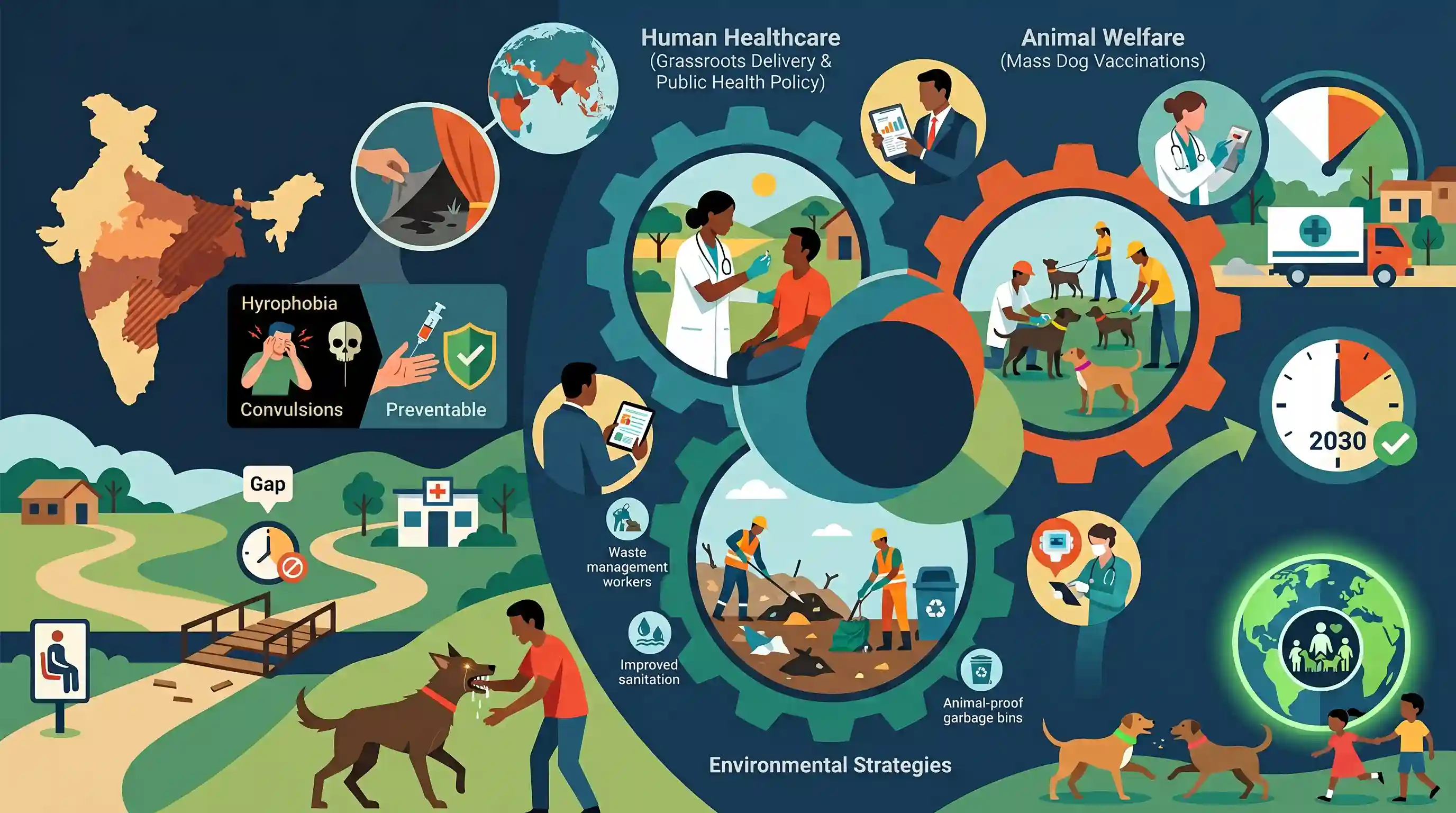
Why It Matters
Rabies exemplifies the socio-economic burden of Neglected Tropical Diseases in India and highlights the critical need for inter-sectoral coordination via the 'One Health' framework, which frequently features in UPSC examinations under health policy and disease control.
Summary
As 2025 comes to a close, rabies continues to exact a heavy toll as a critical Neglected Tropical Disease (NTD). Despite being 100% vaccine-preventable, the disease remains 100% fatal once symptoms manifest. India accounts for a massive proportion of global rabies fatalities, driven largely by inadequate stray dog management and gaps in timely access to post-exposure prophylaxis (PEP) in rural areas. Meeting the global "Zero by 30" target necessitates a robust "One Health" approach, integrating human healthcare, animal welfare (mass dog vaccinations), and environmental strategies to eliminate the threat of this deadly zoonotic infection.
Key Points
- Rabies remains a severely Neglected Tropical Disease (NTD), with a 100% fatality rate once clinical symptoms appear, yet it is completely vaccine-preventable.
- India bears a disproportionately high burden of global human rabies deaths, the vast majority of which are transmitted via stray dog bites.
- The global community aims to achieve the "Zero by 30" target, striving for zero human deaths from dog-mediated rabies by 2030.
- Effective elimination requires a 'One Health' approach that combines accessible human post-exposure prophylaxis (PEP) with mass dog vaccination and animal population control.
Important Terms
Zero by 30 (Global Strategic Plan)

A global strategic plan by WHO, FAO, and WOAH to eliminate dog-mediated human rabies deaths by 2030 through mass dog vaccination and expanded access to human vaccines.
UPSC context
GS Paper 2: International collaborations for public health. GS Paper 3: Science and Technology (Disease control).
National Action Plan for Dog Mediated Rabies Elimination from India (NAPRE)
India's multi-ministerial roadmap launched in 2021 to eliminate dog-mediated rabies deaths by 2030 using a One Health framework and localized state-level action plans.
UPSC context
GS Paper 2: Government policies and interventions for health. Tests knowledge of specific national health targets.
One Health Approach
An integrated, multisectoral approach that recognizes the interconnectedness of human health, animal health, and the shared environment to address zoonotic threats and antimicrobial resistance.
UPSC context
GS Paper 2: Public health management. GS Paper 3: Environment and biodiversity. A frequently recurring theme in UPSC Mains.
Neglected Tropical Diseases (NTDs)
A diverse group of infections, including rabies and leprosy, that prevail in tropical areas among impoverished communities, often lacking sufficient global funding and political attention.
UPSC context
GS Paper 2: Social justice and health. Relevant for issues related to poverty and healthcare delivery.
Post-Exposure Prophylaxis (PEP)
Emergency medical treatment consisting of rabies vaccine and/or immunoglobulin administered immediately after exposure (bites or scratches) to prevent the virus from entering the central nervous system.
UPSC context
UPSC Prelims: Science and Technology (Biological sciences/Health). GS Paper 2: Healthcare infrastructure and delivery gaps.
Zoonotic Diseases
Infectious diseases that are transmitted from animals to humans, such as rabies, Nipah, and COVID-19, often exacerbated by habitat loss and close human-animal contact.
UPSC context
UPSC Prelims: General Science. GS Paper 3: Biodiversity, environment, and disaster management (pandemics).
Prelims Trap
Rabies can be cured with broad-spectrum antiviral medications once clinical symptoms like hydrophobia manifest.
Rabies is 100% vaccine-preventable via post-exposure prophylaxis (PEP) but 100% fatal once clinical symptoms appear. There is no cure after onset.
Static Concepts Connected
What defines Neglected Tropical Diseases (NTDs) under the WHO framework?
- Diverse Pathogens: NTDs are a diverse group of communicable diseases caused by viruses, bacteria, parasites, fungi, and toxins, prevailing mainly in tropical areas.
- The 'Neglected' aspect: They predominantly affect impoverished communities and historically receive minimal global R&D funding and policy attention compared to HIV/AIDS, TB, or Malaria.
- India's Burden: India carries a significant global NTD burden, which includes Rabies, Kala-Azar, Lymphatic Filariasis, Leprosy, and Dengue.
What is the 'One Health' approach?
- Core Principle: An integrated, unifying approach recognizing that the health of humans, domestic and wild animals, and the wider ecosystem are closely linked and interdependent.
- Zoonotic Focus: It provides the essential framework for tackling zoonoses (like Rabies, Nipah, COVID-19), Antimicrobial Resistance (AMR), and food safety issues.
- Global Framework: It is globally championed by the 'Quadripartite' alliance—WHO, FAO, UNEP, and WOAH—to coordinate multi-sectoral pandemic preparedness.
Cross-Topic Patterns
Municipal Governance + National Health Targets
Stray dog management falls under urban local bodies (74th Amendment, Schedule 12). Achieving the national rabies elimination target heavily depends on civic administrative capacity, linking GS-2 local governance directly with GS-3 health.
NTD Elimination Timelines
UPSC often tests specific disease eradication timelines. Aspirants should map "Zero by 30" for Rabies alongside India's specific elimination target years for Kala-azar, Lymphatic Filariasis, and TB.

Prelims 2026 will likely feature a multi-statement question pairing NTDs with their vectors or evaluating the One Health Quadripartite.
Linked PYQs · 3
Linked PYQs · 3
- 2024MainsGS2
In a crucial domain like the public healthcare system the Indian State should play a vital role to contain the adverse impact of marketisation of the system. Suggest some measures through which the State can enhance the reach of public healthcare at the grassroots level.
- 2020MainsGS2
In order to enhance the prospects of social development, sound and adequate health care policies are needed particularly in the fields of geriatric and maternal health care. Discuss.
- 2017PrelimsGS1
Consider the following statements: 1. In tropical regions, Zika virus disease is transmitted by the same mosquito that transmits dengue. 2. Sexual transmission of Zika virus disease is possible. Which of the statements given above is/are correct?
