Global Health Financing Deficits and Climate Public Health Crises
Source:The Hindu ↗
Why It Matters
Provides a crucial interdisciplinary perspective linking climate change with public health and gender issues. It offers strong arguments for Mains answers regarding the necessity of holistic healthcare models, the social impacts of climate change, and the growing role of philanthropic organizations in global development.
Summary
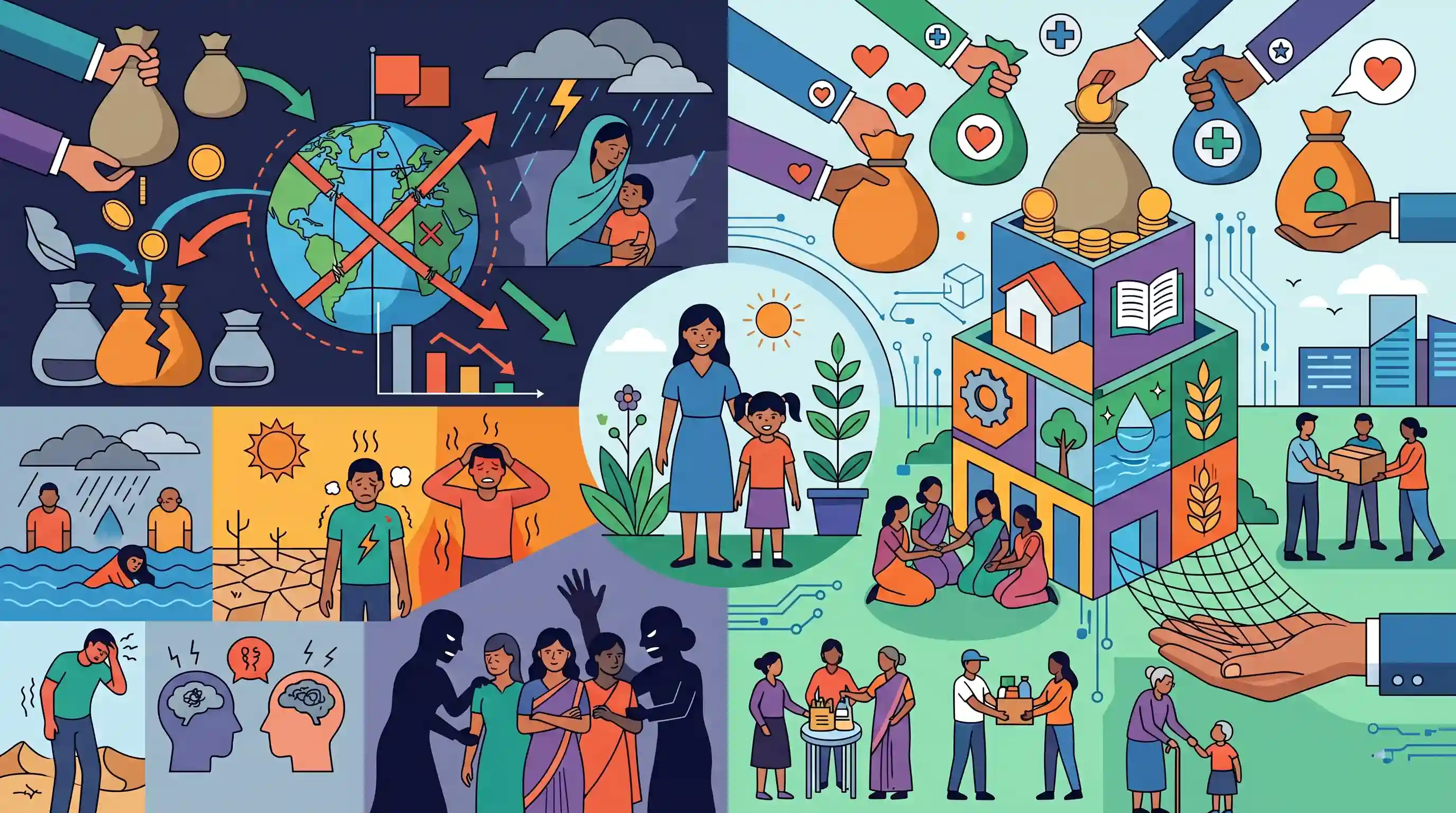
Former WHO Chief Scientist Dr. Soumya Swaminathan highlighted that geopolitical challenges and declining development funds are reversing decades of global health gains, particularly in maternal and child health. Speaking at the Philanthropy Asia Summit, she underscored the severe intersection of climate change and public health, noting that extreme weather not only causes direct physical and mental health issues but also disproportionately harms women by escalating gender-based violence. The address emphasized the necessity of tackling social determinants of health, such as inequality, rather than relying solely on clinical care, and pointed to philanthropy as essential "risk capital" to address these complex, intertwined crises.
Key Points
- Geopolitical tensions and a drop in global development funding are reversing long-standing gains in global health, specifically in maternal and child care.
- Climate change is emerging as a major public health crisis, with extreme heat affecting immune, cardiovascular, and mental health systems, while also forcing climate-induced migration.
- Women are disproportionately affected by climate change, facing an increased incidence of gender-based and domestic violence during extreme weather events like droughts.
- Public health strategies must shift focus from hospital-centric care to addressing the social determinants of health, such as income inequality and living conditions.
- Philanthropy is increasingly vital in Asia, acting as "risk capital" to fund innovative solutions for the intersecting challenges of climate, health, and gender inequity.
Important Terms
Social Determinants of Health (SDH)

Non-medical factors (poverty, education, environment) that shape health outcomes and drive health inequities.
UPSC context
GS 2 (Health/Social Justice); tests understanding of holistic health policy beyond clinical care.
Philanthropy Asia Summit (PAS)
Annual Singapore-based platform convening global philanthropists to catalyze multi-sector partnerships for health, education, and climate action.
UPSC context
GS 2 (NGOs/Charities); relevant for the role of private funding in sustainable development.
Risk Capital
Philanthropic funding for high-stakes social innovations, used to "de-risk" projects before government or commercial scaling.
UPSC context
GS 3 (Economy/Investment Models); discusses innovative financing for social and environmental challenges.
Maternal and Child Health (MCH)
Healthcare services focused on pregnancy, childbirth, and infant health to reduce mortality and morbidity rates.
UPSC context
GS 2 (Welfare/Women & Children); core for evaluating SDG 3 and national health indicators.
Temasek Trust
Singapore-based philanthropic arm that manages funds for social and environmental impact and organizes collaborative alliances.
UPSC context
GS 2 (Civil Society); example of institutional philanthropy’s role in regional development.
Gender-Based Violence (GBV)
Harmful acts directed at individuals based on gender, often exacerbated by climate-related displacement or economic stress.
UPSC context
GS 1 (Social Issues) and GS 2 (Vulnerable Sections); explores the link between climate change and social instability.
Prelims Trap
"Social determinants of health primarily refer to clinical care infrastructure, hospital availability, and genetic predispositions."
UPSC distractors often confuse clinical/medical care with 'social determinants'. SDOH strictly refers to non-medical factors like income, education, and living conditions that drive health inequities.
Static Concepts Connected
What constitute the 'Social Determinants of Health' (SDOH)?
- Non-medical factors: Conditions in which people are born, grow, work, live, and age, shaped by the distribution of money, power, and resources.
- Key components: Income inequality, education access, housing, safe drinking water, sanitation, and social inclusion.
- Health equity impact: WHO estimates that SDOH account for between 30-55% of health outcomes, heavily outweighing traditional clinical care in addressing systemic inequities.
How does the FCRA framework regulate global philanthropy in India?
- Regulatory authority: Administered by the Ministry of Home Affairs to regulate foreign donations, ensuring they do not adversely affect internal security.
- Recent restrictions: Recent amendments strictly prohibit the sub-granting (transfer) of foreign contributions to other NGOs and cap administrative expenses at 20%.
- Sectoral impact: Tighter compliance requirements have significantly reduced the inflow of international developmental funding for health, climate, and social sectors in India.
Cross-Topic Patterns
Climate as a threat multiplier for women
Climate shocks like droughts exacerbate resource scarcity, increasing financial stress and forcing women to travel further for water, which directly escalates their vulnerability to gender-based and domestic violence.
Philanthropy replacing traditional state aid
As official development assistance shrinks, private philanthropy is acting as 'risk capital'—funding innovative, high-risk public health models and climate interventions that conservative state budgets typically avoid.

Expect a Mains GS2/GS3 question evaluating climate change not just as an environmental crisis, but as a public health and gender multiplier.
Linked PYQs · 3
Linked PYQs · 3
- 2020MainsGS2
In order to enhance the prospects of social development, sound and adequate health care policies are needed particularly in the fields of geriatric and maternal health care. Discuss.
- 2021MainsGS2
“Besides being a moral imperative of a Welfare State, primary health structure is a necessary precondition for sustainable development.” Analyze.
- 2024MainsGS2
Public charitable trusts have the potential to make India's development more inclusive as they relate to certain vital public issues. Comment.
