Evidence Based Public Health Policymaking and Data Utilization
Source:The Hindu ↗
Why It Matters
Data-driven governance is a crucial theme in UPSC Mains GS-2. Understanding the limitations of current data utilization in the health sector and the need for evidence-based policymaking provides aspirants with critical analytical points for answers on public health infrastructure, the National Health Mission, and social sector development.
Summary
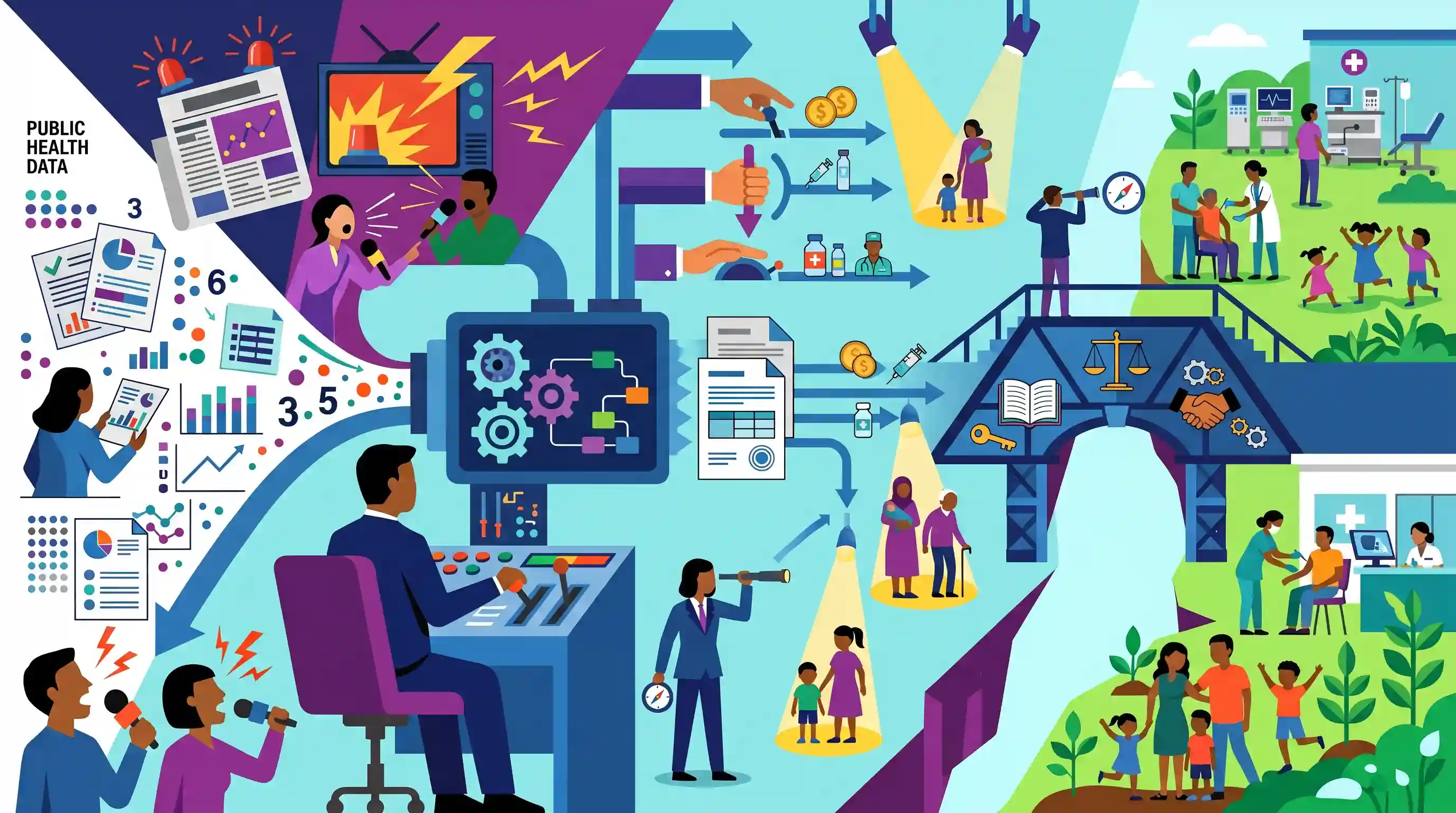
The article highlights the underutilization of India's extensive public health data, arguing that metrics from surveys like the National Family Health Survey (NFHS) are too often used to generate alarming news headlines rather than concrete policy responses. It emphasizes that data should be the cornerstone of evidence-based policymaking, guiding resource allocation and targeted interventions. To improve public health governance, the government must bridge the gap between data collection and actionable health system strengthening at the grassroots level, thereby ensuring sustainable development and better health outcomes for vulnerable populations.
Key Points
- India generates vast amounts of health data through surveys like the National Family Health Survey (NFHS), HMIS, and the Sample Registration System (SRS).
- Often, this data is heavily publicized in the media to highlight deficits or demographic trends, creating sensational headlines without prompting systemic change.
- There is a critical need to transition from using health data merely for evaluation and reporting to utilizing it for evidence-based policy formulation.
- Actionable health intelligence should guide resource allocation, identify vulnerable populations, and design targeted interventions at the grassroots level.
- Bridging the gap between data generation and ground-level public health action is a fundamental requirement to achieve sustainable health outcomes and strengthen India's primary health care system.
Important Terms
National Family Health Survey (NFHS)

A large-scale, multi-round survey conducted by the Ministry of Health and Family Welfare to provide reliable national and state-level data on fertility, mortality, and maternal-child health.
UPSC context
GS Paper 2: Health/Social Justice; essential for monitoring indicators and evaluating welfare scheme outcomes.
Health Management Information System (HMIS)
A digital portal for real-time collection and analysis of health data from facilities, used to monitor program performance and guide resource allocation.
UPSC context
GS Paper 2: Governance/Health; tests knowledge of digital interventions and data-driven monitoring in public health.
National Health Mission (NHM)
India's flagship health program launched to provide universal access to equitable, affordable, and quality healthcare by strengthening rural and urban health infrastructure.
UPSC context
GS Paper 2: Government Policies; the primary framework for health service delivery and infrastructure in India.
NITI Aayog
The government's premier policy think tank that provides strategic advice and monitors health performance through tools like the State Health Index.
UPSC context
GS Paper 2: Governance; critical for understanding cooperative federalism and outcomes-based policy reform.
Evidence-based Policymaking (EBPM)
A governance approach where policy decisions are informed by rigorous empirical data and research findings rather than intuition or political expediency.
UPSC context
GS Paper 2: Governance; a core concept for answering questions on transparency, accountability, and administrative reform.
Ministry of Health and Family Welfare (MoHFW)
The nodal ministry responsible for implementing national health programs, family welfare initiatives, and overseeing medical education and standards across India.
UPSC context
GS Paper 2: Executive/Governance; the central authority for all health-related policy formulation and implementation.
Prelims Trap
"The Sample Registration System (SRS) is published annually by the Ministry of Health and Family Welfare."
The SRS is actually conducted by the Office of the Registrar General of India (ORGI), which operates under the Ministry of Home Affairs, not the Health Ministry.
Static Concepts Connected
Which agencies are responsible for India's major demographic and health surveys?
- NFHS: Nodal agency is the International Institute for Population Sciences (IIPS), Mumbai, functioning under the Ministry of Health and Family Welfare.
- Sample Registration System (SRS): Conducted by the Office of the Registrar General of India under the Ministry of Home Affairs. Provides reliable estimates of IMR, MMR, and fertility.
- HMIS: A centralized Government-to-Government (G2G) web portal under MoHFW used to monitor the National Health Mission (NHM).
What is evidence-based policymaking in public health?
- Targeted Resource Allocation: Shifting from generic scheme implementation to identifying specific vulnerable populations (e.g., high anemia districts) for specialized interventions.
- Actionable Intelligence: Moving beyond viewing data (like NFHS reports) merely as evaluation tools for past performance to using them as predictive intelligence for future planning.
- Concurrent Monitoring: Utilizing platforms like HMIS to continually track facility-wise service delivery and infrastructure gaps at the grassroots level.
Cross-Topic Patterns
Digital Health & Ayushman Bharat Digital Mission
The push for actionable health intelligence aligns with ABDM's goal of creating a seamless electronic health record ecosystem, transitioning from aggregated survey data to real-time, targeted clinical interventions.
Federalism and Inter-State Health Disparities
NFHS data consistently highlights extreme inter-state disparities in maternal and child health, bridging demographic data debates with the fiscal federalism challenges of funding the National Health Mission.

Expect a Prelims matching-pair question on major health datasets (SRS, NFHS, HMIS) and their correct nodal ministries.
Linked PYQs · 3
Linked PYQs · 3
- 2021MainsGS2
“Besides being a moral imperative of a Welfare State, primary health structure is a necessary precondition for sustainable development.” Analyze.
- 2024MainsGS2
In a crucial domain like the public healthcare system the Indian State should play a vital role to contain the adverse impact of marketisation of the system. Suggest some measures through which the State can enhance the reach of public healthcare at the grassroots level.
- 2020MainsGS2
In order to enhance the prospects of social development, sound and adequate health care policies are needed particularly in the fields of geriatric and maternal health care. Discuss.
