Manipur Ethnic Conflict and President Rule Constitutional Implications
Source:The Hindu ↗
Why It Matters
This article provides a real-world case study on the intersection of Constitutional Law (Article 356, S.R. Bommai) and Internal Security (ethnic conflict, militancy in the North-East). It is directly relevant for answering GS2 questions on federalism and President's Rule, as well as GS3 questions on the complexities of peace-building and internal security challenges in border states.
Summary
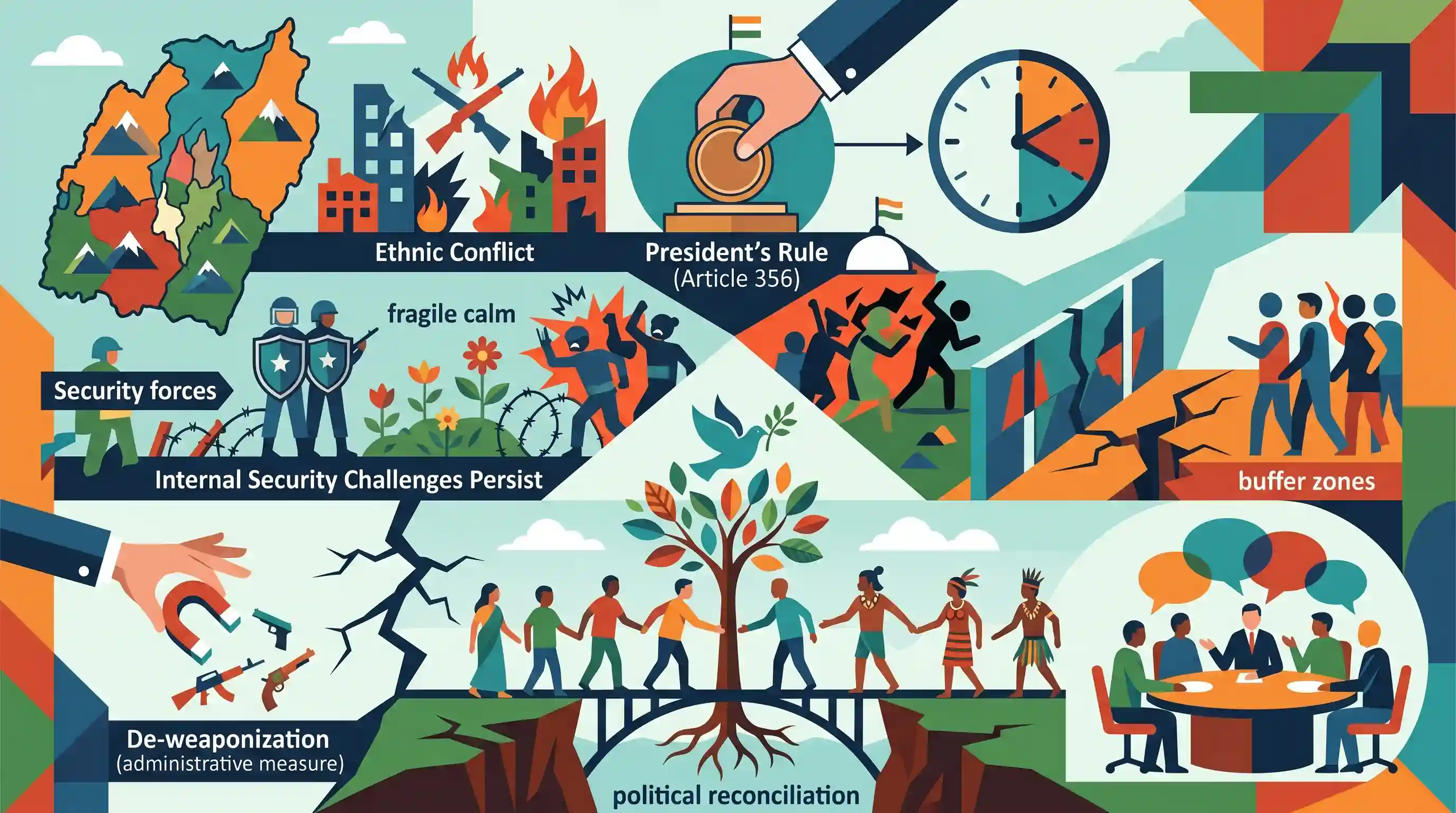
The editorial discusses the extension of President's Rule in Manipur for an additional six months amid the persistent ethnic conflict between Kuki-Zo and Meitei communities. It notes that while the imposition of Article 356 has become rare post the S.R. Bommai judgment, the severe internal security challenges and constitutional breakdown in Manipur necessitated its use. Despite a fragile calm resulting from crackdowns on militant groups, deep ethnic divides and rigid buffer zones remain. The article emphasizes that long-term peace cannot rely solely on administrative measures like de-weaponization; it requires urgent political reconciliation and dialogue to bridge the fractured society.
Key Points
- President's Rule in Manipur has been extended for another six months due to the ongoing ethnic conflict between the Kuki-Zo and Meitei communities.
- The use of Article 356 has significantly declined since the 1990s due to the S.R. Bommai judgment and regional party influence, making its application rare except in genuine cases of constitutional breakdown or severe internal security challenges.
- While crackdowns on militant groups have reduced open violence and allowed some displaced families to return, rigid buffer zones and deep ethnic schisms continue to divide the state.
- Kuki-Zo groups are maintaining demands for a separate administration, whereas hardline Meitei organizations persist with an 'outsiders' narrative.
- Administrative actions like de-weaponization must be accompanied by genuine political reconciliation and initiatives by committed political actors to achieve lasting peace.
Important Terms
Article 356

Constitutional provision allowing the President to impose 'President's Rule' in a state if the constitutional machinery fails, transferring state executive powers to the Union government.
UPSC context
GS Paper II (Polity); tests knowledge of emergency provisions, federalism, and Centre-State relations.
S.R. Bommai Judgment
Landmark 1994 Supreme Court ruling that restricted arbitrary use of Article 356, mandated floor tests to prove majorities, and declared secularism part of the Constitution's basic structure.
UPSC context
GS Paper II (Polity); essential for questions on judicial review, federal balance, and constitutional law.
Kuki-Zo Groups
Ethnic tribal communities primarily inhabiting Manipur's hill districts, currently in conflict with the Meiteis over land rights, political autonomy, and Scheduled Tribe (ST) status demands.
UPSC context
GS Paper III (Internal Security); relevant for North-East insurgency and ethnic conflict studies.
Meitei Organisations
Groups representing Manipur's majority ethnic community, primarily residing in the Imphal Valley, seeking Scheduled Tribe status to protect their ancestral land, culture, and political representation.
UPSC context
GS Paper I (Society); covers ethnic identity, reservation politics, and social diversity.
Buffer Zones
Strategic demarcated areas guarded by central security forces to physically separate warring ethnic communities and prevent violent clashes during the ongoing Manipur conflict.
UPSC context
GS Paper III (Internal Security); tests understanding of conflict management and peacekeeping in disturbed areas.
Constitutional Breakdown
A situation where a state government cannot function according to constitutional provisions, serving as the legal prerequisite for the President to invoke Article 356.
UPSC context
GS Paper II (Polity); crucial for analyzing criteria for central intervention and executive discretion.
Prelims Trap
Under Article 356, President's Rule can be directly imposed solely on the grounds of armed rebellion or internal disturbance.
Article 356 requires a "failure of constitutional machinery." Internal disturbance alone isn't a direct ground unless it causes this failure. (Art 352 uses "armed rebellion", Art 355 covers "internal disturbance").
Static Concepts Connected
What did the S.R. Bommai judgment establish regarding Article 356?
- Judicial Review: The President's satisfaction in invoking Article 356 is not absolute and is subject to judicial review to check mala fide intent.
- Floor Test: The majority of the council of ministers must be tested on the floor of the House, not by the Governor's subjective assessment.
- Basic Structure Violation: Secularism is a basic feature of the Constitution; state governments actively subverting it can be validly dismissed under Article 356.
How is tribal autonomy constitutionally managed in Manipur?
- Article 371C: The Constitution provides for the creation of a Hill Areas Committee comprising MLAs elected specifically from the hill areas of Manipur.
- Not Sixth Schedule: Unlike the tribal areas of Assam, Meghalaya, Tripura, and Mizoram (AMTM), Manipur’s tribal regions do not fall under the Sixth Schedule.
Cross-Topic Patterns
Border Management + Internal Security
The ethnic crisis is exacerbated by the porous Myanmar border. The suspension of the Free Movement Regime (FMR) connects domestic instability with transnational issues like refugee influx and narcotics trafficking.
Article 355 vs Article 356 Dynamics
The Union initially assumed control of Manipur's security under Article 355 without dismissing the state government, showcasing a graduated approach to federal intervention before invoking full President's Rule (Article 356).

Expect a 2026 question linking asymmetric federalism (Art 371C) with border management (FMR) and the changing usage of Article 356.
Linked PYQs · 3
Linked PYQs · 3
- 2023MainsGS2
Account for the legal and political factors responsible for the reduced frequency of using Article 356 by the Union Governments since mid 1990s.
- 2025MainsGS3
What are the major challenges to internal security and peace process in the North-Eastern States? Map the various peace accords and agreements initiated by the government in the past decade.
- 2017MainsGS3
The North-East region of India has been infested with insurgency for a very long time. Analyze the major reasons for the survival of armed insurgency in this region.
