Madhya Pradesh High Court: 27 Percent OBC Quota Law Struck Down
Source:The Hindu ↗
Why It Matters
Crucial for understanding state-level reservation jurisprudence, judicial oversight on quota limits, and governance in Madhya Pradesh.
Summary
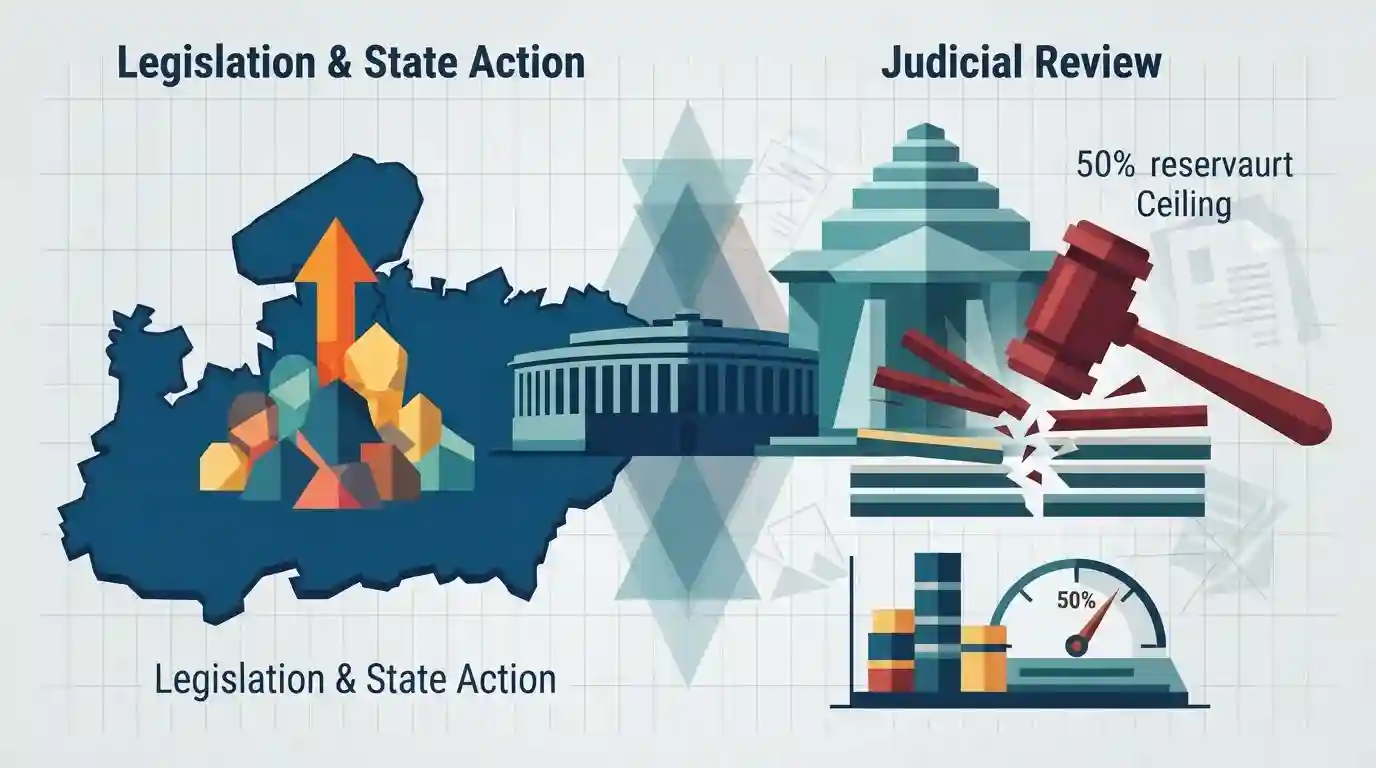
The Madhya Pradesh High Court struck down the state's legislation providing a 27% quota for Other Backward Classes (OBCs), deeming it unconstitutional as it breached the Supreme Court-mandated 50% reservation ceiling limit without proper quantifiable data or exceptional justifications.
Key Points
- The Madhya Pradesh High Court struck down the state's law providing 27% reservation for Other Backward Classes (OBCs), ruling it unconstitutional.
- The court reaffirmed the constitutional ceiling limit on total reservations (typically 50%), noting that breaching this limit without extraordinary circumstances violates fundamental rights under the Constitution.
- The ruling holds massive political and social implications for recruitment and admissions within Madhya Pradesh.
Important Terms
Madhya Pradesh 27% OBC Quota Law

A 2019 legislative amendment passed by Madhya Pradesh to increase OBC reservation from 14% to 27%, which was struck down by the High Court for breaching the 50% ceiling limit without quantifiable data.
UPSC context
MPPSC Paper II (Polity & Governance): Tests understanding of reservation policies, constitutional provisions, social justice, and judicial review of state legislations.
Madhya Pradesh High Court
The constitutional court exercising jurisdiction over Madhya Pradesh, empowered under Article 226 to review state legislations and administrative actions for violation of fundamental rights and constitutional limits.
UPSC context
MPPSC Paper II (Judiciary & Polity): Tests knowledge of High Court powers, writ jurisdiction, and judicial review of state laws.
State Government of Madhya Pradesh
The executive organ of Madhya Pradesh headed by the Chief Minister and Council of Ministers, responsible for policy formulation, enacting state laws, and public service administration.
UPSC context
MPPSC Paper II (State Administration): Tests roles of the executive, legislative procedures, governance, and state-level policy implementation.
Prelims Trap
The constitutional text explicitly sets a strict 50% ceiling limit on all reservations.
Aspirants often assume the 50% reservation ceiling is a rigid statutory limit written directly in the text of the Constitution, whereas it is a judicially evolved principle.
Static Concepts Connected
What are the key judicial pronouncements and constitutional provisions governing reservations in India?
- 50% Limit: Indra Sawhney (1992): Established the 50% ceiling limit for total reservations and ruled that creamy layer must be excluded.
- Constitutional Basis: Article 16(4): Empowers the State to make provisions for the reservation of appointments in favor of any backward class.
- EWS Quota: 103rd Constitutional Amendment: Enabled 10% EWS reservation, breaching the 50% ceiling with constitutional backing.
Cross-Topic Patterns
Reservation laws and judicial review in MP
Judicial scrutiny of state reservation acts connects Articles 14, 16, and 32 with the Ninth Schedule protections and MPPSC recruitment notifications.
Quantifiable data in reservations and local bodies
Empirical data requirements for caste quotas mirror the triple-test criteria mandated for local body elections under Article 243.

Expect questions on the 50% reservation ceiling, Indra Sawhney judgment, and constitutional basis of backward class reservations.
Linked PYQs · 3
Linked PYQs · 3
- 2021MPPSC_PRELIMSGS1
The Madhya Pradesh Public Service Commission shall consist of maximum
- 2022MPPSC_PRELIMSGS1
The 91st Amendment of the Indian Constitution provides
- 2022MPPSC_PRELIMSGS1
What is the minimum population required for the declaration of a Gram Panchayat in Madhya Pradesh?
