Madhya Pradesh High Court strikes down 27 percent OBC quota law
Source:The Hindu ↗
Why It Matters
This judgment directly impacts state-level reservation policies, governance, and judicial oversight on affirmative action laws in Madhya Pradesh, making it crucial for aspirants studying Indian polity, fundamental rights, and judicial review.
Summary
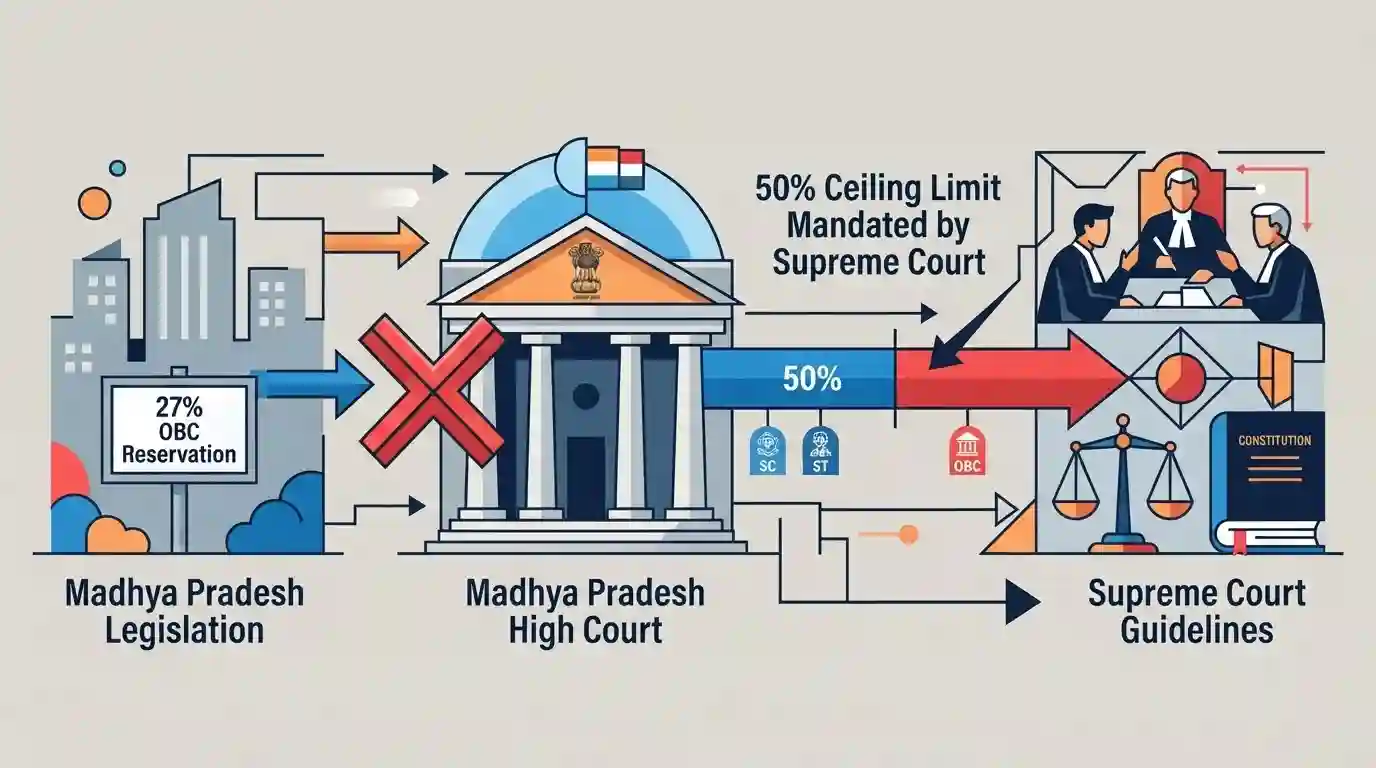
The Madhya Pradesh High Court declared the state's legislation providing 27% reservation for Other Backward Classes (OBCs) unconstitutional, noting that it breaches the 50% reservation ceiling limit mandated by the Supreme Court.
Key Points
- The Madhya Pradesh High Court struck down the state's law providing a 27% quota for Other Backward Classes (OBCs), declaring it unconstitutional.
- The court reaffirmed the Supreme Court's mandate regarding the 50% ceiling limit on total reservations.
- The legal development impacts recruitment processes, public employment, and admissions within Madhya Pradesh.
Important Terms
Madhya Pradesh 27% OBC Quota Law

A state legislation that sought to increase the OBC reservation in Madhya Pradesh from 14% to 27%, which was struck down by the High Court for breaching the 50% constitutional ceiling limit.
UPSC context
MPPSC Paper II (Polity & Governance / Social Justice): Tests understanding of state reservation policies, constitutional validity, and equity issues.
Indra Sawhney case
A landmark 1992 Supreme Court judgment that upheld the 27% OBC quota while establishing a strict 50% ceiling on total reservations, barring extraordinary circumstances.
UPSC context
MPPSC Paper II (Indian Constitution & Judicial Review): Tests knowledge of basic structure, judicial precedents, and the legal framework of affirmative action.
Madhya Pradesh High Court
The constitutional court of Madhya Pradesh that examines state legislation and executive actions for conformity with fundamental rights and basic structure doctrines.
UPSC context
MPPSC Paper II (Judiciary & State Administration): Tests the role of High Courts in judicial review and federal balance within the state structure.
Static Concepts Connected
What are the key constitutional provisions and judicial milestones governing reservations in India?
- Indra Sawhney (1992):: Indra Sawhney Case (1992): Established the inviolable 50% ceiling limit on total reservations except in extraordinary circumstances.
- Constitutional Basis:: Articles 15(4) and 16(4): Empower the State to make special provisions for the advancement of socially and educationally backward classes or Scheduled Castes and Tribes.
- EWS Amendment:: 103rd Constitutional Amendment: Introduced a 10% reservation for Economically Weaker Sections (EWS), enabling total reservations to exceed 50% for the first time.
Cross-Topic Patterns
Judicial Quota Rulings and MPPSC Exam Cycles
The MP High Court ruling directly impacts the operational schedule of the Madhya Pradesh Public Service Commission (MPPSC), particularly regarding the release of pending results and recruitment notifications.
Reservation Ceiling and Constitutional Amendments
The 50% ceiling limit on reservations established in the Indra Sawhney case intersects with constitutional debates over Article 15(6) and 16(6) concerning Economically Weaker Sections (EWS).

MPPSC Prelims or Mains may test the Indra Sawhney case 50% ceiling limit or the constitutional basis of state reservation laws.
Linked PYQs · 3
Linked PYQs · 3
- 2022MPPSC_PRELIMSGS1
The 91st Amendment of the Indian Constitution provides
- 2025MPPSC_PRELIMSGS1
In which Article of the Indian Constitution is there a provision of reservation of seats for Scheduled Tribes in the State Assembly?
- 2025MPPSC_PRELIMSGS1
The doctrine of 'basic structure' in the context of Indian Constitution was propounded in which of the following cases for the first time?
