Calcutta High Court Sets Deadline for RG Kar CBI Investigation
Source:millennium-post ↗
Why It Matters
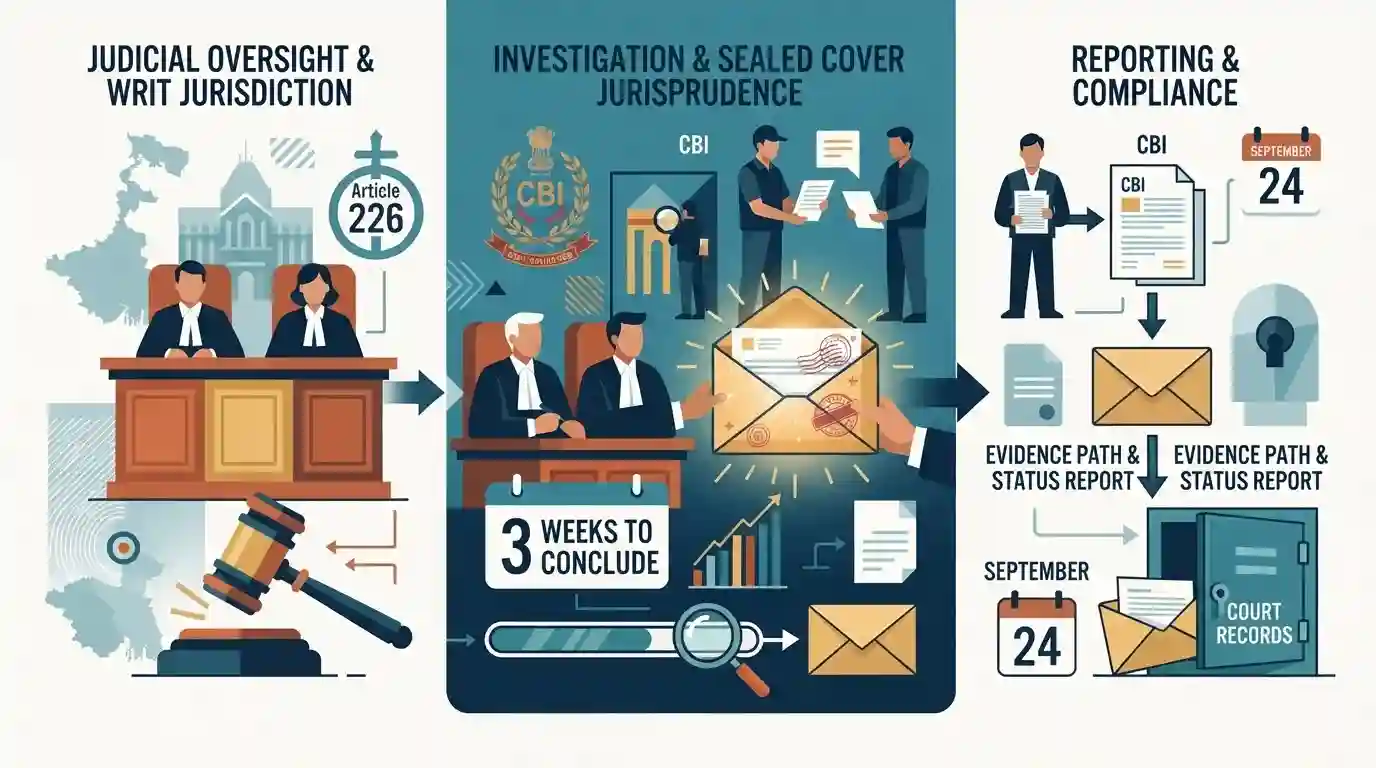
This development exemplifies the extensive writ jurisdiction of the High Court under Article 226 of the Constitution of India, showcasing how courts can mandate and actively monitor investigations by central agencies (CBI) within a state, bypassing the general requirement of state consent under Section 6 of the Delhi Special Police Establishment (DSPE) Act. It also highlights the practice of sealed cover jurisprudence during active criminal investigations.
Summary
The Calcutta High Court's special bench of Justices Shampa Sarkar and Tirthankar Ghosh has set a strict three-week deadline for the CBI to conclude its investigation into the RG Kar Medical College rape and murder case. During an in-camera hearing, the court took the CBI's case diary and report on record under a sealed cover and directed the submission of a closed-envelope report outlining the evidence path against key suspects, scheduling the next hearing for September 24.
Key Points
- The Calcutta High Court set a three-week deadline for the Central Bureau of Investigation (CBI) to complete its probe into the RG Kar Medical College rape and murder case.
- A special bench comprising Justices Shampa Sarkar and Tirthankar Ghosh orally remarked that the probe must now move toward a final conclusion, stating that no further background details or additional evidence are required.
- The court directed Additional Solicitor General Dhiraj Trivedi to submit a closed-envelope report tracing the investigation path that led to locating the suspects' involvement.
- The High Court took the CBI's current investigation report and case diary on record, ordering both to be kept under a sealed cover.
- The matter is listed for the next hearing on September 24.
Important Terms
Constitution of India (Article 226)

A constitutional provision empowering High Courts to issue directions, orders, and writs (like Habeas Corpus, Mandamus, Certiorari) to protect Fundamental Rights and other legal rights within their territorial jurisdiction.
UPSC context
Tested in WBCS Paper V (Indian Polity), evaluating judicial review, writ jurisdiction, and the difference between Article 32 and Article 226.
Central Bureau of Investigation (CBI)
India's premier central investigating agency, functioning under the Ministry of Personnel, Public Grievances and Pensions, specializing in anti-corruption, economic offences, and complex interstate or international crimes.
UPSC context
Tested in WBCS Paper V (Polity/Statutory Bodies), checking candidates' knowledge of CBI's establishment, administrative control, and non-statutory status.
Delhi Special Police Establishment (DSPE) Act, 1946
The governing legislation from which the Central Bureau of Investigation (CBI) derives its investigative powers. It mandates state consent under Section 6 for CBI operations inside state territories.
UPSC context
Essential for WBCS Paper V, testing federalism, Centre-State relations, and legal limitations of central agencies within state jurisdictions.
Calcutta High Court
The oldest High Court in India, established in 1862 under the High Courts Act, 1861, with territorial jurisdiction over the state of West Bengal and the Union Territory of Andaman and Nicobar Islands.
UPSC context
Vital for WBCS Paper V and West Bengal GK, testing state judiciary structure, historical background, and specific regional jurisdiction.
RG Kar Medical College and Hospital
A prestigious government medical college and hospital located in Kolkata, West Bengal, established in 1886. It is currently the focal point of a major ongoing CBI investigation.
UPSC context
Relevant for Current Affairs in Paper III/IV, assessing awareness of socio-legal events and judicial interventions in West Bengal.
Prelims Trap
The High Court requires state government consent under the DSPE Act before ordering a CBI probe under Article 226.
Constitutional courts can bypass Section 6 state consent requirements using judicial review powers (Article 226/32) as ruled in the 2010 CPDR case.
Static Concepts Connected
Can a High Court direct a CBI probe without State consent?
- Constitutional Power: Under Article 226, High Courts possess writ powers to order federal investigations without state permission.
- Judicial Precedent: The Supreme Court in CPDR (2010) ruled that constitutional courts can bypass Section 6 of the DSPE Act.
- Exceptional Circumstances: This extraordinary power is used sparingly to preserve public confidence in justice and state police integrity.
What is the legal status of the CBI?
- Non-Statutory Status: Established in 1963 by an executive resolution on the Santhanam Committee's recommendation, not by an Act of Parliament.
- DSPE Act Powers: The CBI derives its police powers of investigation entirely from the Delhi Special Police Establishment Act, 1946.
- Nodal Agency: Functions under the Ministry of Personnel, Public Grievances and Pensions as the premier central investigative agency.
Cross-Topic Patterns
Writ Jurisdiction + Federal Police Powers
Analyses how Article 226 acts as a constitutional check on List II (Police) subjects, allowing judicial redistribution of executive investigative powers.
Article 20(3) + Forensic Investigation Limits
Examines how the pursuit of evidence paths must respect self-incrimination safeguards during scientific tests like polygraphs and narco-analysis.

Multi-statement questions will likely target the intersection of Article 226 writ jurisdiction and Section 6 state consent under DSPE Act.
Linked PYQs · 1
Linked PYQs · 1
- 2020WBCS_PRELIMSGS1
The Supreme Court of India upheld that RTI was applicable to the
