High Court Seeks Status Report on Mandi Bridge Construction
Source:himachalscape ↗
Why It Matters
Demonstrates the active role of the judiciary through Public Interest Litigation in holding the executive accountable for delays in critical rural infrastructure projects, particularly in geographically challenging and disaster-prone areas like Himachal Pradesh.
Summary
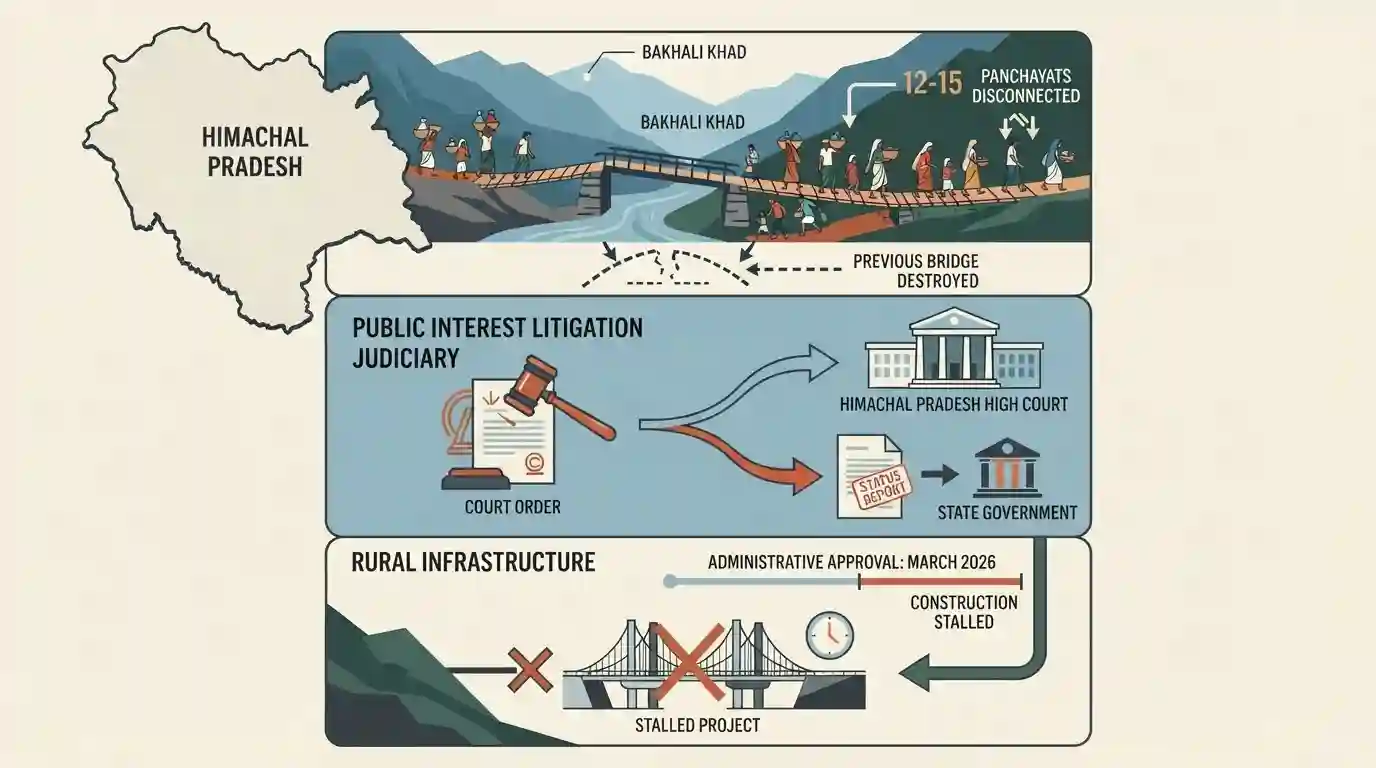
The Himachal Pradesh High Court has directed the state government to submit a status report on a Rs 22 crore bridge project over Bakhali Khad in Mandi district following a Public Interest Litigation (PIL). The petition emphasized that the washing away of the previous bridge left 12-15 panchayats severely disconnected, with only a temporary footbridge available. Despite administrative approval being granted in March 2026, construction progress remains stalled, prompting judicial intervention to ensure timely infrastructure development.
Key Points
- The Himachal Pradesh High Court demanded a status report from the state government regarding the proposed Rs 22 crore motorable bridge over Bakhali Khad in Mandi district.
- A public interest petition highlighted that the previous bridge was washed away, leaving 12 to 15 panchayats with only a footbridge and no proper road connectivity.
- While administrative approval for the project was granted in March 2026, the court is investigating if any subsequent tenders were issued.
Important Terms
Public Interest Litigation (PIL)

A legal mechanism allowing any public-spirited individual to petition constitutional courts for the protection of public welfare and fundamental rights, bypassing the traditional rule of locus standi.
UPSC context
Crucial for GS-II (Judiciary); highlights judicial activism and the enforcement of executive accountability regarding public grievances.
Himachal Pradesh High Court
The apex judicial body in the state. Under Article 226 of the Constitution, it exercises extensive writ jurisdiction to issue directions, hear PILs, and enforce administrative action on delayed public works.
UPSC context
GS-II (State Judiciary); tests understanding of constitutional courts' powers, judicial review, and interventions in state governance.
Bakhali Khad
A Himalayan stream (khad) located in Mandi district, Himachal Pradesh. Mountain streams like this are highly susceptible to seasonal flash floods, frequently threatening and destroying localized rural transport infrastructure.
UPSC context
GS-I (Geography) and GS-III (Disaster Management); serves as a localized example of Himalayan topological challenges.
Rural Infrastructure
Basic physical networks—like roads, footbridges, and motorable bridges—that support rural economies. In difficult hilly terrains, resilient infrastructure is essential to prevent the complete socio-economic isolation of village panchayats.
UPSC context
GS-III (Infrastructure & Economic Development); highlights the necessity of rural connectivity and timely completion of public works.
State Government of Himachal Pradesh
The elected executive authority responsible for regional governance, policy implementation, and allocating state budgets for infrastructure projects across the state's geographically challenging terrain.
UPSC context
GS-II (State Executive); focuses on governance, administrative efficiency, and accountability in executing sanctioned infrastructure projects.
Prelims Trap
Pandoh Lake is a natural high-altitude freshwater lake in Himachal Pradesh.
Pandoh is not a natural lake; it is a man-made reservoir created by the 76-meter-tall Pandoh Dam on the Beas River, completed in 1977.
Static Concepts Connected
What is the constitutional basis and origin of Public Interest Litigation (PIL) in India?
- Constitutional Authority: The Supreme Court (Article 32) and High Courts (Article 226) can entertain PILs to protect collective/public interests.
- Locus Standi Relaxation: It relaxes the traditional 'locus standi' rule, allowing third parties to represent marginalized groups who cannot access justice.
- Judicial Pioneers: Pioneered in the late 1970s and early 1980s by judicial icons Justice P.N. Bhagwati and Justice V.R. Krishna Iyer.
What are the key hydrological and infrastructural features of the Beas River basin?
- Origin and Course: Originates at Beas Kund near Rohtang Pass, flowing through Mandi, Kullu, and Kangra before joining the Sutlej at Harike, Punjab.
- Major Tributaries: Includes perennial, snow-fed streams like Uhl, Parbati, Jiuni, Suketi Khad, and Bakhli Khad.
- Beas-Sutlej Link: Diverts Beas water to the Sutlej River system via a channel to Dehar Power House, creating Pandoh Lake (HP's smallest artificial lake).
Cross-Topic Patterns
Judicial Activism vs Infrastructure Delivery
High Court intervention via PILs highlights how judicial oversight is increasingly leveraged to counter executive inertia and bureaucratic delays in critical rural connectivity projects.
Ecological Fragility & Resilient Infrastructure
Repeated washing away of mountain bridges underlines the urgency of integrating disaster-resilient engineering (SDG 9) within ecologically fragile and landslide-prone Himalayan river basins.

Mapping of Beas basin tributaries (like Bakhli, Uhl) and associated diversion dams is a high-probability 2026 physical geography question.
Linked PYQs · 3
Linked PYQs · 3
- 2020HPAS_PRELIMSGS1
Consider the given four statements and choose the correct answer from the given options. 1. Justice Deepak Misra has been instrumental in the creation of Public Interest Litigation (PIL). 2. Justice Ranjan Gogoi joined Rajya Sabha after retirement from Supreme Court. 3. Justice P.N. Bhagwati introduced PIL. 4. Justice V.K. Krishna Iyer resigned before time.
- 2025HPAS_PRELIMSGS1
Match List I with List II : | List-I (Code) | List-II (District) | |---|---| | (a) Highest Rainfall (2018 Data) | (i) Shimla | | (b) Second Most Incidents Reported (2024 Crime Data) | (ii) Mandi | | (c) Fourth Highest Population (2011 Census) | (iii) Kangra | | (d) Fourth Largest Area | (iv) Solan | Choose the correct answer from the options given below : Code: (a) (b) (c) (d)
- 2023HPAS_PRELIMSGS1
Consider the following statements : (1) The rainiest district in Himachal Pradesh is Kangra. (2) Rainfall in the Alpine region of Himachal Pradesh varies between 300-600 mm. (3) Winter season in Himachal Pradesh extends from October to March. (4) Mandi is the hottest place in Himachal Pradesh. Choose the correct answer from the options given below :
