BMC issues QR code IDs to hawkers as HC seeks swift grievance redress
Source:Indian Express ↗
Why It Matters
The article presents a real-world case study on the efficacy of e-governance tools (chatbots) in municipal administration. It also touches upon the vital socio-economic issue of regulating street vendors (the unorganized sector) while balancing urban infrastructure needs and livelihood rights under the Street Vendors Act.
Summary
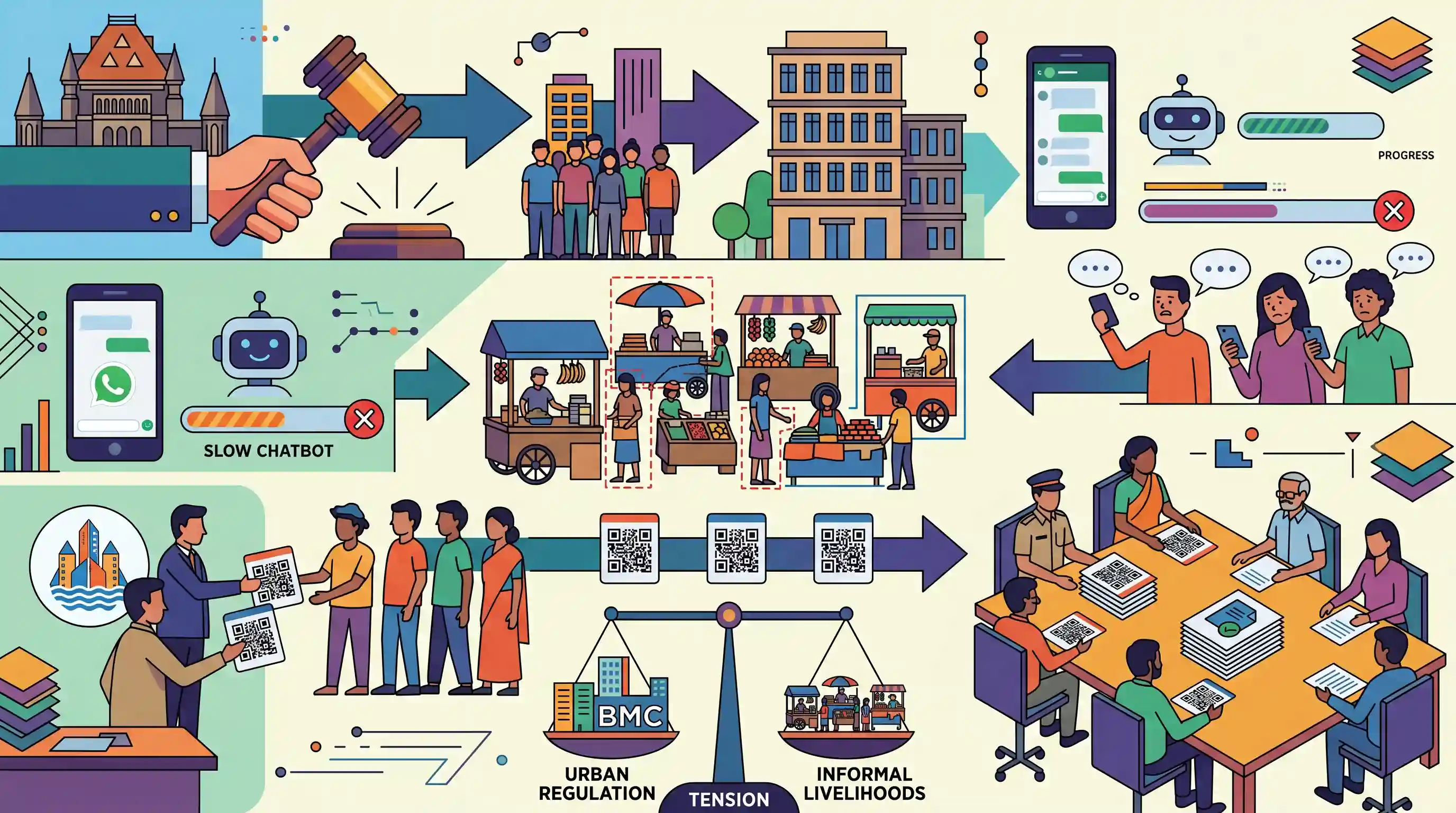
The Bombay High Court has directed the Brihanmumbai Municipal Corporation (BMC) to improve and accelerate its grievance redressal mechanism regarding illegal hawkers in Mumbai. The BMC's new WhatsApp AI chatbot faced criticism for being slow and inefficient. Concurrently, to regulate street vending, the BMC issued provisional QR code-enabled identity cards to over 47,000 hawkers protected by court orders. This interim protection will remain until the Town Vending Committee assesses their formal eligibility under the Street Vendors Act, highlighting the ongoing tension between urban regulation, e-governance efficiency, and informal sector livelihoods.
Key Points
- The Bombay High Court directed the BMC to expedite its grievance redressal process for complaints against illegal hawkers, citing that 'Time is money in Mumbai.'
- A newly introduced WhatsApp chatbot for filing complaints was criticized for being slow, taking about 40 minutes to register an issue.
- The BMC has issued QR code-enabled identity cards to over 47,000 protected street vendors out of nearly 99,000 who were surveyed previously.
- These ID cards are provisional measures to protect hawkers covered by SC and HC orders until the Town Vending Committee (TVC) determines eligibility under the Street Vendors Act.
Important Terms
Street Vendors Act, 2014

Central legislation enacted to regulate street vending in public areas and protect vendors' rights, ensuring protection against arbitrary eviction and providing for designated vending zones.
UPSC context
GS Paper II (Governance); tests knowledge of rights of vulnerable sections and social justice under Article 19(1)(g).
Town Vending Committee (TVC)
A municipal-level participatory body responsible for surveying street vendors, issuing certificates of vending, and demarcating vending zones with mandatory 40% vendor representation.
UPSC context
GS Paper II (Governance); relevant for decentralization, community participation, and urban local governance implementation.
Brihanmumbai Municipal Corporation (BMC)
The governing body for Mumbai, established as an Urban Local Body (ULB) under the 74th Constitutional Amendment Act, responsible for civic administration and infrastructure.
UPSC context
GS Paper II (Polity/Governance); tests understanding of the 74th Amendment and role of large Municipal Corporations.
Bombay High Court
The highest judicial authority in Maharashtra and Goa, exercising original and appellate jurisdiction over municipal actions and fundamental rights protections.
UPSC context
GS Paper II (Judiciary); relevant for judicial oversight of executive actions and urban governance disputes.
Urban Local Bodies (ULBs)
Institutions of self-government in urban areas (like Municipalities/Corporations) constitutionalized by the 74th Amendment Act to handle 18 functional items in the Twelfth Schedule.
UPSC context
GS Paper II (Polity/Governance); critical for understanding democratic decentralization and urban administrative challenges.
Grievance Redressal Mechanism
A system for addressing citizen complaints; in this context, the Court is pushing for efficiency through AI and digital tools like QR codes.
UPSC context
GS Paper II (Governance/E-Governance); tests knowledge of administrative accountability and the application of technology in public service.
Prelims Trap
Town Vending Committees are exclusively composed of municipal officers and police personnel.
The Street Vendors Act, 2014 mandates that at least 40% of TVC members must be street vendor representatives, ensuring participatory regulation, not just municipal control.
Static Concepts Connected
What are the core provisions of the Street Vendors Act, 2014?
- Town Vending Committees: Established to conduct surveys and issue vending certificates. The Act mandates that at least 40% of a TVC's members must be street vendor representatives.
- Protection from eviction: Vendors cannot be evicted or relocated by municipal authorities until a formal survey is completed and a certificate of vending is issued by the TVC.
- Dispute Resolution: The Act mandates independent dispute resolution committees chaired by a civil judge or a judicial magistrate for grievance redressal.
Cross-Topic Patterns
Street Vendors Act + PM SVANidhi scheme
Statutory recognition via municipal QR codes creates the foundational database for central micro-credit schemes like PM SVANidhi, directly linking urban regulation to digital financial inclusion.
E-Governance vs. State Capacity
The BMC chatbot's latency highlights a recurring governance theme: deploying digital front-end tools without adequate back-end administrative capacity leads to superficial public grievance redressal.

Expect a multi-statement Prelims question testing the composition of Town Vending Committees and eviction protections under the 2014 Act.
Linked PYQs · 5
Linked PYQs · 5
- 2024MainsGS2
e-governance is not just about the routine application of digital technology in service delivery process. It is as much about multifarious interactions for ensuring transparency and accountability. In this context evaluate the role of the 'Interactive Service Model' of e-governance.
- 2024MainsGS2
The Citizens' charter has been a landmark initiative in ensuring citizen-centric administration. But it is yet to reach its full potential. Identify the factors hindering the realisation of its promise and suggest measures to overcome them.
- 2023MainsGS2
e-governance, as a critical tool of governance, has ushered in effectiveness, transparency and accountability in governments. What inadequacies hamper the enhancement of these features ?
- 2024MainsGS2
Analyse the role of local bodies in providing good governance at local level and bring out the pros and cons merging the rural local bodies with the urban local bodies.
- 2016MainsGS3
How globalization has led to the reduction of employment in the formal sector of the Indian economy? Is increased informalization detrimental to the development of the country?
