Uttarakhand High Court Reserves Verdict on Relocation Plea
Source:garhwalpost ↗
Why It Matters
The issue highlights the ongoing tension between infrastructural development and environmental conservation in Uttarakhand. It also touches upon the historical mandate of the state's formation and the ecological sensitivity of its forest lands and wildlife habitats.
Summary
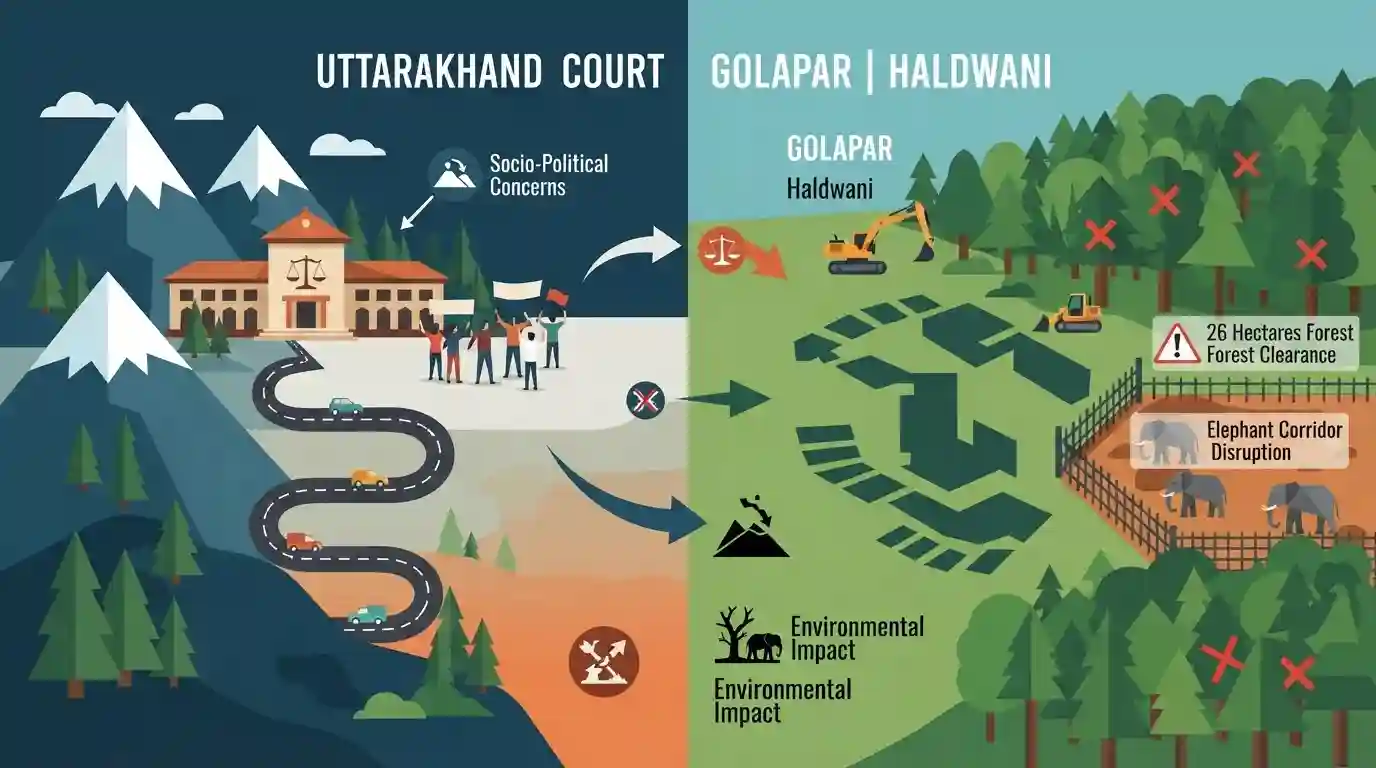
The Uttarakhand High Court has reserved its order on petitions challenging the state government's proposal to relocate the High Court from Nainital to Golapar in Haldwani. The proposed shift is facing strong opposition on both socio-political and environmental grounds. Petitioners contend that moving the court to the plains undermines the core vision of Uttarakhand as a hill state. Additionally, environmentalists highlight that the new site requires clearing 26 hectares of forest land under the Forest Conservation Act, 1980, and threatens a crucial elephant corridor, which could exacerbate ecological degradation and human-animal conflicts.
Key Points
- The Uttarakhand High Court has reserved its order on a petition challenging the state government's decision to shift the High Court from Nainital to Haldwani.
- The state government has proposed moving the court infrastructure to a 26-hectare site in Golapar, Haldwani.
- Petitioners argue the move contradicts the foundational objective of creating Uttarakhand as a 'hill state'.
- Significant environmental concerns have been raised, as the Golapar site involves de-reserving forest land under the Forest Conservation Act, 1980, and is situated near a sensitive elephant corridor, risking increased human-wildlife conflict.
Important Terms
Forest Conservation Act, 1980

A key environmental law enacted in 1980 by the Indian Parliament to regulate the diversion of forest land for non-forest purposes, mandating prior approval from the Central Government.
UPSC context
Crucial for GS-3 (Environment/Ecology) and Prelims, as it dictates the central authority over state-level projects involving reserved forests, like the HC relocation.
Uttarakhand High Court
The highest judicial body in the state of Uttarakhand, currently situated in Nainital. The proposed relocation to Haldwani is the subject of ongoing legal and socio-environmental dispute.
UPSC context
Relevant to GS-2 (Judiciary/State Affairs). Relocation disputes highlight the interplay between administrative convenience, ecological concerns, and regional identity.
State Government of Uttarakhand
The state-level executive authority in Uttarakhand, headed by the Chief Minister. It is responsible for initiating proposals such as the High Court relocation and addressing infrastructural needs.
UPSC context
Tests GS-2 (State Executive). Demonstrates the state's role and limitations when large-scale projects conflict with central environmental regulations.
Central Government
The federal government of India, possessing exclusive authority under the Forest Conservation Act to approve or reject the de-reservation or diversion of reserved forest lands by states.
UPSC context
Important for GS-2 (Federalism) and GS-3 (Environment). Highlights the centralizing elements of Indian environmental law overriding state proposals.
Prelims Trap
"The Gothic-style Uttarakhand High Court building was constructed in 2000 alongside the formation of the state."
The High Court was indeed established on November 9, 2000, but it operates from the historical old Secretariat building that was constructed in 1900.
Static Concepts Connected
How is the principal seat of the Uttarakhand High Court determined?
- UP Reorganisation Act: Section 27 of the UP Reorganisation Act, 2000 legally established the High Court for the newly formed state of Uttaranchal (now Uttarakhand).
- Executive Notification: The President of India officially notified Nainital as the principal seat. Relocating it requires coordination between the State Government and the High Court Chief Justice.
What defines the physiography and ecology of the Haldwani region?
- Bhabar Belt: Haldwani is located in the Bhabar region, a porous, boulder-strewn tract situated immediately south of the Shiwalik foothills, before the Terai plains begin.
- Ecological Corridors: The area's forests serve as vital migratory corridors for elephants across the Terai-Bhabar landscape, making land diversion highly sensitive under the Forest Conservation Act, 1980.
Cross-Topic Patterns
Infrastructure vs. Wildlife Corridors
The Golapar forest clearance issue ties into the recurring UKPSC theme of infrastructure projects fragmenting sensitive Terai-Bhabar elephant habitats.
Judiciary + Hill State Identity
Shifting the court to the plains (only 14% of the state) fuels the socio-political debate over hill-centric development, migration, and stringent land laws in Uttarakhand.

HC relocation issue likely to appear as a multi-statement question merging UP Reorganisation Act, 2000 and Bhabar physiography.
Linked PYQs · 2
Linked PYQs · 2
- 2024UKPSC_PRELIMSGS1
Which Constitutional Amendment Act relates to the protection and improvement of environment and safeguarding of forests and wildlife ?
- 2024UKPSC_PRELIMSGS1
What percentage (approximately) of Uttarakhand is plain area ?
