Calcutta High Court Upholds Speaker Power in Leader of Opposition Row
Source:The Hindu ↗
Why It Matters
The incident underscores the complex dynamics of the Tenth Schedule (Anti-Defection Law), intra-party splits, and the broad discretionary powers exercised by the Speaker in recognizing legislative party leaders. It highlights the tension between legislative autonomy and judicial review.
Summary
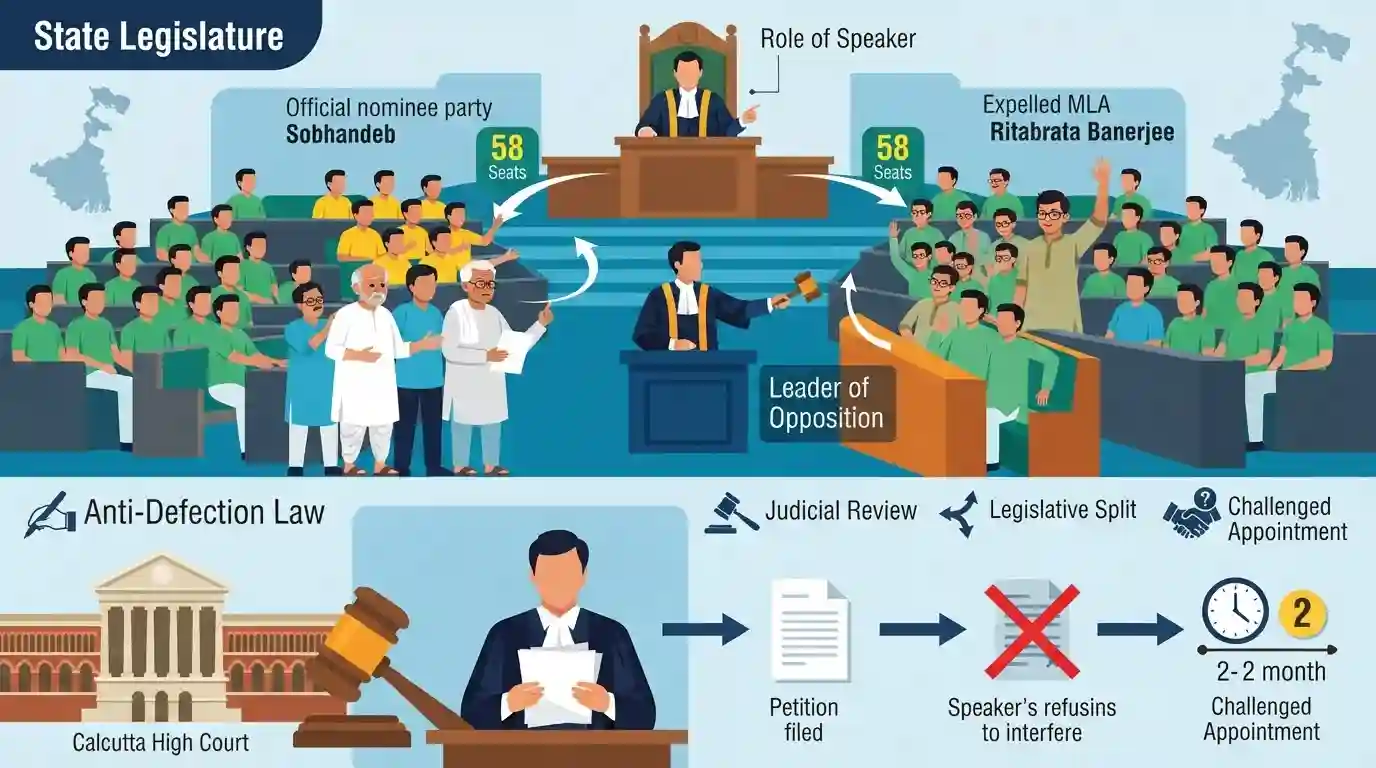
The Calcutta High Court has refused to interfere with the West Bengal Speaker's decision to appoint Ritabrata Banerjee as the Leader of Opposition (LoP). The ruling Trinamool Congress, acting as the opposition in this scenario with 80 seats, saw a deep legislative split when expelled MLA Ritabrata Banerjee claimed the backing of 58 MLAs, defying the party leadership's official nominee, Sobhandeb Chattopadhyay. The High Court stated that no interim relief could be granted to maintain the House's orderliness but ordered a single-judge bench to resolve the petition within two months.
Key Points
- A division bench of the Calcutta High Court refused to issue an interim stay on the appointment of Ritabrata Banerjee as the Leader of Opposition (LoP) in the West Bengal Assembly.
- West Bengal Assembly Speaker Rathindra Bose appointed Ritabrata Banerjee as LoP after he demonstrated the support of 58 Trinamool Congress (TMC) MLAs.
- The appointment sparked a split in the TMC legislature party, as the official party leadership had nominated Sobhandeb Chattopadhyay for the position.
- The High Court instructed a single-judge bench to dispose of the legal challenge within two months, prioritizing the 'orderliness of the House' over immediate intervention.
Important Terms
Leader of Opposition (LoP)

A statutory post in the legislature held by the leader of the largest opposition party. Conventionally requiring 10% of total seats, the LoP enjoys the rank of a Cabinet Minister and sits on critical appointment committees.
UPSC context
Important for WBCS Paper V (Polity). Tests knowledge of parliamentary functioning, statutory recognition, and key committee compositions.
Anti-Defection Law (Tenth Schedule)
Added by the 52nd Amendment (1985), this law disqualifies legislators who voluntarily give up party membership or defy whips. It aims to prevent opportunistic party-switching and ensure government stability.
UPSC context
High-yield for WBCS Paper V. Questions focus on the 10th Schedule, disqualification criteria, the Speaker's role, and merger exceptions.
Judicial Review
The power of constitutional courts to evaluate the legality of state actions. While Speakers enjoy procedural immunity, the Supreme Court established that their final disqualification decisions are subject to judicial review.
UPSC context
Crucial for WBCS Paper V. Tests the separation of powers, Article 226/32 jurisdictions, and the landmark Kihoto Hollohan judgment.
West Bengal Legislative Assembly
The unicameral state legislature of West Bengal, located in Kolkata. It consists of 294 directly elected Members of Legislative Assembly (MLAs) serving five-year terms, operating under Article 168 of the Constitution.
UPSC context
Essential for WBCS Paper V. Tests state-specific political structures, constituency numbers (294), and the functioning of the state legislature.
Calcutta High Court
Formally opened in 1862, it is India's oldest High Court. Situated in Kolkata, its territorial jurisdiction encompasses the state of West Bengal and the Union Territory of the Andaman and Nicobar Islands.
UPSC context
Important for WBCS Paper III and V. Often tested on its founding year (1862), historical significance, and territorial jurisdiction.
Prelims Trap
The judiciary is completely barred from reviewing the Speaker’s decision to appoint a Leader of Opposition under Article 212.
Article 212 only bars judicial inquiry into legislative proceedings based on "procedural irregularity." Substantive illegality or unconstitutional decisions by the Speaker remain fully open to judicial review.
Static Concepts Connected
What are the rules governing the Leader of the Opposition (LoP) in India?
- Statutory Status: The LoP is a statutory post, not a constitutional one. It is governed by specific statutes (like the 1977 Act for Parliament) and equivalent State Acts.
- Cabinet Rank: The LoP enjoys the rank, salary, and allowances equivalent to a Cabinet Minister in the respective government.
- 10% Quorum Rule: By convention and rules, the leader's party must secure at least one-tenth (10%) of the total seats in the House to be officially recognized.
How does Article 212 limit Judicial Review over State Legislatures?
- Procedural Immunity: Courts are prohibited from invalidating legislative proceedings or a Speaker's internal actions purely on the grounds of an "alleged irregularity of procedure."
- Substantive Review: This immunity is not absolute. If a Speaker's action is substantively unconstitutional, grossly illegal, or violates fundamental rights, courts have the power to intervene.
Cross-Topic Patterns
Tenth Schedule vs Legislative Factions
The Speaker recognizing a rebel faction leader as LoP echoes recent Maharashtra crises, testing the boundaries between internal party splits, the whip's authority, and the Tenth Schedule’s anti-defection provisions.
Judicial Restraint & Legislative Autonomy
Refusing interim relief to maintain House "orderliness" highlights how courts defer to legislative autonomy (Article 212), a principle frequently tested alongside the Speaker’s quasi-judicial powers.

Expect a multi-statement question combining the statutory basis of the LoP with the exact limits of Judicial Review under Article 212.
Linked PYQs · 4
Linked PYQs · 4
- 2022WBCS_PRELIMSGS1
The Chairman of the Public Accounts Committee is
- 2015WBCS_PRELIMSGS1
The leader of the Opposition in the Lok sabha enjoys the rank of a -
- 2011WBCS_PRELIMSGS1
The Speaker of the Lok Sabha
- 2023WBCS_PRELIMSGS1
Which amendment of Indian Constitution is related to the Anti-defection law?
