Allahabad High Court Orders Compensation in Unlawful Detention Case
Source:theprint ↗
Why It Matters
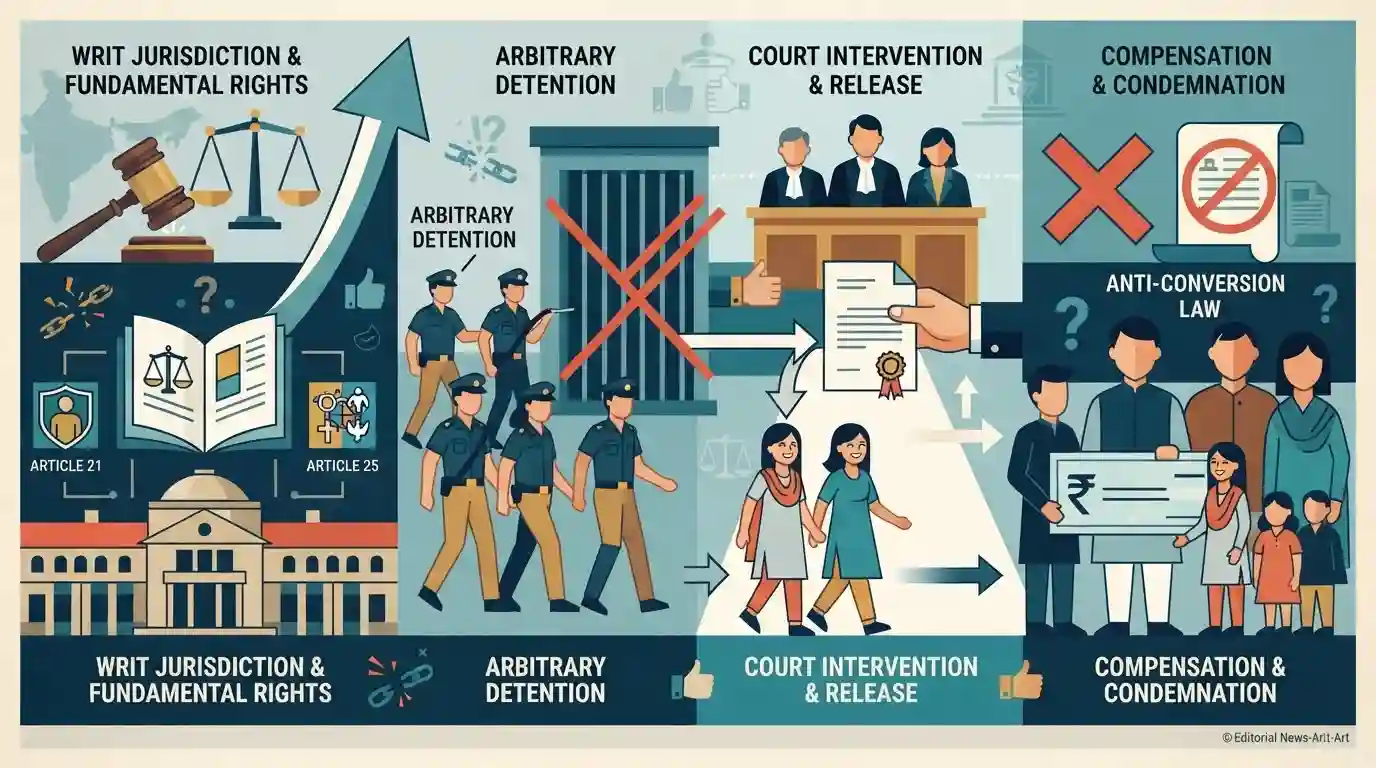
This case is a prime example of the judiciary safeguarding individual liberties (Articles 21 and 25) against arbitrary application of state laws (UP's anti-conversion act) and familial coercion. It highlights the practical application of the Habeas Corpus writ, making it highly relevant for Prelims questions on Fundamental Rights and the powers of the High Court.
Summary
The Allahabad High Court directed the Uttar Pradesh government and a father to pay Rs 25 lakh in compensation to two adult sisters who were illegally detained after converting to Islam. Emphasizing the sanctity of fundamental rights under Articles 21 and 25, the court condemned the arbitrary actions of the police and the misuse of the state's anti-conversion law to curtail the women's personal liberty and religious freedom.
Key Points
- The Allahabad High Court ordered the father and the Uttar Pradesh government to jointly pay Rs 25 lakh to two adult sisters who were illegally confined after voluntarily converting to Islam.
- The court found that the constitutional rights to personal liberty (Article 21) and freedom of religion (Article 25) were severely violated by both their family and state authorities.
- The judgment criticized the misuse of the Uttar Pradesh Prohibition of Unlawful Conversion of Religion Act, 2021, used to forcibly detain the consenting adult women in a Nari Niketan and later hand them over to their father against their will.
- The decision demonstrates the robust use of the writ of Habeas Corpus to protect individuals from arbitrary detention by both state machinery and private individuals.
Important Terms
Uttar Pradesh Prohibition of Unlawful Conversion of Religion Act, 2021

A state law criminalizing religious conversions achieved through misrepresentation, force, coercion, allurement, or solely for marriage. It requires individuals seeking to convert to submit an advance declaration to the District Magistrate.
UPSC context
Crucial for GS Paper 2 (Polity), highlighting debates on Article 25 (Freedom of Religion), state overreach, and individual liberty.
Nari Niketan
State-sponsored shelter homes operated by Social Welfare Departments across various states. They provide safe accommodation, emotional support, and rehabilitation for women in distress, including destitute women, widows, and victims of abuse.
UPSC context
Relevant to GS Papers 1 and 2 (Social Justice, Vulnerable Sections, Women Empowerment) as a mechanism for institutional welfare.
Allahabad High Court
The constitutional court for the state of Uttar Pradesh. Under Article 226 of the Constitution, it exercises writ jurisdiction to enforce fundamental rights, such as issuing Habeas Corpus to protect personal liberty.
UPSC context
Important for GS Paper 2 (Judiciary), demonstrating the role of High Courts in safeguarding Fundamental Rights against arbitrary state action.
Prelims Trap
"The writ of Habeas Corpus can only be issued against state or public authorities, not private citizens."
Habeas Corpus is unique among prerogative writs; constitutional courts can issue it against both public authorities and private individuals (like the father in this case) for unlawful detention.
Static Concepts Connected
What is the doctrine of Constitutional Tort for fundamental rights?
- Origin & Concept: Established in cases like Rudul Sah, it allows constitutional courts to award monetary compensation directly for the violation of fundamental rights by the State.
- Strict Liability: It operates as a strict liability public law remedy under Articles 32 and 226, completely independent of traditional private civil tort claims in lower courts.
- Primary Scope: It is most frequently invoked for gross violations of Article 21, such as illegal detention, custodial torture, or arbitrary deprivation of life and liberty.
How are religious conversions regulated under the Indian constitutional framework?
- State Subject: No central anti-conversion law exists. States enact these laws under the "Public Order" entry of the State List (List II) in the Seventh Schedule.
- Article 25 Limits: Individuals possess the freedom of conscience to voluntarily convert. However, the Supreme Court (Stanislaus case) ruled that there is no fundamental right to convert others via force or allurement.
Cross-Topic Patterns
Autonomy, Privacy, and Article 21
The right to choose faith without state or family interference reflects the decisional autonomy and right to privacy established in the Puttaswamy and Shafin Jahan (Hadiya) judgments.
Public Order as a legislative tool
States frequently use the "Public Order" entry (List II) to legislate on sensitive social issues like religious conversion and cattle slaughter, leading to frequent fundamental rights friction.

Expect a 2026 prelims statement testing if Habeas Corpus applies to private actors and if courts award compensation via writ jurisdiction.
Linked PYQs · 1
Linked PYQs · 1
- 2023UPPSC_PRELIMSGS1
Consider the following statements concerning the powers of the Supreme Court to issue certain writs to stop violation of Fundamental Rights – (1) The Supreme Court has power to issue writs like Habeas Corpus, Mandamus, Prohibition, Quo Warranto and Certiorari which is appropriate for the enforcement of Fundamental Rights. (2) Parliament may by law empower any other court to exercise within its jurisdiction the powers given to Supreme Court. Which of the above mentioned statement/statements is/are correct? Select the correct answer from the code given below –
