Fifth Schedule areas and reservation percentage ceiling
Source:The Hindu ↗
Why It Matters
Highlights a crucial constitutional nuance for GS2—whether judicial caps on affirmative action (the 50% limit) supersede the special governance provisions and demographic realities of Fifth Schedule areas.
Summary
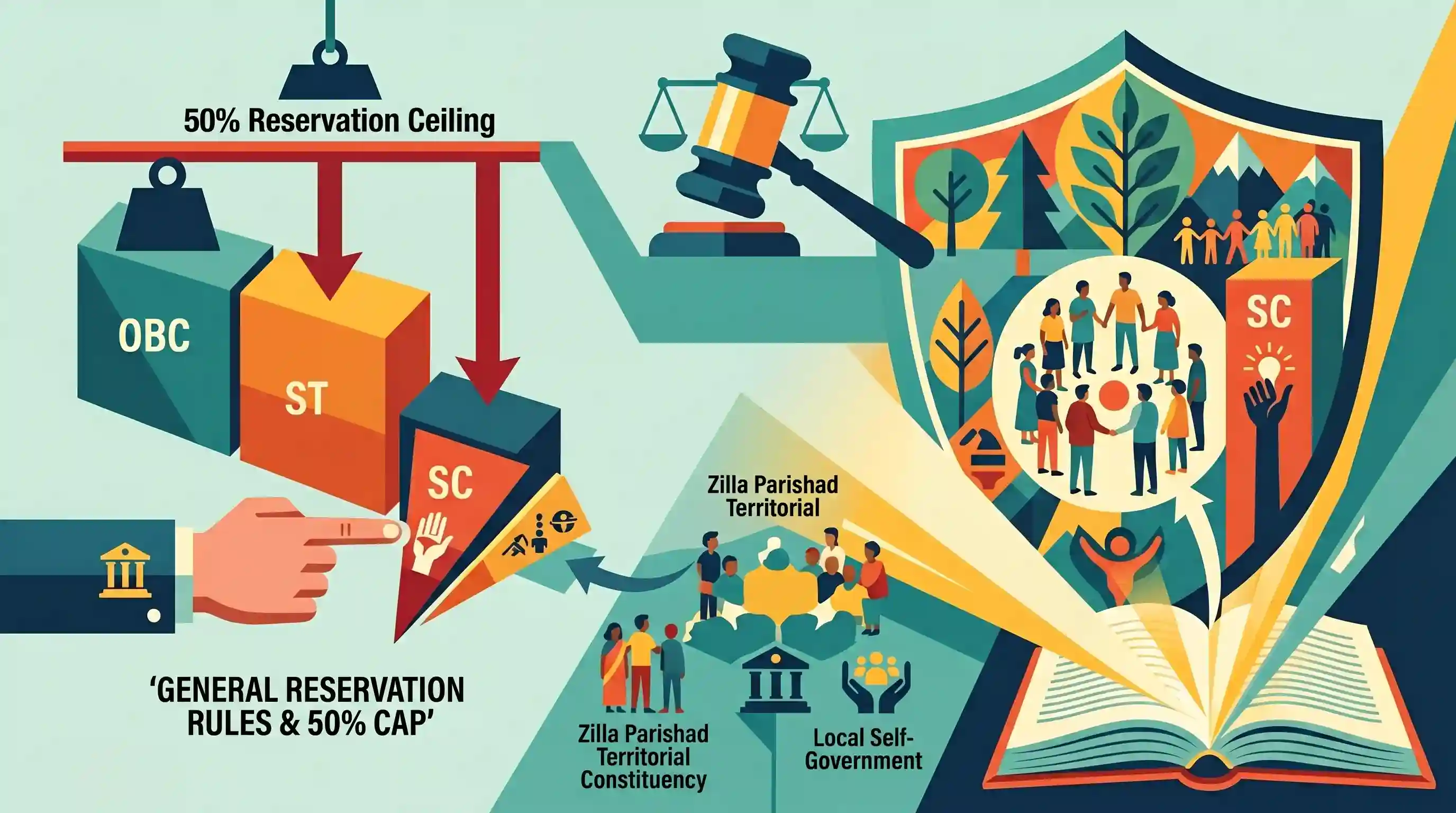
The Telangana High Court has issued notices to state authorities regarding a petition demanding the enforcement of a 15% reservation for Scheduled Castes (SCs) in Zilla Parishad Territorial Constituencies (ZPTCs) in the Bhadradri Kothagudem district. District authorities had allegedly reduced the SC quota to comply with the general 50% ceiling on total reservations. However, the petitioners argue that this 50% upper limit, mandated by the Supreme Court, is not applicable to Scheduled Areas administered under the Fifth Schedule of the Constitution. The case raises a significant constitutional question about the intersection of affirmative action caps and the special administrative status of Fifth Schedule areas.
Key Points
- The Telangana High Court issued notices to the state government and Bhadradri Kothagudem Collector over a petition seeking 15% mandatory reservation for Scheduled Castes (SCs) in ZPTCs.
- Authorities allegedly curtailed the SC quota to ensure that overall reservations for SCs, STs, and Backward Classes did not exceed the 50% ceiling.
- The petitioners argued that the 50% reservation cap established by the Supreme Court does not legally apply to areas governed under the Fifth Schedule of the Constitution.
- The court has granted the state four weeks to file counter-affidavits detailing the statutory backing for applying the 50% limit in Scheduled Areas.
Important Terms
Fifth Schedule of the Constitution

A constitutional provision under Article 244(1) governing the administration of Scheduled Areas and Tribes in ten states. It empowers Governors to modify the application of laws to protect tribal land and culture.
UPSC context
GS Paper II (Polity). Essential for understanding asymmetrical federalism and special administrative safeguards for tribal populations.
Indra Sawhney Judgment (50% Ceiling)
Landmark 1992 Supreme Court verdict that established a 50% ceiling on total reservations to balance affirmative action with the right to equality, except in extraordinary circumstances.
UPSC context
GS Paper II. Fundamental for questions on social justice, judicial review, and the legal limits of reservation policy.
Scheduled Areas
Geographically compact regions with a preponderance of tribal population, designated by the President. These areas receive special administrative protections under the Fifth Schedule to prevent exploitation and preserve autonomy.
UPSC context
GS Paper II and Prelims. Tests knowledge of the President's powers, the Dhebar Commission criteria, and tribal governance frameworks.
Zilla Parishad Territorial Constituencies (ZPTCs)
The direct electoral units of the Zilla Parishad (apex tier of Panchayati Raj). Each constituency represents a rural administrative unit (mandal/block) where voters directly elect one representative.
UPSC context
GS Paper II. Relates to the three-tier structure of Local Self-Government and democratic decentralization under the 73rd Amendment.
PESA Act, 1996
A 1996 law extending the 73rd Constitutional Amendment to Fifth Schedule areas. It grants significant autonomy to Gram Sabhas to manage local resources and preserve traditional tribal customs.
UPSC context
GS Paper II. Key for understanding tribal self-rule and the legal intersections between panchayat systems and indigenous rights.
Prelims Trap
The 50% reservation ceiling mandated by the Supreme Court does not apply to any posts in Fifth Schedule areas.
While PESA mandates 100% ST reservation for Panchayat chairpersons, the SC (2020) struck down 100% ST reservation for teachers in Scheduled Areas. General constitutional ceilings still apply selectively.
Static Concepts Connected
What are the specific reservation mandates under the PESA Act, 1996?
- Minimum quota: ST reservation must be proportionate to the population of the community, but it shall never be less than 50% of the total seats.
- Chairpersons: 100% of Chairperson seats at all Panchayat levels (village, intermediate, district) in Scheduled Areas are exclusively reserved for Scheduled Tribes.
- Nominations: State governments may nominate unrepresented STs to intermediate or district Panchayats, but such nominations cannot exceed 10% of total elected members.
What legislative powers does the Governor hold in Fifth Schedule Areas?
- Non-applicability of laws: The Governor can publicly notify that specific Acts of Parliament or the State Legislature shall not apply, or shall apply with specified exceptions and modifications.
- Peace and good government: The Governor can make regulations to prohibit or restrict the transfer of land by or among STs, and regulate money-lending to ST members.
- Presidential assent: All such regulations made by the Governor require the prior assent of the President of India before taking effect.
Cross-Topic Patterns
Judicial Review of Schedule V Powers
The Governor's power to modify laws in Scheduled Areas is not absolute and remains subject to judicial review and Fundamental Rights (Articles 14 and 16), as seen in the 2020 Chebrolu Leela Prasad case.
Article 243D vs PESA Exceptions
While normal Panchayats reserve seats strictly proportionate to SC/ST population under Article 243D, PESA establishes a hard floor (minimum 50%) specifically for STs, occasionally squeezing out SC/OBC quotas under the 50% ceiling.

Expect a multi-statement question contrasting the 50% reservation cap in local bodies with PESA's 100% ST chairperson exception.
Linked PYQs · 5
Linked PYQs · 5
- 2025PrelimsGS1
Consider the following statements : With reference to the Constitution of India, if an area in a State is declared as Scheduled Area under the Fifth Schedule I. the State Government loses its executive power in such areas and a local body assumes total administration II. the Union Government can take over the total administration of such areas under certain circumstances on the recommendations of the Governor Which of the statements given above is/are correct?
- 2015PrelimsGS1
The provisions in Fifth Schedule and Sixth Schedule in the Constitution of India are made in order to
- 2013PrelimsGS1
The Government enacted the Panchayat Extension to Scheduled Areas (PESA) Act in 1996. Which one of the following is not identified as its objective?
- 2019MainsGS2
“The reservation of seats for women in the institutions of local self-government has had a limited impact on the patriarchal character of the Indian Political Process.” Comment.
- 2022MainsGS2
To what extent, in your opinion, has the decentralisation of power in India changed the governance landscape at the grassroots?
