Rajasthan High Court Issues Notice Over Reduced RGHS Medical Refund
Source:times-of-india ↗
Why It Matters
It reveals critical implementation gaps in state-sponsored cashless health insurance schemes, demonstrating how private hospital non-compliance during medical emergencies defeats the purpose of out-of-pocket expenditure protection for citizens.
Summary
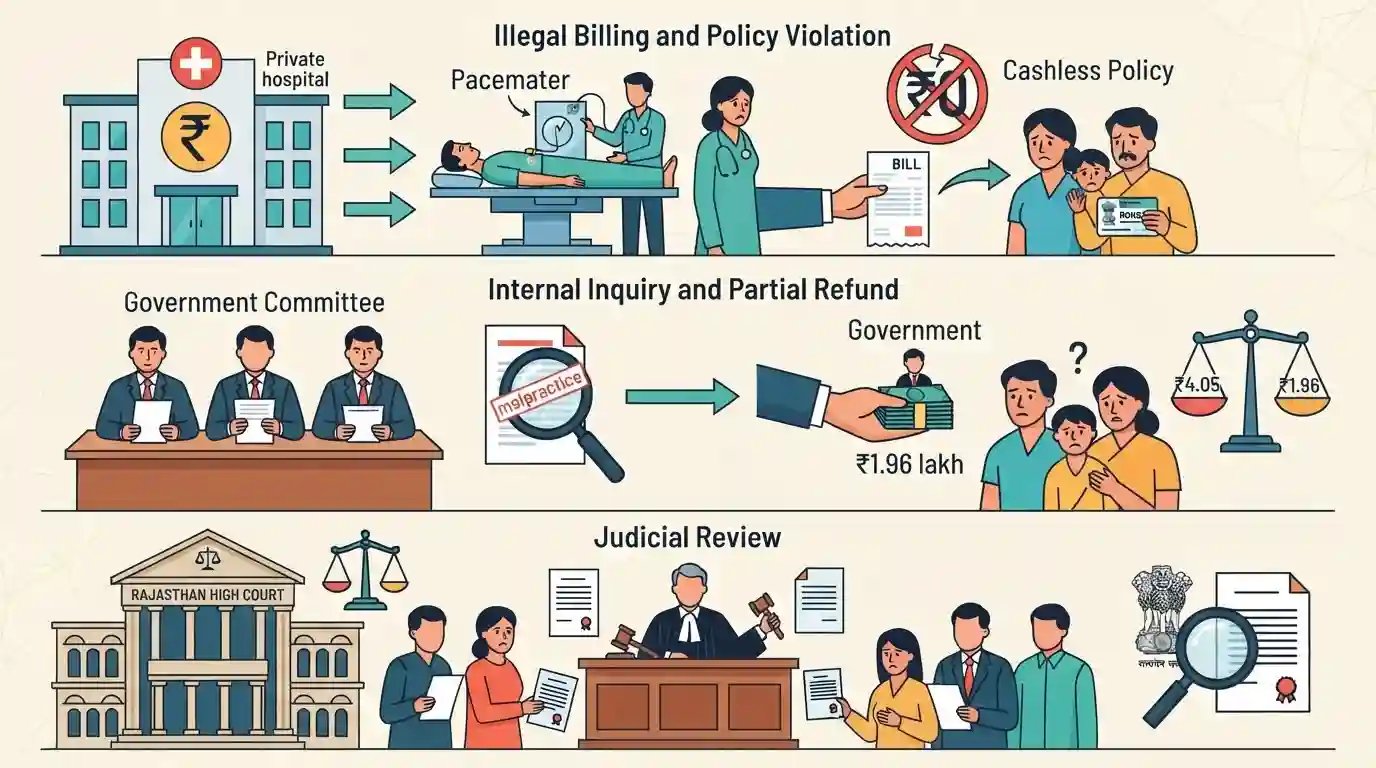
The Rajasthan High Court has issued notices to state health officials, the finance department, and a private empanelled hospital following a writ petition over a partial refund to a Rajasthan Government Health Scheme (RGHS) beneficiary. The hospital illegally charged a patient ₹4.05 lakh for an emergency pacemaker surgery, violating the scheme's strict cashless policy. Although an internal health authority report confirmed the hospital's malpractice, the state government refunded only ₹1.96 lakh to the family. The case underscores regulatory and enforcement challenges within the state's flagship cashless health insurance frameworks.
Key Points
- The Rajasthan High Court issued notices to state authorities and Mahavir Jaipuriya Rajasthan Hospital over an incomplete refund of medical expenses to an RGHS beneficiary.
- The hospital illegally charged ₹4.05 lakh in cash for a life-saving pacemaker implantation from a patient covered under the cashless RGHS scheme.
- Despite a state health authority report finding the hospital guilty of violating RGHS norms, the state only refunded ₹1.96 lakh to the patient.
- The petition highlights the violation of the RGHS policy, which strictly forbids empanelled hospitals from demanding cash payments for emergency and indoor treatments.
Important Terms
Rajasthan Government Health Scheme (RGHS)

A state-sponsored health insurance program launched in 2021 providing cashless medical facilities, diagnostics, and hospitalization for Rajasthan government employees, pensioners, and legislators across empanelled hospitals.
UPSC context
Relevant for GS Paper II (Welfare Schemes). Illustrates state-level public health financing and the enforcement of cashless healthcare mandates.
Judicial Review
The judiciary's power to examine the constitutionality and legality of legislative enactments and executive actions, allowing courts to invalidate decisions that violate the Constitution or basic rights.
UPSC context
Crucial for GS Paper II (Polity). Tests understanding of constitutional checks, balances, and judicial oversight of administrative actions and policies.
Cashless Health Insurance
A healthcare financing model where medical expenses are directly settled between the insurer or government and the empanelled hospital, eliminating the need for patients to pay upfront out-of-pocket costs.
UPSC context
Important for GS Paper II (Social Justice). Assesses mechanisms for reducing out-of-pocket medical expenditures and achieving Universal Health Coverage.
Rajasthan High Court
The highest judicial authority in Rajasthan. It exercises original and appellate jurisdiction, including the power under Article 226 to issue writs for the enforcement of fundamental rights and legal accountability.
UPSC context
Relevant to GS Paper II (Polity). Demonstrates the role of state-level constitutional courts in conducting judicial reviews and checking executive failures.
Prelims Trap
The Right to Health is explicitly enshrined as a Fundamental Right under Article 21 of the Indian Constitution.
The Right to Health is an IMPLICIT fundamental right established through Supreme Court interpretations of Article 21, not explicitly written in the constitutional text.
Static Concepts Connected
What are the core constitutional provisions governing healthcare in India?
- Article 21: The Supreme Court has interpreted the Right to Life to implicitly include the Right to Health and emergency medical aid (e.g., Parmanand Katara case).
- Article 47 (DPSP): Mandates the State to regard raising the level of nutrition, standard of living, and improving public health as among its primary duties.
- State List: Under Schedule VII (Entry 6), public health, sanitation, hospitals, and dispensaries are strictly state subjects, making states the primary healthcare providers.
How do major cashless public health insurance schemes like PM-JAY operate?
- Coverage Structure: Provides completely cashless and paperless access up to ₹5 lakh per family annually for secondary and tertiary care hospitalization.
- Demographic Caps: There are no caps on family size, age, or gender, ensuring comprehensive coverage for vulnerable populations identified via the SECC database.
- Implementation Agencies: Governed by the National Health Authority (NHA) at the center and implemented by State Health Agencies (SHAs) at the state level.
Cross-Topic Patterns
Judicial Review of Welfare Schemes
High Courts frequently invoke Article 226 writ jurisdictions to enforce administrative compliance in welfare schemes, acting as a crucial check against implementing agencies and private entities.
Statutory Rights vs. Insurance Models
Rajasthan's statutory 'Right to Health Act' contrasts with the Center's insurance-entitlement model (PM-JAY), highlighting diverse federal strategies to achieve Universal Health Coverage (UHC).

Expect a 2026 question linking Article 21's implicit Right to Health, Article 47 (DPSP), and the enforcement of cashless welfare schemes.
Linked PYQs · 2
Linked PYQs · 2
- 2021RPSC_PRELIMSGS1
Under the Ayushman Bharat Mahatma Gandhi Rajasthan Health Insurance Scheme, the amount provided per family per year in the event of a critical illness health insurance is
- 2016RPSC_PRELIMSGS1
The Chief Minister Free Medicine Scheme was implemented in Rajasthan on
