Paid Menstrual Leave Policy and Workplace Equality
Source:The Hindu ↗
આ શા માટે મહત્વનું છે
This case illustrates the evolving legal and constitutional discourse around gender justice and workplace equality. Framing the denial of menstrual leave as an "indirect discrimination" violating Article 14 brings a crucial Fundamental Rights perspective to labour welfare and women's workforce participation. It is highly relevant for GS Paper 2 (Constitutional provisions for Gender Justice, Judiciary) and GS Paper 3 (Labour Codes, Inclusive Economic Growth).
સારાંશ
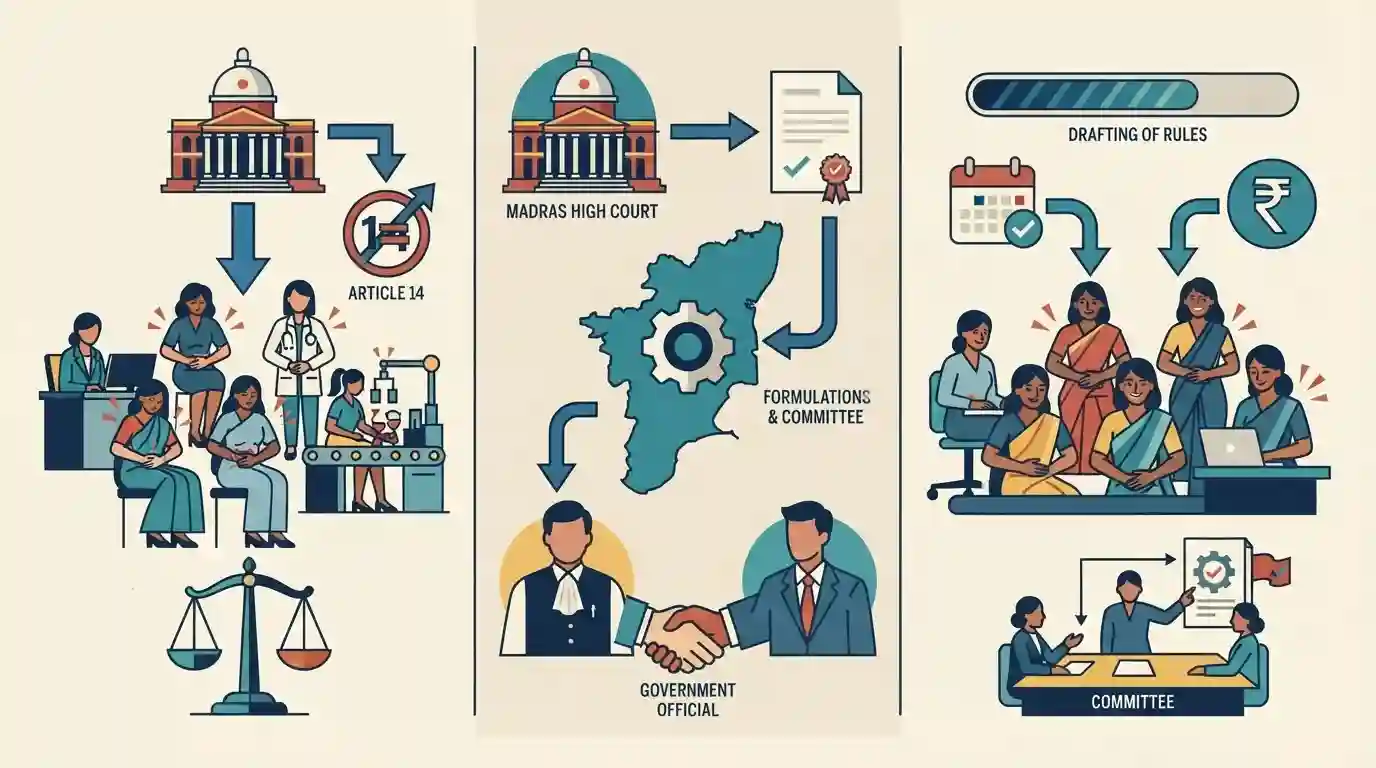
The Madurai Bench of the Madras High Court has directed the Tamil Nadu government to submit an interim report detailing its progress in formulating a comprehensive paid menstrual leave policy for women employees in government and private sectors. A petition argued that the lack of such a policy results in "indirect discrimination" against women, violating their Right to Equality under Article 14 of the Constitution. The petitioner contended that women uniquely suffer from dysmenorrhea, and forcing them to exhaust standard casual or sick leave unfairly impacts their service conditions and wages. The State government informed the court that it is actively considering the formation of a committee to draft these rules in alignment with the Centre's labour codes, acknowledging the need to extend sensitisation to private entities as well.
મુખ્ય મુદ્દા
- The Madurai Bench of the Madras High Court has directed the Tamil Nadu government to submit an interim report on framing a comprehensive paid menstrual leave policy.
- A petition argued that the absence of a menstrual leave policy causes "indirect discrimination" against women, violating Article 14 (Right to Equality) of the Constitution.
- The petitioner highlighted that existing casual or sick leave frameworks are inadequate to address a recurring biological condition like dysmenorrhea, unfairly forcing women into wage loss or working through severe pain.
- The plea sought paid menstrual leave for women in government departments, PSUs, educational institutions, along with special guidelines for private establishments.
- The State government responded that it is actively considering the formation of a committee to frame rules in line with the Central government's labour codes, which includes sensitising the private sector.
મહત્વપૂર્ણ શબ્દો
Paid Menstrual Leave

Workplace or academic policies allowing employees to take paid time off during menstruation to manage physical pain, fatigue, or discomfort (dysmenorrhea) without losing wages.
UPSC context
GS Paper II (Social Justice/Gender Equality) & GS III (Labour Welfare). Tests debates on affirmative action versus potential hiring bias.
Article 14 of the Constitution
A fundamental constitutional provision guaranteeing all persons within India equality before the law and equal protection of the laws, permitting reasonable classification for affirmative action.
UPSC context
GS Paper II (Polity & Constitution). Tests fundamental rights, the rule of law, and judicial metrics for non-arbitrary state action.
Indirect Discrimination
A legal doctrine where a facially neutral rule, applied universally without discriminatory intent, disproportionately harms a vulnerable group due to systemic or biological differences.
UPSC context
GS Paper II (Judiciary/Social Justice). Tests evolving jurisprudence (e.g., Nitisha case) and transition from formal to substantive equality.
Labour Codes
A set of four legislative codes consolidating 29 central labour laws into unified frameworks covering wages, industrial relations, social security, and occupational safety.
UPSC context
GS Paper III (Indian Economy/Labour Reforms). Tests regulatory simplification, ease of doing business, and worker welfare modernization.
Madras High Court
One of India’s oldest constitutional courts of record, having jurisdiction over Tamil Nadu and Puducherry, empowered under Article 226 to issue writs protecting fundamental rights.
UPSC context
GS Paper II (Polity/Judiciary). Tests constitutional powers, writ jurisdiction, and the role of state judiciaries in policy monitoring.
પ્રિલિમ્સ ટ્રેપ
The Supreme Court has recognized paid menstrual leave as an enforceable fundamental right under Article 21, mandating its legislative implementation across India.
The SC refused to mandate nationwide menstrual leave, holding that compulsory leave is a complex executive policy issue that could deter employers from hiring women, thereby harming female labor force participation.
સંલગ્ન સ્થિર ખ્યાલો
What is the doctrine of "Indirect Discrimination" under Indian constitutional jurisprudence?
- Core Definition: Arises when a facially neutral rule, criteria, or practice disproportionately disadvantages a specific protected group (e.g., biological sex).
- Judicial Validation: Formally established by the Supreme Court in Lt. Col. Nitisha (2021) as violating Articles 14 and 15(1).
- Focus of Test: Shifts the legal focus from discriminatory 'intent' to the unequal 'impact' or outcomes of institutional policies.
What is the scope of Article 15(3) of the Indian Constitution?
- Protective Discrimination: Empowers the State to make special, favorable provisions specifically for women and children, overriding general non-discrimination clauses.
- Constitutional Safeguard: Prevents legal challenges against welfare initiatives (like maternity benefits or reservation) on grounds of violating gender equality.
આંતર-વિષય પેટર્ન
Gender welfare vs Labor demand
Mandated paid leaves can inadvertently lower Female Labor Force Participation (FLFP) by increasing the perceived cost of hiring women, showing how social welfare policies interact with market economics.
Asymmetric federalism in welfare
With labor on the Concurrent List, divergent state actions (Bihar, Karnataka) highlight how sub-national governance pioneers social policy in the absence of cohesive central legislation.

Doctrine of indirect discrimination combined with judicial restraint on executive policy limits is highly likely to feature in GS-2 2026.
સંલગ્ન PYQ · 3
સંલગ્ન PYQ · 3
- 2023MainsGS2
Explain the constitutional perspectives of Gender Justice with the help of relevant Constitutional Provisions and case laws.
- 2020MainsGS2
Judicial Legislation is antithetical to the doctrine of separation of powers as envisaged in the Indian Constitution. In this context justify the filing of large number of public interest petitions praying for issuing guidelines to executive authorities.
- 2025MainsGS2
Women's social capital complements in advancing empowerment and gender equity. Explain.
