High Court Mandates Environmental Flow in Hydro Rivers
Source:himachalscape ↗
Why It Matters
Highlights the judicial and administrative interventions required to balance hydropower generation with the ecological integrity of Himalayan rivers. The mandate for minimum environmental flows and regulated desilting represents crucial strategies to mitigate the adverse downstream impacts of dams on aquatic species like trout.
Summary
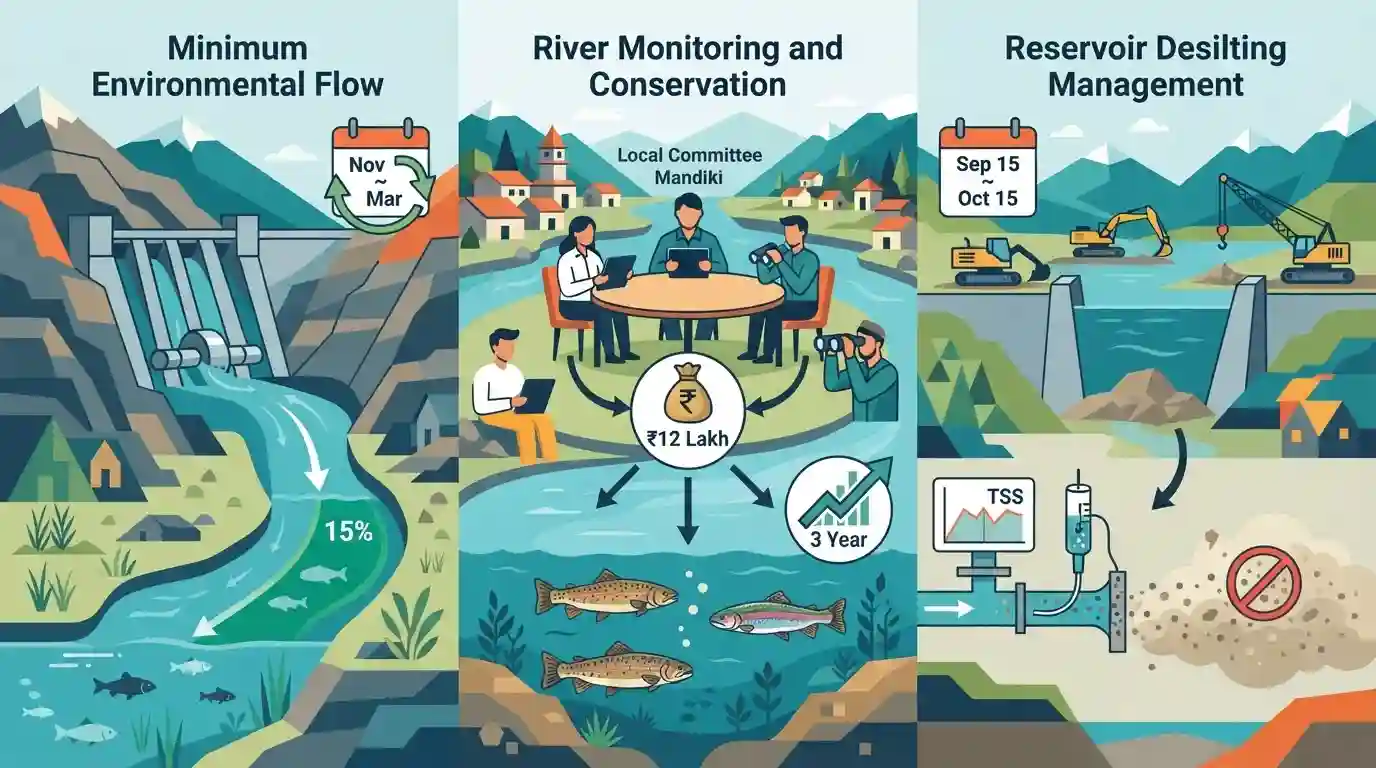
The Himachal Pradesh High Court has directed hydroelectric project operators to ensure a minimum environmental flow of 15% in rivers during the lean season from November to March to protect aquatic ecosystems. A River Monitoring Committee constituted in Mandi will oversee conservation efforts, funded by ₹12 lakh recovered from a project proponent, to restore brown and rainbow trout populations over three years. Additionally, the court ordered that desilting operations for reservoirs be restricted to the period between September 15 and October 15, with strict online monitoring of Total Suspended Solids (TSS) to minimize ecological disruption downstream.
Key Points
- The Himachal Pradesh High Court mandated that all hydroelectric projects in the state maintain at least 15% environmental flow in rivers during the lean season (November to March).
- A River Monitoring Committee in Mandi will oversee the utilization of ₹12 lakh from a project proponent to implement conservation measures for aquatic life.
- The conservation plan includes graded stocking of brown trout and rainbow trout over a three-year period to restore affected river ecosystems.
- The court ruled that desilting of dams must be carried out annually between September 15 and October 15, coupled with mandatory online monitoring of Total Suspended Solids (TSS) levels.
Important Terms
Environmental Flow (E-Flow)

The mandatory minimum water volume (here, 15%) that hydroelectric projects must continually release into a river during the lean season to sustain downstream aquatic ecosystems and biodiversity.
UPSC context
GS-3 (Environment). Crucial for balancing hydroelectric infrastructure expansion with sustainable water management and biodiversity conservation.
Total Suspended Solids (TSS)
Solid sediment particles suspended in water. High TSS from unscientific dam desilting heavily pollutes rivers, creating turbid conditions that suffocate sensitive aquatic species like trout.
UPSC context
GS-3 (Environment). A critical water quality metric tested in topics related to river pollution and environmental impact assessments.
River Monitoring Committee
A district-level oversight body headed by the Deputy Commissioner, mandated to ensure compliance with environmental flow norms, monitor dam desilting schedules, and utilize ecological compensation funds.
UPSC context
GS-2 & GS-3. Highlights decentralized environmental governance and regulatory enforcement mechanisms for infrastructure projects.
Brown and Rainbow Trout
Cold-water fish species native or adapted to Himalayan rivers. They require clear, highly oxygenated water and serve as key bio-indicators of a river's ecological health.
UPSC context
GS-3 (Biodiversity). Tests knowledge of cold-water aquatic biodiversity, indicator species, and the ecological consequences of habitat degradation.
Desilting Operations
The removal of accumulated silt from dam reservoirs. To protect fish breeding seasons, courts have restricted these operations strictly to specific non-breeding windows (e.g., Sept 15–Oct 15).
UPSC context
GS-3 (Environment). Connects to reservoir management, sediment dynamics, and mitigating the ecological impacts of hydroelectric dams.
Fisheries Department
The state authority tasked with enforcing river discharge norms for dams, recovering environmental penalties, and executing graded restocking plans to restore depleted aquatic life.
UPSC context
GS-2 & GS-3. Reflects the institutional framework involved in executing species recovery and enforcing ecological compensation.
Himachal Pradesh High Court
The highest judicial body in the state. Here, it exercised environmental jurisprudence by invoking the 'polluter pays' principle and enforcing mandatory e-flows against non-compliant dams.
UPSC context
GS-2 & GS-3. Demonstrates judicial activism and suo motu interventions to protect environmental rights and enforce green norms.
Prelims Trap
"Rainbow trout and brown trout are endemic or native fish species naturally found in the Himalayan river ecosystems."
Both are exotic salmonid species introduced to India by the British in the 19th/20th centuries. UPSC frequently tests the endemicity of well-known wildlife.
Static Concepts Connected
What constitutes "Environmental Flow" (E-Flow) in river ecosystems?
- Ecological baseline: The minimum acceptable flow of freshwater required in a river to sustain aquatic biodiversity, habitats, and downstream ecosystems after diversions.
- Lean season critical: Most crucial during November to March in the Himalayas when glacial melt stops and rainfall is minimal, making rivers vulnerable to complete drying.
- Polluter Pays Principle: Courts mandate E-flows and penalize hydro-project violators to fund ecological restoration, applying this foundational concept of Indian environmental jurisprudence.
How do Run-of-the-River (RoR) hydroelectric projects impact river ecology?
- Flow diversion: Water is diverted through tunnels for power generation, frequently leaving original downstream riverbed stretches completely dry if E-flows are not strictly enforced.
- High TSS levels: Periodic dam desilting releases massive amounts of Total Suspended Solids (TSS) downstream, degrading water quality, destroying spawning grounds, and choking fish gills.
Cross-Topic Patterns
Hydropower vs. Aquatic Biodiversity
India's ambitious renewable energy targets drive Himalayan hydropower expansion, creating direct conflict with riverine connectivity, E-Flow mandates, and aquatic conservation efforts.
Bio-indicators and River Health
Highly oxygen-dependent, cold-water fish like trout act as critical bio-indicators. Their vulnerability makes them a prime metric for assessing hydropower siltation impacts and changing river temperatures.

Expect a multi-statement Prelims question linking Environmental Flow (E-Flow) mandates, run-of-the-river dam mechanics, and TSS impacts.
Linked PYQs · 2
Linked PYQs · 2
- 2018HPAS_PRELIMSGS1
The impacts caused by construction of dams and reservoirs include all, except :
- 2018HPAS_PRELIMSGS1
Which one is incorrect regarding sustainable development ?
